
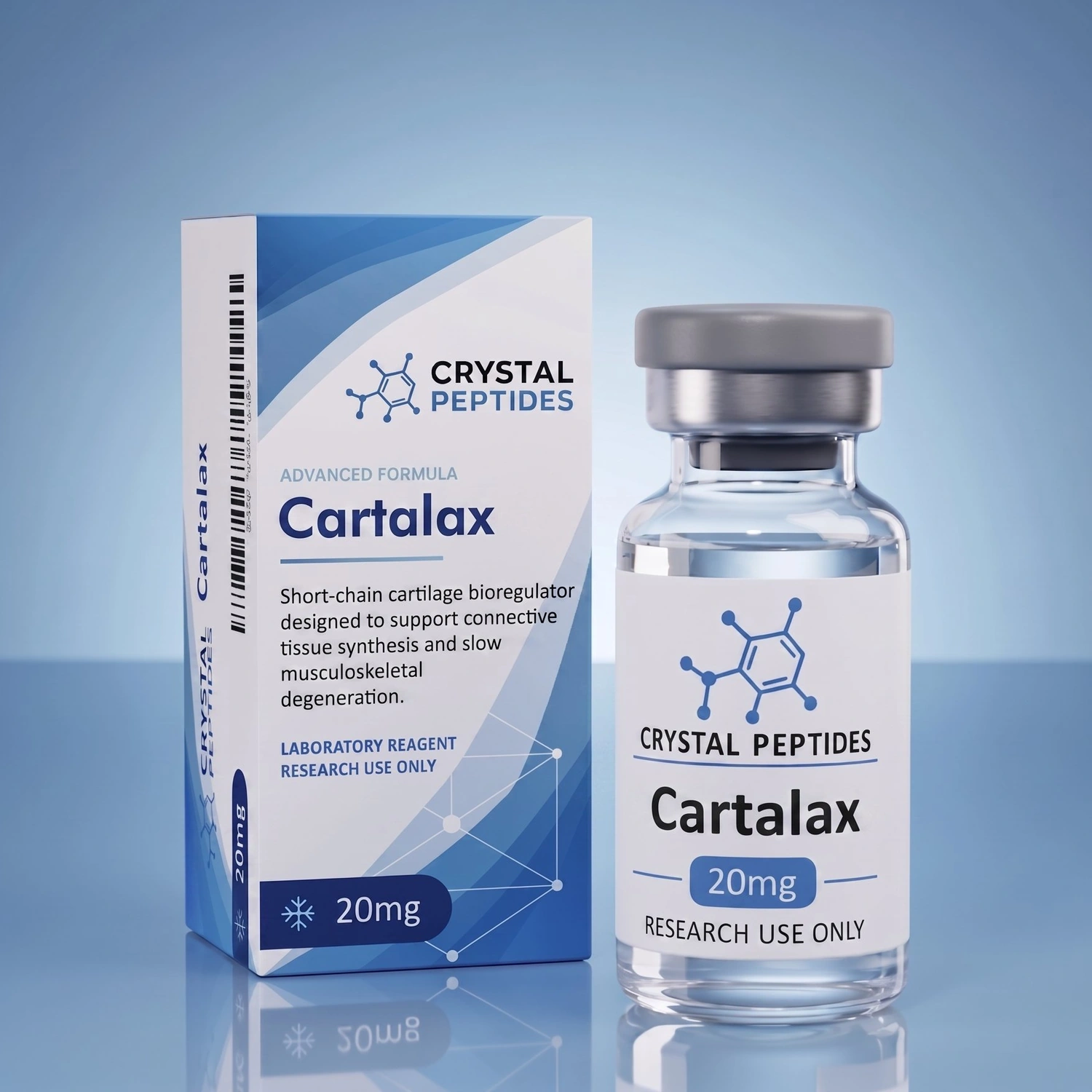
Cartalax (20mg)
20mg
❄️Lyophilized powder (not reconstituted)
Total: 42.98 GBP
Discount per Quantity
| Quantity | Discount | Price per Unit |
|---|---|---|
| 5 - 10 | 10% | 38.69 GBP |
| 11 - 20 | 15% | 36.54 GBP |
| 21+ | 20% | 34.39 GBP |
Rigorous third-party testing
Every batch of our research chemicals and peptides undergoes independent third-party laboratory testing for purity and identity.
Total: 42.98 GBP
What Is Cartalax?
Cartalax is a short synthetic tripeptide composed of alanine, glutamic acid and aspartic acid (Ala-Glu-Asp), also known as the AED peptide. It is also identified in scientific literature and chemical databases by its developmental name, T-31 peptide. Research on Cartalax/AED peptide has investigated cellular ageing, gene-expression changes and biological processes relevant to connective-tissue and cartilage research, although the available evidence remains limited and predominantly preclinical.
Researchers looking to buy Cartalax in Europe can source the peptide from Crystal Peptides, a supplier of high-purity research compounds with a focus on independent quality testing. Every new product batch is tested by third-party analytical laboratories, such as Janoshik, for applicable quality parameters including identity, purity and sterility. A batch-specific Certificate of Analysis is provided to document the reported results.
This product is sold for research use only and is not for human or veterinary use.
What’s Included
Cartalax is supplied as a lyophilized powder in a sealed glass vial. The material is typically white to off-white in appearance.
A Certificate of Analysis (CoA) is available for every product lot following third-party testing by independent laboratories. Depending on the laboratory and the product being tested, the CoA may include analytical results such as:
• Identity testing: Confirms that the material corresponds to Cartalax (Ala-Glu-Asp).
• HPLC purity: Measures the proportion of the principal Cartalax component relative to detectable chromatographic impurities.
• Mass spectrometry (MS): Provides molecular-mass data to support peptide identity and characterization.
• Peptide content: Helps establish the amount of Cartalax present in the tested material.
• Related peptide impurities: Where reported, identifies or quantifies truncated sequences, synthesis-related impurities or other peptide variants.
• Endotoxin testing: Where performed, assesses bacterial endotoxin levels, which can be relevant to laboratory experiments involving sensitive biological systems.
• Sterility testing: Where applicable, evaluates the material for detectable microbial contamination.
• Residual solvents or other process-related impurities: Where applicable, helps assess contaminants originating from peptide synthesis or purification.
The batch-specific CoA should be used as the definitive source for the analytical results and specifications of the Cartalax lot supplied. Testing parameters can vary according to the product and independent laboratory performing the analysis.
Please note that reconstitution solution is not included with your Cartalax order. If required for your laboratory work, you can add BAC Water (10ml) to your order.
Technical Specifications
Property | Specification |
Product name | Cartalax |
Alternative names | AED, Ala-Glu-Asp, T-31 peptide |
Molecule type | Synthetic tripeptide |
Amino acid sequence | Ala-Glu-Asp (AED) |
Peptide length | 3 amino acids |
Molecular formula | C₁₂H₁₉N₃O₈ |
Molecular weight | 333.29 g/mol |
PubChem CID | 87815447 |
Appearance | Lyophilized powder |
Purity | Please check COA for batch-specific information |
CAS number | 85806-95-7 |
Intended use | Laboratory research only. Not for human or veterinary use. |
Note: When evaluating Cartalax research material, the batch-specific analytical documentation should be used to confirm the exact identity, purity and specification of the material supplied.
Cartalax Overview and Mechanism of Action
Cartalax is a short synthetic tripeptide composed of alanine, glutamic acid and aspartic acid, commonly written as Ala-Glu-Asp or AED. It is also referred to as T-31 in parts of the scientific literature. Research on Cartalax has primarily explored its potential influence on cellular and molecular processes rather than focusing on a single defined receptor or enzyme target.
Experimental studies involving AED have examined changes in gene expression and cellular activity in several laboratory models, including human mesenchymal stem cells, fibroblasts and renal cell cultures. These findings have contributed to research into how short regulatory peptides may influence cellular processes, although the mechanisms underlying Cartalax activity remain incompletely characterised and the available evidence is predominantly preclinical.
AED and Peptide Bioregulator Research
The proposed bioregulator model suggests that very short peptides may influence cellular regulatory processes and gene expression. Within this framework, Cartalax/AED has been associated particularly with research into connective-tissue and cartilage-related biology.
However, the evidence should be interpreted according to the experimental model. Published research does not establish a single, independently validated receptor or molecular pathway through which Cartalax produces all of its reported effects.
Gene Expression Research
AED has been investigated for its ability to influence gene-expression patterns in aging cell cultures. Research in human mesenchymal stem cells has examined changes in genes associated with cellular maintenance and differentiation, while other studies have investigated short peptides including AED in aging renal cell cultures. [1]
These findings provide a basis for further laboratory investigation of AED as a regulatory peptide, but cell-culture observations should not be interpreted as evidence of an established biological effect in humans.
Proposed Interaction With Cellular Regulatory Machinery
Some research proposes that short peptides such as AED may interact with chromatin or DNA and, in turn, influence transcription. Molecular modelling and related experimental studies have been used to investigate this hypothesis. However, evidence for a Cartalax-specific DNA-binding mechanism remains limited. This mechanism should therefore be regarded as a proposed model for further investigation rather than an established mode of action. [2]
Cartalax and Cartilage-Related Research
Cartalax is frequently described commercially as a cartilage-related peptide, and the AED sequence has been investigated in experimental models relevant to connective tissue and mesenchymal stem-cell biology. However, the direct evidence specifically linking the isolated AED tripeptide to cartilage effects remains limited. [2]
For research purposes, Cartalax is therefore best considered a compound of interest for studying short-peptide regulation, gene expression and cartilage-associated cellular biology rather than as a compound with an established cartilage-specific mechanism.
Research Applications & Scientific Background
Cartalax, also identified as Ala-Glu-Asp (AED) or T-31, has been investigated primarily within the field of short peptide bioregulator research. The published literature is relatively limited, with research focused mainly on cell-culture models and proposed effects on gene expression and cellular regulation.
Mesenchymal Stem Cell Research
AED has been investigated in human mesenchymal stem-cell cultures, including models designed to examine cellular changes associated with replicative ageing. Research in this area has examined whether short peptides can alter the expression of genes and proteins associated with cellular maintenance and differentiation. [4]
These findings provide a basis for further laboratory investigation of AED, but cell-culture results should not be interpreted as evidence of an established effect in humans.
Cartilage and Chondrocyte Research
Cartalax is frequently associated with cartilage research because the AED peptide has been investigated in experimental models involving chondrocyte-related biology. A 2023 study reported changes in expression of markers including SOX9, aggrecan, type II collagen and COMP in ageing human mesenchymal stem-cell cultures exposed to AED. [4]
The available evidence is nevertheless limited. The frequently used description of Cartalax as a cartilage-specific or chondroprotective peptide goes beyond what can currently be established from a broad, independently replicated evidence base.
Gene Expression Research
One of the recurring areas of interest in AED research is regulation of gene expression. Studies from the Khavinson research programme have investigated whether short peptides can influence transcriptional patterns in cultured cells, including models of cellular ageing. [4]
This research provides a framework for investigating AED as a potential cellular regulatory peptide, although the precise molecular mechanisms remain an area for further study.
Fibroblast and Connective-Tissue Research
Short peptides in the Khavinson research programme, including AED, have also been examined in fibroblast and connective-tissue models. These experiments have investigated cellular functions and changes associated with ageing and tissue maintenance.
For laboratory researchers, this makes Cartalax relevant to investigations of short-peptide regulation, connective-tissue biology and cellular ageing.
Peptide Bioregulator Research
Cartalax forms part of a broader group of very short peptides developed within the Khavinson bioregulator research programme. The proposed concept is that short peptide sequences may influence cellular regulatory processes, including gene-expression patterns.
This remains a research hypothesis, not an established general mechanism. The limited number of studies, concentration of research within one scientific group and lack of independent replication should be considered when evaluating the evidence for AED.
Research Limitations
The scientific literature on Cartalax is considerably smaller than that available for many better-studied research peptides. Much of the identifiable AED research comes from the same research network, and there is no robust independent clinical evidence establishing Cartalax as a treatment for cartilage disorders, joint disease or ageing.
For this reason, Cartalax is best approached as an experimental peptide for laboratory investigation of AED-related cellular and molecular biology rather than as a compound with established therapeutic applications.
Cartalax vs BPC-157 vs GHK-Cu vs Epitalon Comparison
Cartalax, BPC-157, GHK-Cu and Epitalon are all investigated in peptide research, but they differ substantially in molecular structure, composition and research context.
Property | Cartalax (AED) | |||
Molecule type | Synthetic tripeptide | Synthetic peptide | Copper–tripeptide complex | Synthetic tetrapeptide |
Sequence / composition | Ala-Glu-Asp (AED) | 15-amino-acid peptide | Gly-His-Lys (GHK) associated with copper | Ala-Glu-Asp-Gly (AEDG) |
Peptide length | 3 amino acids | 15 amino acids | 3 amino acids + copper | 4 amino acids |
Molecular distinction | Short peptide without a metal component | Longer linear peptide | Peptide–metal complex | AED sequence with an additional glycine residue |
Primary research context | Gene-expression, cellular and connective-tissue research | Cellular, tissue and experimental repair research | Extracellular matrix, fibroblast and copper-dependent cellular research | Cellular ageing and short-peptide research |
Mechanistic focus | Proposed regulatory effects on cellular and gene-expression processes | Multiple proposed molecular and cellular pathways | Peptide–copper interactions and downstream cellular processes | Proposed effects on cellular and gene-expression pathways |
Defined receptor target | No single established receptor target | No single established receptor target | No single established receptor target | No single established receptor target |
Key research consideration | Limited and predominantly preclinical evidence | Broad preclinical research base | Chemical behaviour depends on peptide–copper composition | Structurally distinct from AED despite sequence overlap |
Research Note
The distinction between Cartalax and Epitalon is particularly important because their sequences overlap: Cartalax is Ala-Glu-Asp (AED), whereas Epitalon is Ala-Glu-Asp-Gly (AEDG). The additional glycine makes Epitalon a different molecular entity. Likewise, GHK-Cu is not simply another three-amino-acid peptide because its copper association is an integral part of its molecular identity.
Storage & Laboratory Handling
Cartalax is supplied as a lyophilized tripeptide. Keeping the material sealed, dry and protected from unnecessary environmental exposure helps maintain its analytical integrity during laboratory storage.
• Keep the vial sealed and protected from moisture when not in use.
• Store according to the product documentation and applicable batch-specific recommendations.
• Protect from excessive heat and prolonged temperature fluctuations.
• Protect from direct or prolonged light exposure.
• Allow a refrigerated or frozen vial to reach an appropriate temperature before opening where necessary to minimize condensation on the lyophilized material.
• Once reconstituted, follow the storage and stability conditions established for the specific preparation and experimental protocol.
• Avoid unnecessary repeated freeze-thaw cycles when working with prepared solutions.
• Use appropriate laboratory procedures to minimize contamination during preparation and handling.
There is currently limited published stability data specific to the AED (Ala-Glu-Asp) peptide. Consequently, specific shelf-life periods for Cartalax should not be assumed from general peptide-storage practices alone. When you buy Cartalax for laboratory research, check the provided CoA for specific handling and preparation guidelines.
Certificate of Analysis & Quality Assurance
A Certificate of Analysis (CoA) provides batch-specific analytical data for the Cartalax material supplied. For a defined tripeptide such as Cartalax, the most important considerations are whether the reported results support the identity of the material and whether its reported purity meets the applicable specification.
How to Evaluate a Cartalax CoA
When reviewing a CoA, researchers should consider:
• Identity: Does the analytical data confirm the intended Ala-Glu-Asp (AED) peptide?
• Purity: Does the reported purity meet the stated product specification?
• Analytical methods: Are the methods used appropriate for verifying peptide identity and purity?
• Batch information: Does the CoA clearly correspond to the specific lot being purchased or studied?
• Additional quality parameters: Where reported, do the results provide relevant information about contaminants or other quality attributes?
The testing parameters and specifications may vary between products and independent laboratories.
When you buy Cartalax from Crystal Peptides, check that the batch number/SKU matches the one on the latest CoA. The CoA for the specific Cartalax batch should be treated as the definitive source for the analytical characteristics of the material supplied.
Frequently Asked Questions
What is Cartalax?
Cartalax is a short synthetic tripeptide consisting of alanine, glutamic acid and aspartic acid. Its sequence is written as Ala-Glu-Asp or AED, and it is also identified as T-31 peptide in chemical and scientific databases.
What is the Cartalax peptide sequence?
The Cartalax peptide sequence is Ala-Glu-Asp (AED). It contains three amino-acid residues and has a molecular weight of approximately 333.29 g/mol. Researchers should verify the sequence against the analytical documentation supplied for a particular research material.
Is Cartalax the same as AED or T-31?
Yes. Cartalax, Ala-Glu-Asp (AED) and T-31 peptide are names used for the same three-amino-acid peptide in chemical databases and the scientific literature. PubChem lists Cartalax, Ala-Glu-Asp and T-31 peptide among the synonyms for the AED compound.
Is Cartalax the same as Epitalon?
No. Cartalax is the tripeptide Ala-Glu-Asp (AED), whereas Epitalon is a different tetrapeptide, Ala-Glu-Asp-Gly (AEDG). The two compounds share the first three amino acids but differ by the additional glycine residue in Epitalon. They should therefore be treated as separate research materials.
What is Cartalax studied for in research?
Research involving Cartalax/AED has primarily examined short-peptide regulation, gene-expression changes and cellular processes in experimental models. The available literature includes research involving cell cultures such as mesenchymal stem cells, fibroblasts and other cellular systems. The evidence remains predominantly preclinical.
Is there research on Cartalax and cartilage?
Cartalax is frequently described in commercial sources as a cartilage-related peptide, but the published evidence specifically examining AED in cartilage or joint tissue is limited. Current reviews have not identified a substantial peer-reviewed body of cartilage research, and the commonly cited cartilage-related designation traces in part to patent literature rather than a robust independent research base.
For this reason, Cartalax is better described as an experimental peptide of interest to researchers studying AED and cellular regulation rather than as a compound with an established cartilage-specific effect.
How is Cartalax (AED) purity and identity tested?
Cartalax can be characterized using analytical techniques such as HPLC and mass spectrometry. HPLC provides information about chromatographic purity, while mass spectrometry can provide molecular-mass data supporting the identity of the AED peptide. Additional testing may assess peptide content, endotoxins, sterility or process-related impurities, depending on the laboratory and product batch.
Where can I buy Cartalax (AED) for research in Europe?
Researchers in Europe can buy Cartalax (AED) from Crystal Peptides as a lyophilized laboratory research peptide. The material is supplied with batch-specific analytical documentation following third-party testing. It is intended exclusively for research and development and is not for human or veterinary use.
Scientific References
Ashapkin, V., Khavinson, V., Shilovsky, G., Linkova, N., & Vanuyshin, B. (2020). Gene expression in human mesenchymal stem cell aging cultures: Modulation by short peptides. Molecular Biology Reports, 47(6), 4323–4329. doi: 10.1007/s11033-020-05506-3.
Khavinson, V. K., Popovich, I. G., Linkova, N. S., Mironova, E. S., & Ilina, A. R. (2021). Peptide regulation of gene expression: A systematic review. Molecules, 26(22), 7053. doi: 10.3390/molecules26227053.
Linkova, N., Khavinson, V., Diatlova, A., Myakisheva, S., & Ryzhak, G. (2023). Peptide regulation of chondrogenic stem cell differentiation. International Journal of Molecular Sciences, 24(9), 8415. doi: 10.3390/ijms24098415.
Khavinson, V. K., Lin’kova, N. S., & Tarnovskaya, S. I. (2016). Short peptides regulate gene expression. Bulletin of Experimental Biology and Medicine, 162(2), 288–292. doi: 10.1007/s10517-016-3596-7.
Used solely for in vitro experiments and cannot be:
- Used in clinical trials involving humans
- Administered to humans as part of an experiment or investigation
- Supplied to another party for human investigational use.