The Importance of Comprehensive Testing: Purity, Amount, Endotoxin, Heavy Metals and Sterility
One percentage cannot tell the whole story
A laboratory report can show excellent purity and still leave important questions unanswered. How much of the named peptide was measured? Were bacterial endotoxins assessed? Which elemental impurities were included? Was a sterility test performed?
These are different questions, not five ways of describing the same result. A useful quality review connects each claim to a suitable test, an identifiable sample and a report that can be checked independently. For research, that makes material selection more transparent and experimental results easier to interpret.
At Crystal Peptides, our public Lab Tests library includes Janoshik reports covering these different analytical areas across the catalogue. The scope varies by product, sample and report: check the relevant batch rather than assuming that every certificate contains all five tests.
The five checks at a glance
| Test | Main question | What it does not establish by itself |
|---|---|---|
| Purity | How much of the detected chromatographic signal is attributed to the main component under this method? | The amount present, absence of every contaminant, or sterility |
| Amount | How much of the named peptide was measured in the sample? | Purity or microbiological quality |
| Endotoxin | What bacterial endotoxin activity was detected under the stated test conditions? | Absence of living microorganisms or all other pyrogens |
| Heavy metals | Which specified elemental impurities were measured, and at what levels? | Absence of elements outside the panel or all chemical contaminants |
| Sterility | Was microbial growth detected under the specified test conditions? | An absolute guarantee for every unit, or absence of endotoxins |
Identity is also fundamental: the laboratory must establish what substance is being measured. It supports the interpretation of this five-part framework rather than replacing any of its checks.
1. Purity: understand what the percentage measures
HPLC separates components before they reach a detector. In an area-normalised purity result, the main peak is compared with the integrated peaks detected under that particular method. Separation, detector response and integration therefore matter; a percentage is not a universal inventory of everything in a sample.
Purity is especially useful when comparing a target component with related impurities or degradation products that the method can resolve. It does not automatically measure water, every solvent residue, inorganic material or microbial contamination. Nor does a high purity percentage demonstrate that the stated number of milligrams is present.
For the analytical techniques themselves, read Why Purity Matters: HPLC and Mass Spectrometry. The wider principle is fitness for purpose: identity, assay and impurity procedures must be evaluated for the question they are intended to answer. See ICH Q2(R2), published by EMA.
2. Amount: milligrams are a separate measurement
Amount testing measures the quantity of the identified compound using an appropriate quantitative procedure. The weight of a powder is not automatically the weight of its peptide content, and a printed label is not a measured result.
Look for the actual value and its units. Milligrams per sample, milligrams per unit and concentration are not interchangeable. Check what was submitted, how the result is expressed and whether the report explains the measurement basis. Where uncertainty or a specification is provided, interpret the result against that information rather than inventing a tolerance.
More is not inherently better: the goal is an accurately characterised material. An amount above a nominal label claim should not be promoted as increased effectiveness.
3. Endotoxin: not the same as sterility
Bacterial endotoxins originate from the outer membrane of Gram-negative bacteria. They can remain after bacteria are no longer viable, so a sterility result does not substitute for endotoxin testing. The reverse is also true: an endotoxin result is not a test for all living microorganisms.
Read the result together with its units, detection or reporting limit, sample preparation and method suitability. A value reported as below a limit means below that limit under the test conditions—not a demonstrated absolute zero. Sample interference must be considered when interpreting these assays.
Endotoxin acceptance criteria depend on context; a general research article should not turn a laboratory value into a universal safety threshold. FDA's current questions and answers explain the importance of suitable methods and acceptance criteria. Its technical background on bacterial endotoxins also explains why endotoxins and viable bacteria are different concerns.
4. Heavy metals: examine the panel, not just its name
“Heavy metals” is a familiar label for testing that is more precisely described as elemental impurity analysis. The useful information is the list of elements assessed, the measured values, units and reporting limits. A report for a defined panel cannot establish the absence of every element.
Methods such as ICP-MS or ICP-OES can determine specified elemental impurities when appropriately validated. A result below a quantitation limit is not proof of absolute absence. Different elements and applications require different interpretations; there is no single meaningful “safe for everything” number.
ICH Q3D, published by EMA describes a risk-based framework for elemental impurities in medicines. It is useful background, not evidence that a research product is an approved medicine or satisfies every pharmaceutical requirement.
5. Sterility: valuable evidence with defined limits
A sterility test examines whether viable microorganisms grow under the specified test conditions. The result belongs to the samples tested and to that procedure. Sampling, method suitability and the test environment all affect what can be concluded.
A favourable result is meaningful, but it cannot prove that every unit in an entire batch is sterile. Sterility assurance also involves manufacturing controls, packaging integrity, storage and handling. A certificate does not replace that wider system, and sterility does not mean endotoxin-free.
The FDA's discussion of production and process controls explains why sterility testing forms part of a broader contamination-control strategy and has limitations even in regulated pharmaceutical manufacturing.
A real report: what the Retatrutide example shows
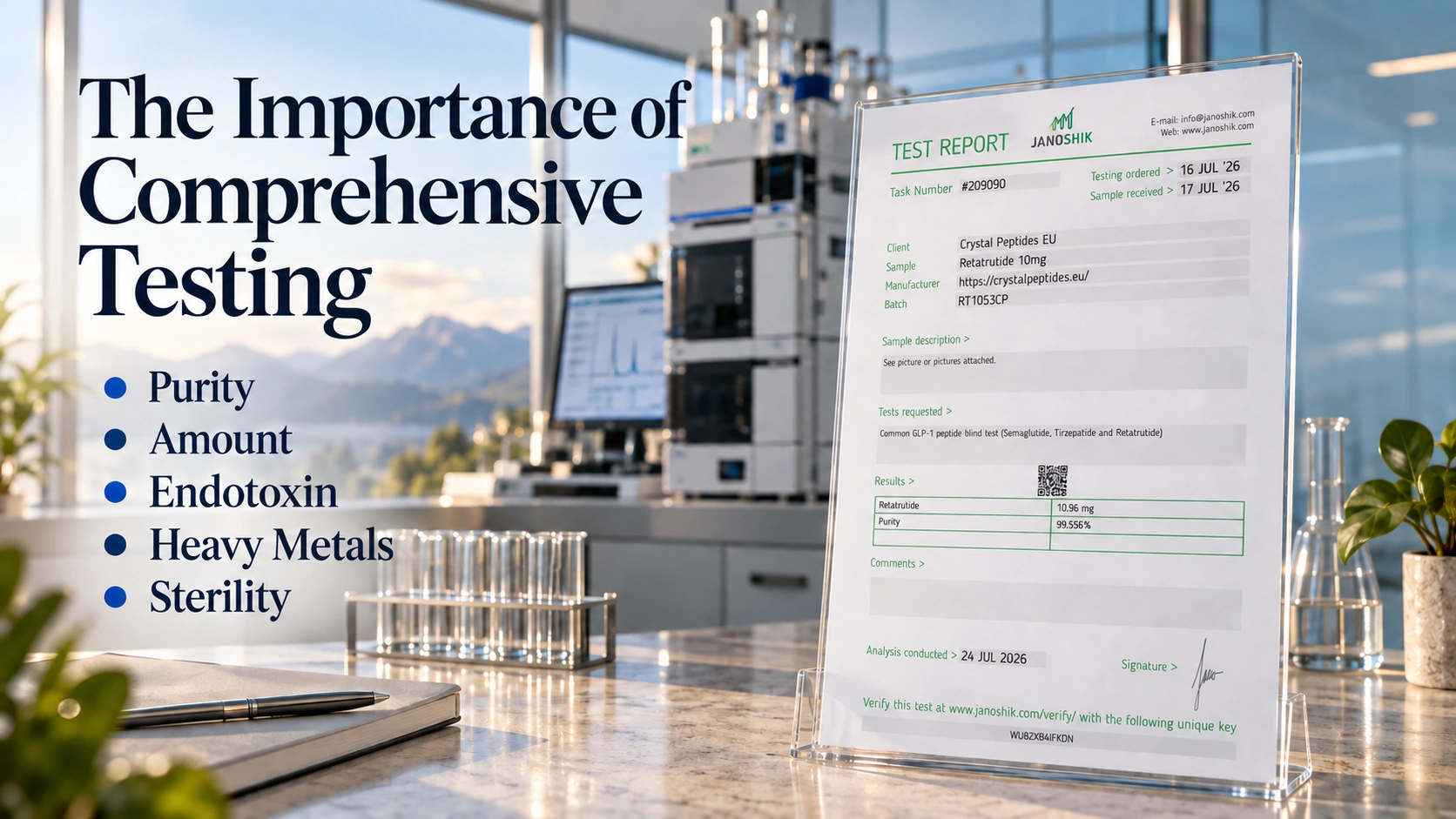
Our library links to Janoshik report #209090, issued for Crystal Peptides EU. It identifies the sample as Retatrutide 10mg, batch RT1053CP, with analysis dated 24 July 2026.
| Field in that report | Recorded result |
|---|---|
| Identified compound and amount | Retatrutide — 10.96 mg |
| Purity | 99.556% |
| Endotoxin, heavy metals and sterility | Not reported on this certificate |
This is an example of reading the scope accurately—not evidence that all five checks were completed on this sample. Separate reports in the library must be reviewed independently, with attention to product, strength and batch. A report for another strength or an earlier batch should not be silently treated as the certificate for a current sample.
The cover uses an illustrative laboratory setting. Consult the linked original report, not the cover artwork, for the authoritative document and its results.
How to review a certificate in five steps
- Match the sample name, strength and batch to the material being evaluated.
- Verify the report number and verification key directly with the issuing laboratory.
- Identify exactly which tests were requested and which results are actually reported.
- Read the units, methods, reporting limits and any comments or qualifications.
- Record missing information as not reported, then seek clarification before relying on the claim.
Keep the report with the relevant research records. A traceable result is more useful than a cropped screenshot, a generic badge or a percentage detached from its sample.
Frequently asked questions
Does high purity prove the correct amount is present?
No. Purity and amount answer different questions. Review both measurements and check the units and sample description.
Does a sterility result mean there are no endotoxins?
No. Viable microorganisms and bacterial endotoxins require different assessments. Neither result substitutes for the other.
Does a Janoshik logo mean all five tests were performed?
No. The requested analyses and recorded results determine a report's scope. Check the actual certificate and its verification page.
Is a result below the reporting limit the same as zero?
No. It means the test did not report a value above the specified limit under its stated conditions. Preserve that qualification when quoting it.
Do these tests establish suitability for human use?
No. Analytical results do not demonstrate clinical effectiveness, regulatory approval or suitability for self-administration. Crystal Peptides materials are supplied for laboratory research. This article explains testing; it is not medical advice or a dosing guide.
The takeaway: choose evidence that can be checked
Comprehensive testing is valuable because the five checks complement one another. Purity describes one analytical dimension; amount, endotoxin, elemental impurities and sterility add different information. None should be inferred from an unrelated result.
Start with the Crystal Peptides Lab Tests library, verify the relevant document with the laboratory, and evaluate what it shows—and what it leaves unanswered.
Research Disclaimer
This article is for informational and research purposes only. The content is not intended as medical advice, diagnosis, or treatment recommendation.