

SS-31 and MOTS-c: Two Different Paths in Mitochondrial Research
SS-31 and MOTS-c appear together in discussions of mitochondria, but they represent different scientific ideas. SS-31, also known as elamipretide, has been studied for its interaction with cardiolipin in the inner mitochondrial membrane. MOTS-c is a mitochondrial-derived peptide investigated as a signal connecting metabolic conditions with cellular responses. Sharing a research theme does not make them interchangeable.
The most useful comparison starts with three questions: what does each molecule interact with, which experimental systems have been studied, and how far do those findings extend? Those questions provide a clearer picture than describing either compound simply as an “energy peptide.”
SS-31: studying the membrane environment
Mitochondrial energy production depends on an organized membrane environment. The inner membrane contains proteins that transfer electrons and help establish the gradient used to produce ATP. Cardiolipin is a lipid that contributes to this environment and interacts with several of its proteins.
One important partner is cytochrome c. Its familiar role is carrying electrons between respiratory-chain components. Under particular conditions, however, its interaction with cardiolipin can favor peroxidase activity: chemistry that can contribute to lipid oxidation. These are different functions of the same protein, not interchangeable measures of mitochondrial health.
In mechanistic experiments using model membranes and isolated mitochondrial preparations, researchers investigated how SS-31 affected this interaction. Their results supported a specific mechanism: SS-31 limited cardiolipin-associated cytochrome c peroxidase activity while preserving electron-transfer function. The work also examined respiration and ATP synthesis. These were biochemical and organelle-level measurements, not evidence about a person's subjective energy or endurance. Birk and colleagues, 2014.
The study is useful because it connects an interaction at the membrane with functional measurements. It does not establish that every condition involving fatigue has the same underlying defect, or that changing this interaction produces a clinical benefit in every population.
MOTS-c: studying metabolic communication
MOTS-c is a 16-amino-acid peptide described from a short open reading frame associated with mitochondrial 12S ribosomal RNA. Its original characterization connected mitochondrial genetic information with metabolic regulation rather than identifying another structural component of the respiratory chain.
Cell experiments implicated pathways linked to AMPK, a regulator of cellular responses to energy availability. Mouse experiments examined insulin sensitivity and metabolic changes associated with a high-fat diet. Together, these findings established a research direction: a mitochondrial-derived signal could influence how cells and organisms respond to metabolic conditions. They did not establish a treatment for human metabolic disease. Lee and colleagues, 2015.
Subsequent work showed that MOTS-c could relocate to the nucleus during metabolic stress and influence gene-expression responses. A peptide described as “mitochondrial-derived” therefore need not act only inside mitochondria. Its origin and its site of action are separate questions. Kim and colleagues, 2018.
This gives the comparison a useful molecular distinction. SS-31 research often examines the membrane machinery supporting mitochondrial function; MOTS-c research also examines communication between cellular compartments. Neither description captures every reported action, but they are more informative than a shared energy-related label.
What the exercise findings mean
A 2021 study measured naturally occurring MOTS-c around exercise in a small group of young men. The same paper included experiments involving administered MOTS-c in mice. Those are related but different forms of evidence: observing an endogenous response in humans does not show that administering a peptide reproduces exercise's benefits in humans. Reynolds and colleagues, 2021.
This distinction is easy to lose when a paper contains several experimental systems. The human component can establish that a measured biological response occurs during exercise. The animal intervention can test consequences of administering the peptide under the conditions of that model. Neither component turns the other into a human treatment trial.
SS-31 has a specific clinical history
Elamipretide has progressed beyond laboratory experiments into clinical development. In TAZPOWER, a small randomized crossover study in Barth syndrome, the controlled phase did not meet its two primary endpoints: walking performance and fatigue. Improvements were subsequently reported during the open-label extension. Reporting both parts is essential. TAZPOWER primary report.
The randomized comparison and the extension answer different questions. During an open-label extension, participants and investigators know the treatment being received, and there is no concurrent placebo group against which to judge changes. Longer observation can be valuable without supplying the same protection against alternative explanations as a controlled comparison.
On September 19, 2025, the US FDA granted accelerated approval to Forzinity, an elamipretide medicine, to improve muscle strength in adult and pediatric patients with Barth syndrome weighing at least 30 kg. The accelerated pathway requires confirmation of clinical benefit. This regulatory decision concerns a particular medicine, indication and population—not research-grade SS-31 for general fatigue, performance or longevity. The FDA announcement provides regulatory context, not evidence that all products carrying the molecular name are equivalent.
A comparison that preserves the evidence
| Question | SS-31 / elamipretide | MOTS-c |
|---|---|---|
| Molecular focus in the cited work | Cardiolipin and inner-membrane function | Metabolic signaling and stress adaptation |
| Laboratory readouts | Electron transfer, respiration and ATP synthesis | Gene expression, AMPK-linked responses and glucose handling |
| Human evidence discussed here | Disease-specific intervention studies and a narrowly defined medicinal approval | Endogenous responses measured around exercise |
| Unsupported extrapolation | General-purpose restoration of energy | A proven human substitute for exercise |
The studies do not establish a head-to-head efficacy ranking or a benefit from combining these compounds. A membrane-function experiment and a metabolic-signaling experiment require different endpoints and interpretations, even when both concern mitochondria. The useful conclusion is not that one peptide is universally better: it is that each scientific claim must remain attached to the molecule, model and measurement that produced it.
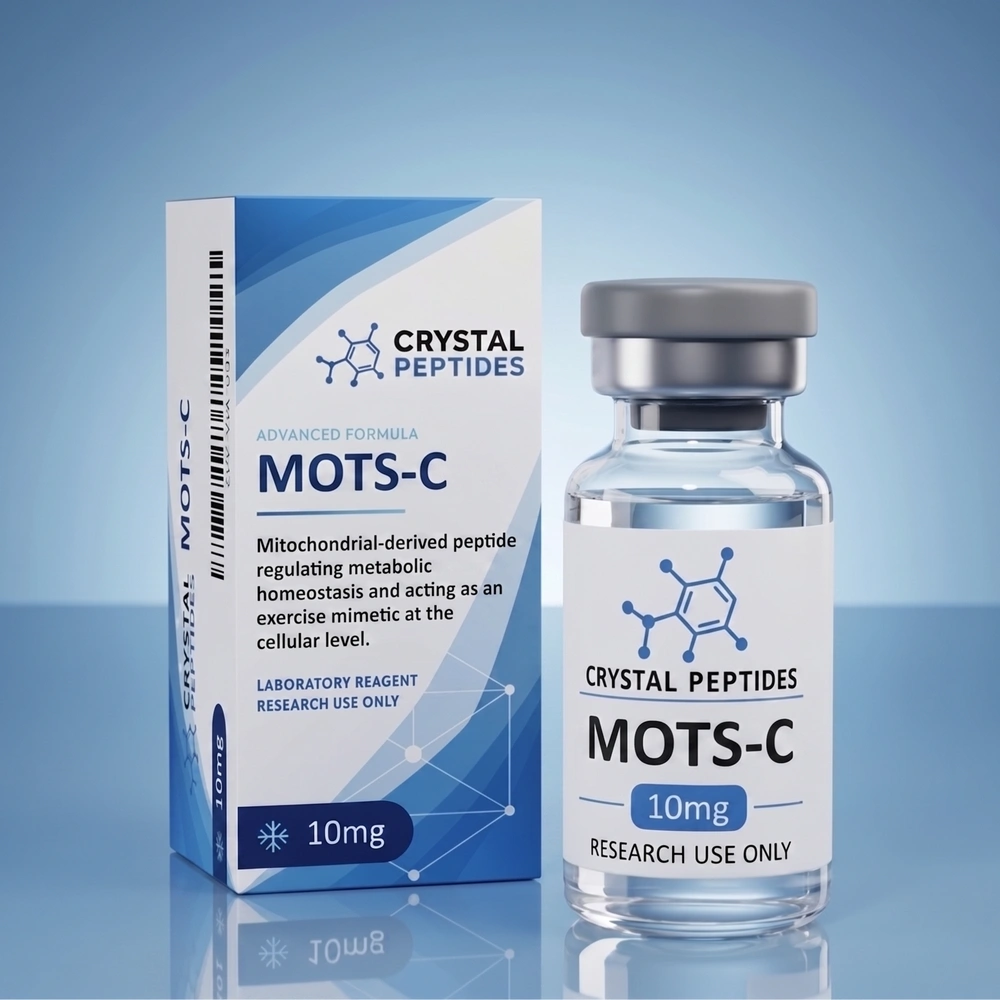
Explore the Products from This Article
All products are >99% purity, manufactured in a certified EU laboratory, with accompanying lab analysis.

Research Disclaimer
This article is for informational and research purposes only. The content is not intended as medical advice, diagnosis, or treatment recommendation.