Reading a Nasal Spray Label: Content, Concentration and Spray Count
Start with what is in the container
A nasal spray label can place several numbers beside the same ingredient name, but they answer different questions. Milligrams (mg) describe mass; millilitres (mL) describe liquid volume. Concentration connects the two.
For example, a label declaring 10 mg in 10 mL describes a nominal concentration of 1 mg/mL. “Nominal” means calculated from the stated quantities, rather than independently measured. The ingredient name also matters: a concentration cannot establish molecular identity or show whether the named compound remains intact in the liquid.
Where the number per spray comes from
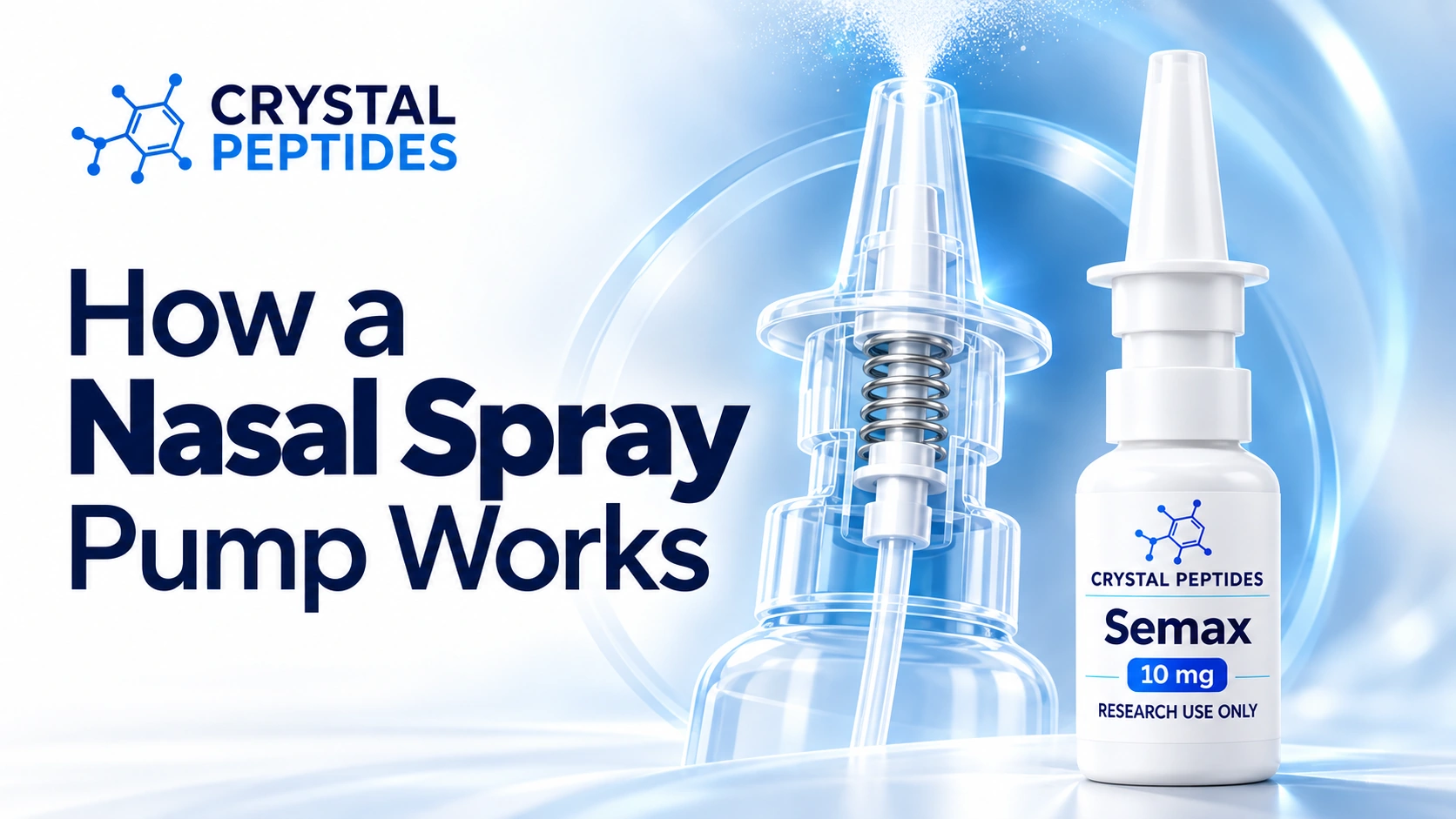
A pump introduces another quantity: the volume emitted in an actuation. If that volume is assumed to be 0.167 mL, the calculation is:
1 mg/mL × 0.167 mL = 0.167 mg, or 167 micrograms, nominally per spray.
Dividing 10 mL by the same assumed pump volume gives approximately 60 sprays. These are label-arithmetic examples, not administration instructions or independently validated measurements. The calculation does not establish that every actuation emits that volume, or that all the bottle's contents are available to the pump.
Priming, residual liquid and changes across the usable fill can affect output. The pump guide examines that device question separately.
Delivered does not mean absorbed
Even a measured amount leaving the nozzle is not a measurement of the amount entering the bloodstream or reaching a particular tissue. Deposition, clearance and passage across the nasal lining are additional steps, discussed in the nasal delivery mechanism guide.
The FDA's nasal spray quality guidance provides regulatory context for evaluating formulation and device performance together. It is not evidence that an individual bottle delivers its stated amount or produces a biological outcome.
Read the claim, then look for its evidence
A useful label distinguishes total ingredient mass, liquid volume, nominal concentration and the basis for any per-actuation claim. Batch-linked results should identify what was actually measured; an ingredient purity result alone does not validate pump output.
Questions about the liquid vehicle, container and changes during storage belong to formulation assessment. Keeping those questions separate makes the label more informative without asking its arithmetic to prove delivery, stability or absorption.
Research Disclaimer
This article is for informational and research purposes only. The content is not intended as medical advice, diagnosis, or treatment recommendation.