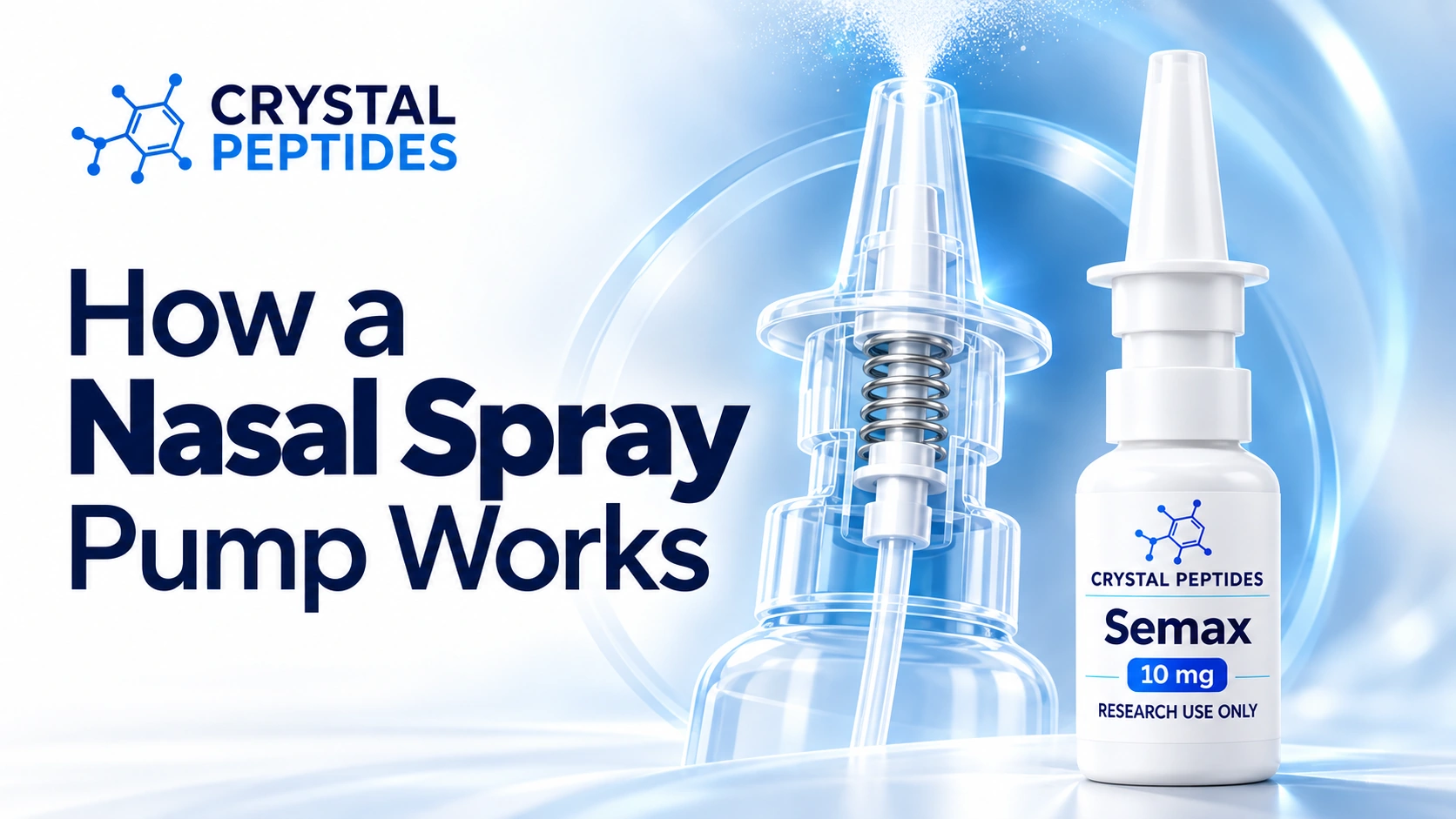
How a Nasal Spray Pump Works: What Consistent Delivery Means
The bottle is part of the mechanism
A mechanical nasal spray pump draws liquid from a reservoir into a metering mechanism. Pressing the actuator moves liquid through a nozzle, producing droplets. The intended output depends on the complete assembly—not simply the opening at the top.
The liquid matters too. Properties such as viscosity and surface tension can affect how it moves through the device and breaks into droplets. A pump specification alone therefore cannot establish the performance of every formulation placed in that container. The formulation guide examines this relationship between liquid, vehicle and packaging.
Equal-looking sprays can contain different amounts
Three quantities are easy to confuse: the concentration in the bottle, the volume expelled and the amount of compound in that expelled liquid. For a homogeneous solution, concentration multiplied by expelled volume gives a calculated amount. But a calculation based on an assumed pump volume remains nominal until measurements support that assumption.
Weighing spray output can help assess the amount of liquid expelled; converting mass to volume requires its density. Neither measurement alone establishes the compound content of that liquid. That requires a suitable analytical assay. A photograph of a fine mist establishes even less: it cannot quantify chemical content or absorption.
These distinctions also explain why reading a nasal label is different from evaluating delivery performance.
Consistency must last beyond one spray
A metering chamber does not justify assuming constant output throughout a bottle's life. Priming state, interruptions, initial fill and residual liquid can affect the usable output. Product-specific evaluation therefore considers the beginning, middle and end of container life, rather than relying on one apparently satisfactory actuation.
Health Canada's nasal-product quality guidance provides regulatory context for delivered-dose uniformity and testing under defined operating conditions. It is not evidence that a particular research bottle has passed those evaluations. Nor can the appearance of a device reveal a universal priming requirement.
Leaving the nozzle is not reaching a target
Even demonstrated consistency at the nozzle would answer only a delivery-device question. Deposition, clearance and movement across nasal tissue remain separate biological questions, as explained in the nasal delivery mechanism guide.
A useful pump report therefore identifies the formulation and container tested, the conditions examined and the quantity actually measured. Consistent liquid output, consistent compound output and absorbed exposure are distinct findings—not interchangeable descriptions of the same result.
Research Disclaimer
This article is for informational and research purposes only. The content is not intended as medical advice, diagnosis, or treatment recommendation.