How Nasal Peptide Delivery Works: Following a Molecule Across the Barrier
A spray lands on a protective surface
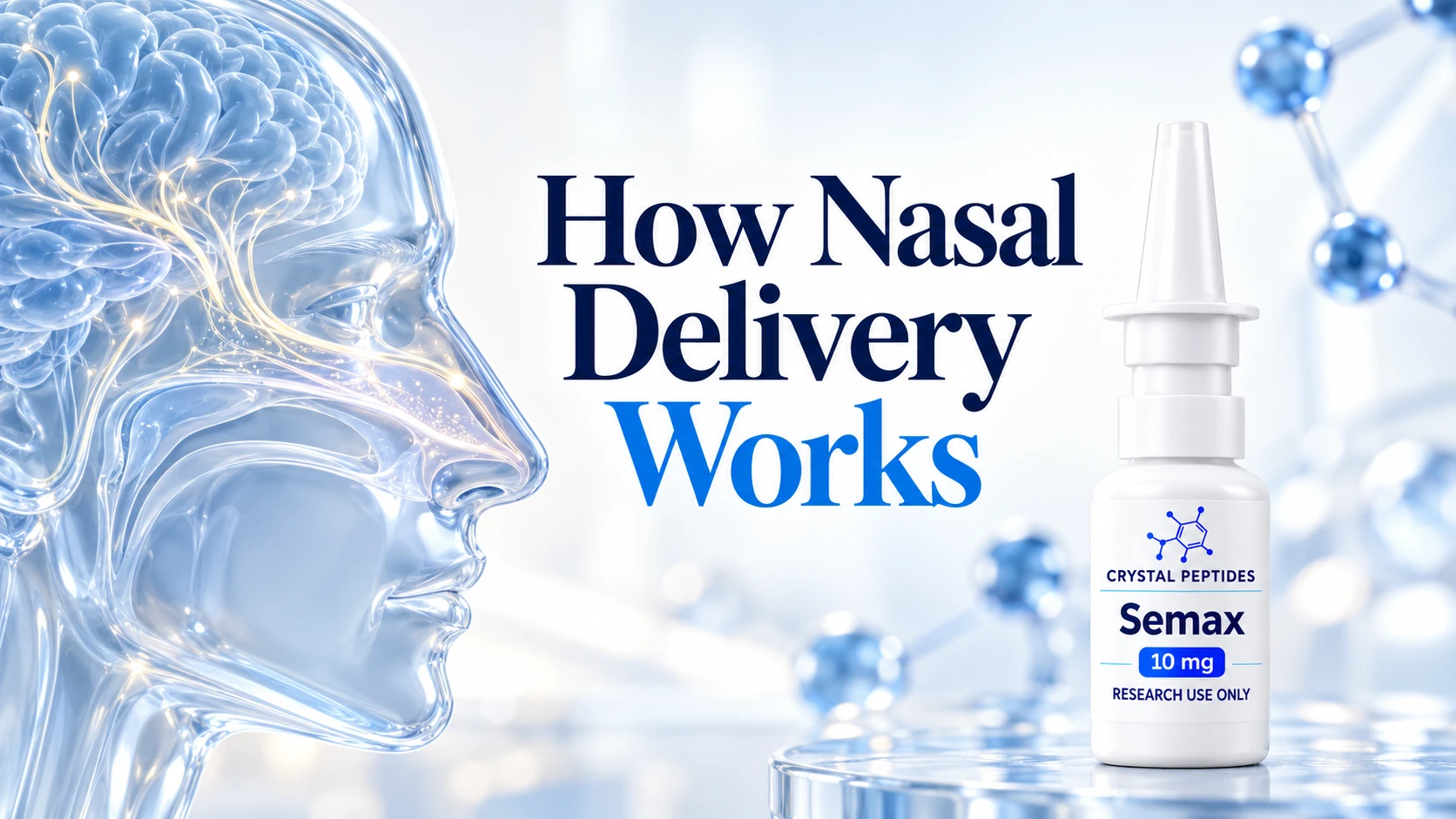
The nasal lining is moist and well supplied with blood vessels, but it is not an open passage into the body. Its mucus layer traps material, while moving cilia help carry that material towards the throat. A deposited compound may act locally, cross the underlying epithelium, undergo degradation or leave the nasal cavity through clearance and swallowing.
For peptides—molecules built from amino acids—size, charge and susceptibility to enzymes can influence these competing processes. Being biologically active at a receptor does not establish that enough intact peptide can reach that receptor through the nose.
Three quantities therefore need separating: what leaves the pump, what reaches the nasal surface and what is absorbed. None can be calculated from the others using bottle content alone.
Blood and brain are different destinations
If a molecule crosses the nasal epithelium and enters nearby blood vessels, it can circulate beyond the nose. That is systemic absorption. Routes associated with olfactory and trigeminal structures are also investigated as possible ways for substances or signals to influence the nervous system.
The phrase “nose to brain” can obscure this distinction. A change in brain activity might reflect direct delivery, an effect mediated through the circulation or downstream signalling from another tissue. Brain imaging measures a physiological response, not necessarily the location or quantity of intact peptide.
A useful example is the human study comparing intranasal and intravenous oxytocin. Researchers examined regional brain perfusion alongside circulating oxytocin. Some perfusion changes tracked increased blood concentrations, whereas other nasal-associated changes were consistent with an additional contribution from nose-to-brain pathways. Different nasal devices also produced different patterns.
The intravenous comparison matters: it helps investigate whether raising blood exposure can explain an imaging response. The device comparison asks whether how material is deposited changes the result. Together, these observations support more than one possible mechanism; they do not provide a map of peptide molecules entering particular brain targets.
A hormone response does not identify the whole journey
Endocrine networks transmit signals between tissues. A compound can activate an accessible receptor and initiate a hormonal response without necessarily entering deep brain tissue itself. “Acts on a brain-related pathway” and “reaches the brain directly” are not interchangeable statements.
In a 2025 randomised, double-blind, placebo-controlled crossover study, intranasal kisspeptin-54 stimulated gonadotropin release in healthy participants and women with hypothalamic amenorrhoea. This is a meaningful human endocrine endpoint. Complementary mouse experiments implicated olfactory-system signalling, but they do not establish the precise route responsible in every human participant.
The identity also matters: kisspeptin-54 is not kisspeptin-10. Findings for one preparation cannot simply be assigned to another sequence or formulation.
What related peptides can—and cannot—tell us
An early controlled human investigation of intranasal GHRH(1–44) reported growth-hormone responses. That supports a finding for the studied GHRH preparation, not a general rule that growth-hormone secretagogues cross the nasal barrier effectively.
The distinction becomes clearer with ipamorelin. Its human pharmacokinetic and pharmacodynamic study used a 15-minute intravenous infusion in healthy men and measured circulating growth hormone. A separate nasal absorption paper studied ipamorelin and related secretagogues in rats. Neither establishes human nasal exposure for CJC-1295 without DAC, ipamorelin or a fixed combination. Sharing an endocrine target does not remove differences in molecular transport.
Match the conclusion to the measurement
Different experiments answer different questions. A small intranasal Semax study involved 24 healthy volunteers and measured resting-state functional brain connectivity. Its default-mode-network findings were not a demonstration of improved cognition or a measurement of the fraction absorbed.
A Selank comparison with medazepam assessed rating-scale outcomes in 62 patients with generalised anxiety disorder and neurasthenia. It should not be described as a modern blinded placebo-controlled equivalence trial, and the abstract does not establish an administration route for extrapolating nasal delivery.
By contrast, a placebo-controlled intranasal PT-141 study in men measured blood exposure as well as pharmacodynamic outcomes. That directly addresses human exposure for its experimental preparation. It does not establish another spray’s output or absorption, nor does it validate MT-1 or MT-2 through their shared connection to melanocortin biology.
Preclinical findings sit at another level. Intranasal epitalon research examined neuronal activity in rats, while 2026 nasal NAD research investigated cultured cells and mice. Neither measures human exposure from a finished spray. NAD+ is a coenzyme, not a peptide; a delivery format does not make unlike molecules equivalent.
The final barrier is evidence for the actual preparation
The liquid and pump influence deposition, but nominal content is not delivered content, and delivered content is not absorbed content. Priming state, fill level and residual liquid can contribute to variation; constant output should not be assumed without measurements.
The EMA guideline on pharmaceutical quality of inhalation and nasal products provides quality-assessment context for considering formulation and device together. It is not evidence that a particular research spray reaches blood or brain.
Our formulation guide examines the vehicle, container and stability questions; the pump guide addresses output. Here, the central question is biological: has the exact compound, through the exact preparation and route, produced measured exposure and the claimed effect? A plausible pathway is a starting point for that investigation, not its conclusion.
Research Disclaimer
This article is for informational and research purposes only. The content is not intended as medical advice, diagnosis, or treatment recommendation.