GHK-Cu and AHK-Cu: What Changes When One Amino Acid Changes?
GHK-Cu and AHK-Cu differ by one amino acid, yet their names should not be treated as interchangeable. GHK contains glycine, histidine and lysine; AHK contains alanine, histidine and lysine. The Cu designation refers to a copper complex. That small structural difference is a useful starting point for a comparison, but it cannot by itself predict which compound will produce a particular biological outcome.
Their research histories also differ. GHK-Cu has been investigated in connective-tissue models and copper-binding chemistry. AHK-Cu has an experimental literature involving hair follicles and dermal papilla cells. Understanding the methods behind those observations is more informative than reducing the comparison to “skin versus hair.”
One amino acid changes the molecule, not just its name
Glycine and alanine are both small amino acids. Glycine has hydrogen as its side chain, whereas alanine has a methyl group. Replacing one with the other changes the first residue of the peptide while leaving histidine and lysine in the same sequence positions.
That difference establishes that GHK and AHK are distinct molecules. It does not establish that they have equivalent copper-binding behavior, tissue distribution or biological potency. Those are experimental questions rather than conclusions available from the abbreviations.
A copper peptide is also more than a peptide name followed by a mineral. Researchers study how the metal coordinates with the peptide and how surrounding conditions influence the complex. Thermodynamic experiments on GHK examined strong copper binding under defined conditions and the importance of accounting for competing ligands and the experimental buffer. The study also examined DAHK, a four-amino-acid sequence—not the three-amino-acid AHK discussed here. It therefore cannot serve as a direct GHK-versus-AHK comparison. Trapaidze and colleagues, 2012.
What GHK-Cu research actually measured
An early GHK-Cu study examined collagen synthesis in fibroblast cultures. Fibroblasts are cells involved in producing connective-tissue components. The researchers reported increased collagen synthesis under their experimental conditions, without a corresponding increase in cell number. That distinction helped separate the measured biochemical response from simple proliferation. Maquart and colleagues, 1988.
Collagen production and cell multiplication are not interchangeable endpoints. A culture containing more cells might produce more total material without each cell changing its activity. Measuring both helps interpret what has changed. Nevertheless, a culture dish does not reproduce the entire skin barrier, immune environment or healing process, and this experiment did not establish the performance of a finished skincare formulation in people.
A later experiment investigated GHK-Cu through sequential injections into subcutaneous mesh wound chambers in rats. Researchers measured the accumulation of extracellular-matrix components within this experimental wound environment. The chamber model allowed them to examine local tissue responses in a living animal rather than isolated cells. Maquart and colleagues, 1993.
Accumulation is an important distinction: the amount present reflects the balance of production, breakdown and retention. It is not the same measurement as collagen synthesis in a cell culture. The rat findings support further investigation of local matrix responses, but they do not demonstrate human wrinkle reduction, systemic rejuvenation or effectiveness through an unrelated delivery route.
What makes AHK-Cu interesting in hair research
The frequently cited AHK-Cu study investigated isolated human hair follicles and cultured dermal papilla cells. Dermal papilla cells participate in the signaling environment of the follicle. Researchers observed follicle elongation in organ culture and increased proliferation of the cultured cells. They also examined markers associated with cell survival; not every result reached statistical significance. Pyo and colleagues, 2007.
These experiments address related but different questions. Follicle organ culture preserves more tissue organization than a culture of one cell type. The cell experiments help investigate possible contributors to the response, but increased dermal papilla cell proliferation alone is not proof of increased hair production.
Human-derived tissue is valuable, yet an isolated follicle remains an experimental model. The study did not measure visible scalp coverage, durability after treatment or effectiveness across different causes of hair loss. Nor did it establish that AHK-Cu outperforms GHK-Cu in a clinical comparison.
Why formulation prevents a simple ranking
A GHK-Cu transport study used a laboratory membrane system to investigate passage across a model of the outer skin barrier. Its findings concerned transport under the chemical conditions tested, not clinical performance of every formulation containing GHK-Cu. Model-membrane transport study.
Molecular activity, movement through a model membrane and a visible tissue outcome are separate questions. A cell experiment can expose cells directly to a substance, bypassing barriers that a finished product would encounter. Conversely, detecting passage through a membrane does not establish that a sufficient amount reaches the relevant cells in an active form.
Comparing the evidence without oversimplifying it
| Feature | GHK-Cu | AHK-Cu |
|---|---|---|
| Peptide sequence | Gly–His–Lys | Ala–His–Lys |
| Research examples discussed here | Copper binding, fibroblast collagen synthesis and rat wound chambers | Isolated human follicles and dermal papilla cell cultures |
| Measured responses | Binding behavior, collagen synthesis and matrix-component accumulation | Follicle elongation, cell proliferation and survival-related markers |
| Unanswered clinical question | Whether a specified formulation improves a defined human skin outcome | Whether a specified formulation produces durable, visible hair regrowth |
Calling GHK-Cu a skin peptide and AHK-Cu a hair peptide may help orient a reader, but it is not a strict biological boundary or a validated ranking. The studies use different experimental systems and endpoints; they do not establish that one compound should replace the other or that combining them is superior.
The useful conclusion is narrower: a one-residue substitution creates a different molecule, while the available studies supply different kinds of evidence. To interpret either compound, keep its identity, formulation, experimental model and measured outcome together. Similar names cannot substitute for a matched comparison.
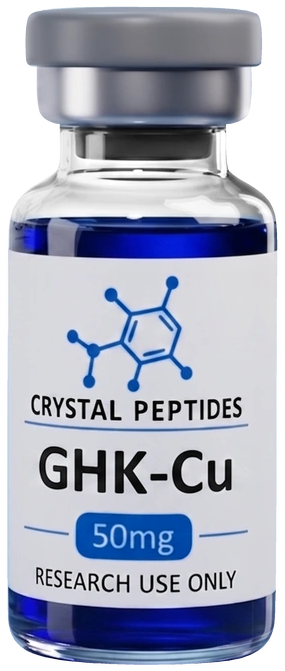
Explore the Products from This Article
All products are >99% purity, manufactured in a certified EU laboratory, with accompanying lab analysis.
Research Disclaimer
This article is for informational and research purposes only. The content is not intended as medical advice, diagnosis, or treatment recommendation.