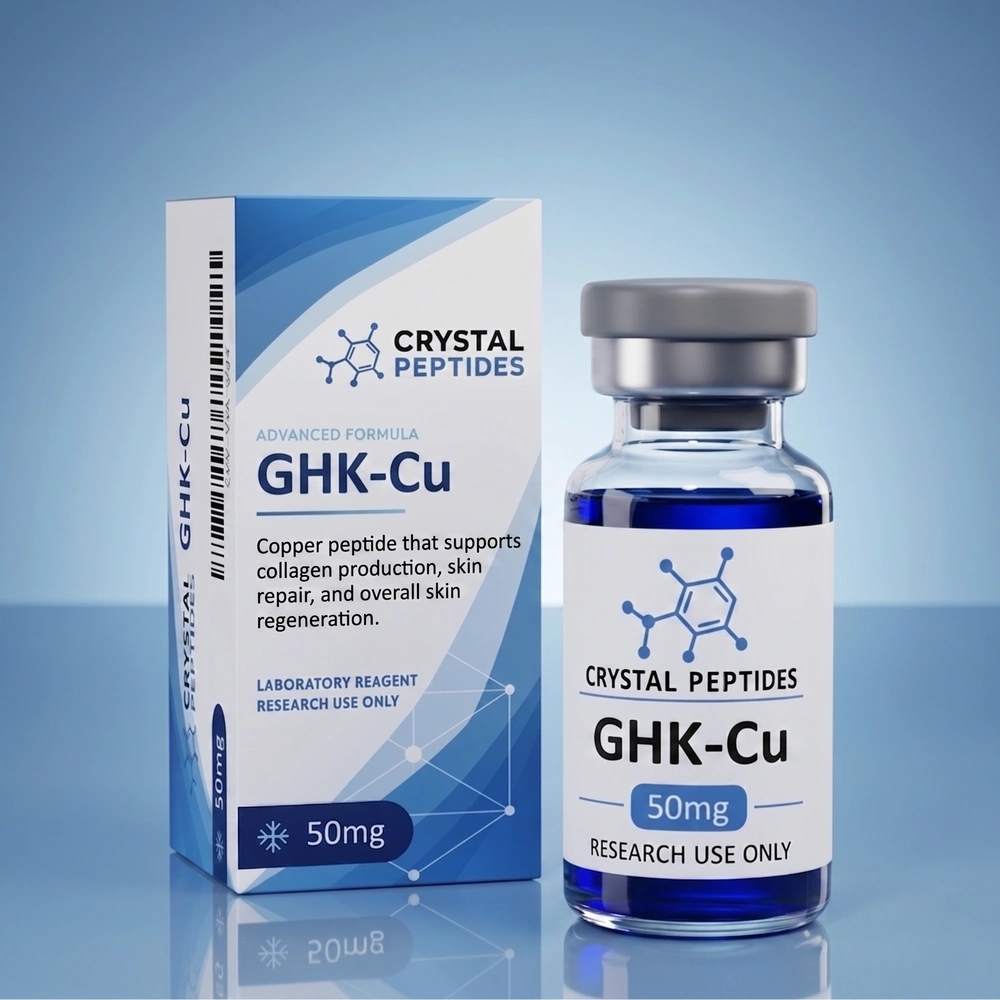
GHK-CU (50)
❄️Lyophilized powder (not reconstituted)
Size:
Total: 25.79 GBP
Discount per Quantity
| Quantity | Discount | Price per Unit |
|---|---|---|
| 5 - 10 | 10% | 23.21 GBP |
| 11 - 20 | 15% | 21.92 GBP |
| 21+ | 20% | 20.63 GBP |
Rigorous third-party testing
Every batch of our research chemicals and peptides undergoes independent third-party laboratory testing for purity and identity.
Total: 25.79 GBP
GHK-CU (50mg)
What Is GHK-Cu?
GHK-Cu is a copper-binding tripeptide complex formed by the naturally occurring tripeptide glycyl-L-histidyl-L-lysine (GHK) and copper. This distinctive peptide–metal complex has attracted research interest across several areas of molecular and cellular biology, including extracellular matrix remodelling, wound-healing biology, fibroblast activity, cellular signalling and copper-dependent biochemical processes. Research has also examined how the interaction between GHK and copper influences the properties and biological activity of the resulting complex.
Buy GHK-Cu 50mg in Europe from Crystal Peptides, a leading supplier known for strict purity and quality standards. Every new batch is tested by an independent laboratory (Janoshik) for applicable quality parameters such as identity, purity and sterility, and a batch-specific Certificate of Analysis is provided for verification. Secure, reliable and discreet shipping is available throughout Europe; see full shipping information below.
This product is sold for research use only and is not for human or veterinary use.
What’s Included?
The GHK-Cu 50mg is supplied as a lyophilized powder in a sealed glass vial. The material is typically blue to white-blue in appearance, consistent with the presence of copper in the complex.
A Certificate of Analysis (CoA) is available for every product lot as a result of analytical testing conducted by a third-party laboratory. Depending on the laboratory and the product being tested, the CoA may include analytical results such as:
- Identity testing: Confirms that the material corresponds to GHK-Cu and helps verify the identity of the supplied compound.
- HPLC purity: Measures the proportion of the principal GHK-Cu component relative to detectable chromatographic impurities.
- Mass spectrometry (MS): Provides molecular-mass data to support compound identity and characterization.
- Peptide content: Helps establish the amount of peptide material present in the tested sample.
- Copper content or elemental analysis: When available, this test helps characterize the copper component of the complex.
- Endotoxin testing: Performed on some peptide products to screen for bacterial endotoxin levels, which can be relevant to laboratory experiments involving cell-based or other sensitive biological systems.
- Sterility testing: Where applicable, evaluates the sample for detectable microbial contamination.
The batch-specific CoA should be used as the definitive source for the analytical results and specifications of the GHK-Cu lot supplied. Testing parameters can vary according to the product and independent laboratory performing the analysis.
Please note that reconstitution solution is not included with your order. If required for your research, buy BAC Water from Crystal Peptides to be shipped together with your GHK-Cu order.
Technical Specifications
Property | Specification |
Product name | GHK-Cu |
Alternative names | Copper tripeptide, copper peptide GHK, Cu-GHK |
Parent peptide | Glycyl-L-histidyl-L-lysine (GHK) |
Molecule type | Copper–tripeptide complex |
Peptide length | 3 amino acids |
Amino acid sequence | Gly-His-Lys (GHK) |
Metal component | Copper |
CAS number | 300801-03-0 |
PubChem CID | 133697840 |
Molecular formula | C28H48CuN12O8 |
Molecular weight | 744.3 g/mol |
Appearance | blue or blue-to-bluish lyophilized powder |
Product quantity | 50 mg |
Intended use | Laboratory research only. Not for human or veterinary use. |
Note: For research purposes, check the provided Certificate of Analysis for batch-specific specifications and analytical test results to establish the precise molecular form, composition and purity of the material supplied.
GHK-Cu Overview and Mechanism of Action
GHK-Cu is a complex of glycyl-L-histidyl-L-lysine (GHK) and copper. GHK is a naturally occurring tripeptide that can bind copper ions, and the resulting copper complex has been investigated extensively in cellular and tissue biology. [1]
The biological properties of GHK-Cu are closely connected to both components of the complex. GHK provides the peptide structure capable of coordinating copper, while copper is an essential trace element involved in numerous enzymatic and cellular processes. Research has therefore examined GHK-Cu in relation to extracellular matrix regulation, cellular signalling, tissue remodelling and wound-healing biology.
Copper Binding and Complex Formation
GHK contains amino-acid residues capable of coordinating copper, with the histidine residue playing an important role in metal binding. Formation of the copper complex changes the chemical and biological characteristics of the free tripeptide and provides a useful model for studying peptide–metal interactions. [1]
The precise molecular characteristics of a GHK-Cu preparation can depend on factors including the peptide-to-copper ratio, chemical environment and preparation method. These characteristics are therefore relevant when interpreting analytical data or comparing different research materials.
GHK-Cu and Cellular Signalling
Research has investigated GHK-Cu in several cellular systems, including studies of fibroblasts and other cells involved in extracellular matrix biology. Reported research areas include regulation of proteins associated with collagen and extracellular matrix organization, cellular migration and responses involved in tissue remodelling. [2]
These effects are not attributable to a single receptor or signalling pathway. GHK-Cu research encompasses multiple molecular processes, including copper-dependent enzymatic activity and changes in gene and protein expression observed in experimental models.
Extracellular Matrix and Tissue Remodelling
One of the better-established areas of GHK-Cu research concerns extracellular matrix biology. Experimental studies have examined its relationship with collagen, glycosaminoglycans and other components involved in maintaining and remodelling connective tissue. [2]
This makes GHK-Cu a useful research compound for investigating the molecular processes underlying matrix synthesis, degradation and cellular responses during tissue remodelling.
GHK-Cu vs Free GHK
It is important to distinguish between GHK and GHK-Cu when selecting or interpreting research materials. GHK is the tripeptide glycyl-L-histidyl-L-lysine itself, while GHK-Cu is a copper–peptide complex in which GHK is associated with copper, giving the material different chemical and analytical characteristics.
This distinction is crucial when comparing experimental results, interpreting analytical data or evaluating the identity and composition of a research material. Results obtained with GHK should not automatically be assumed to apply to GHK-Cu, or vice versa. For a specific GHK-Cu preparation, the exact molecular form, composition and relevant quality attributes should be established from the applicable product specification and batch-specific documentation.
Research Applications & Scientific Background
GHK-Cu has been investigated across several areas of molecular and cellular biology, particularly research involving extracellular matrix regulation, tissue remodelling, cellular responses and copper-dependent processes. Its combination of a biologically occurring tripeptide with a metal ion makes it relevant to both peptide biology and metallobiochemistry.
Extracellular Matrix Research
GHK-Cu has been studied in relation to extracellular matrix components including collagen and glycosaminoglycans. Experimental research has examined changes in the expression and regulation of proteins involved in matrix organization, making the complex relevant to studies of connective-tissue biology and matrix remodelling. [2]
Fibroblast and Cellular Research
Fibroblasts are an important experimental model for studying extracellular matrix production and tissue remodelling. Research involving GHK-Cu has investigated cellular responses including changes in matrix-associated protein expression, cell migration and other processes relevant to fibroblast biology.
Wound-Healing and Tissue-Repair Research
Experimental studies have investigated GHK-Cu in models of wound healing and tissue repair, including cellular processes involved in regeneration and remodelling. [1] Research in this area can encompass cell migration, extracellular matrix organization and the regulation of repair-associated molecular pathways.
Gene and Protein Expression
GHK-Cu has also been investigated for its effects on gene expression and protein regulation. Studies have reported changes involving genes associated with extracellular matrix formation, inflammation, oxidative stress and cellular differentiation. These findings provide a basis for investigating how peptide–metal complexes can influence broader cellular responses. [1][3]
Copper and Metallobiochemistry
Because GHK can coordinate copper, GHK-Cu provides a useful research model for studying peptide–metal interactions. Copper is involved in numerous enzymatic reactions and cellular processes, so research can examine how copper availability, binding and coordination influence the properties of the complex and its experimental environment. [1]
Analytical and Structural Research
GHK-Cu can also be used in analytical research focused on peptide identity, copper complexation and molecular characterization. Techniques such as chromatography, mass spectrometry and elemental analysis can be used to characterize the peptide component, copper content and related chemical species within a preparation.
GHK-Cu in Comparative Research
Comparing GHK with GHK-Cu can help researchers investigate how metal coordination changes peptide chemistry and biological behaviour. Such comparisons are useful when examining peptide–metal interactions, structure-function relationships and the contribution of copper to experimental responses.
GHK-Cu vs AHK-Cu vs BPC-157 Comparison
GHK-Cu belongs to a broader area of research involving copper-binding peptides and peptide–metal complexes. Comparing it with structurally related compounds such as AHK-Cu, as well as with a distinct peptide such as BPC-157, helps illustrate why peptide sequence and molecular composition matter when evaluating research materials.
Property | GHK-Cu | ||
Molecule type | Copper–tripeptide complex | Copper–tripeptide complex | Synthetic peptide |
Parent peptide | Gly-His-Lys (GHK) | Ala-His-Lys (AHK) | Distinct 15-amino-acid sequence |
Peptide length | 3 amino acids | 3 amino acids | 15 amino acids |
Copper component | Present | Present | Not a defining component |
Research context | Copper-peptide chemistry, extracellular matrix and cellular biology | Copper-peptide and cellular research | Cellular and tissue biology |
Structural distinction | GHK coordinated with copper | AHK coordinated with copper | Longer peptide without a defined copper complex |
GHK-Cu is also used in multi-peptide research formulations such as the Glow Blend and Klow Blend, where it contributes the copper–tripeptide component alongside other peptides with distinct molecular properties and research applications.
GHK-Cu in Glow Blend
The Glow Blend is a combination of GHK-Cu with BPC-157 and TB-500 in a multi-peptide research formulation. GHK-Cu provides the copper-binding peptide component of the blend, making it particularly relevant to research involving extracellular matrix biology, fibroblast activity, cellular signalling and copper-dependent processes. The combination allows researchers to investigate GHK-Cu alongside other peptides studied in tissue-response and cellular research, while each component retains its own distinct molecular characteristics.
GHK-Cu in Klow Blend
The Klow Blend as supplied by Crystal Peptides is a formulation of GHK-Cu together with proportional amounts of BPC-157, TB-500, and KPV. GHK-Cu contributes its copper–tripeptide chemistry and provides a research component relevant to extracellular matrix, cellular signalling and connective-tissue biology.
Researchers studying the Klow or Glow blends should consider GHK-Cu as one defined component of the overall blend and interpret experimental findings in the context of the complete formulation rather than attributing an observed effect to GHK-Cu alone.
Storage & Laboratory Handling
GHK-Cu is supplied as a lyophilized copper–tripeptide complex. Appropriate storage and handling help preserve the material's analytical characteristics and reduce unnecessary degradation.
- Keep the vial sealed and protected from moisture when not in use.
- Store according to the product documentation and applicable batch-specific recommendations.
- Protect from excessive heat and prolonged temperature fluctuations.
- Protect from unnecessary exposure to light.
- Once prepared for an experiment, follow the storage and stability conditions established for the specific preparation and experimental protocol.
- Avoid unnecessary repeated freeze-thaw cycles where applicable, particularly when working with prepared solutions.
- Use appropriate laboratory handling procedures to minimize contamination during preparation and experimental use.
Because GHK-Cu is a peptide–copper complex, its stability can depend on factors including formulation, concentration, solvent, pH, temperature and storage conditions. Researchers should therefore use the applicable product documentation and experimental protocol when establishing handling and storage conditions.
When you buy GHK-Cu from Crystal Peptides, you will find the product comes with protective packaging designed to help preserve the material's stability and integrity through delivery. Always check the specific handling and storage instructions provided in the product documentation for the applicable batch and follow established laboratory procedures when storing or preparing the material.
Certificate of Analysis & Quality Assurance
A Certificate of Analysis (CoA) provides batch-specific analytical information about the GHK-Cu material supplied. Because GHK-Cu combines a peptide with copper, evaluating the material involves more than confirming the identity of the underlying tripeptide.
Depending on the testing performed by the independent laboratory, relevant analytical information may include:
- Identity: Confirms that the tested material corresponds to GHK-Cu.
- HPLC purity: Indicates the proportion of the principal chromatographic component relative to detected impurities.
- Mass spectrometry: Provides molecular-mass information supporting peptide identity and characterization.
- Peptide content: Provides information about the amount of peptide material in the tested sample.
- Copper or elemental analysis: Where available, helps characterize the copper component of the preparation.
- Endotoxin testing: Assesses the level of bacterial endotoxins detected in the sample.
- Sterility testing: Where performed, checks for detectable microbial contamination.
- Residual solvents and related impurities: Where applicable, identifies potential process-related contaminants.
At the same time, verify that the Certificate of Analysis (CoA) corresponds to the specific product lot you purchased. The batch-specific CoA should be treated as the definitive source for the analytical results and specifications applicable to that material.
Frequently Asked Questions
What is GHK-Cu?
GHK-Cu is a copper-containing complex of the tripeptide glycyl-L-histidyl-L-lysine (GHK). The peptide binds copper(II), producing a copper–peptide complex that has been investigated extensively in biochemical, cellular and tissue research.
What is the difference between GHK and GHK-Cu?
GHK is the free tripeptide consisting of glycine, histidine and lysine, while GHK-Cu is the copper-bound form. The addition of copper changes the chemical properties of the material and is an important part of the research interest surrounding GHK-Cu.
What is GHK-Cu studied for in research?
Research on GHK-Cu has examined extracellular matrix biology, fibroblast activity, collagen and glycosaminoglycan production, tissue remodelling and cellular signalling. Experimental studies have also investigated changes in matrix metalloproteinases and other proteins involved in extracellular matrix regulation.
How does GHK-Cu work?
GHK-Cu does not appear to operate through one single mechanism. Research has examined its copper-binding properties, effects on cellular and gene expression pathways, and interactions with processes involved in extracellular matrix regulation. The precise response can depend on the experimental system and conditions being studied.
Why is GHK-Cu blue?
The characteristic blue or blue-green appearance of GHK-Cu is associated with its copper(II) complex. Copper coordination produces distinctive optical properties that can be detected spectroscopically, making the colour consistent with the presence of the copper-containing complex.
What is the difference between GHK-Cu and other copper peptides?
“Copper peptide” is a broader term that can describe different peptides capable of coordinating copper. GHK-Cu specifically refers to the copper complex of glycyl-L-histidyl-L-lysine. Other copper peptides, including AHK-Cu, contain different peptide sequences and should therefore be treated as distinct research materials rather than interchangeable compounds.
How is GHK-Cu purity and identity tested?
GHK-Cu can be characterized using analytical techniques such as HPLC and mass spectrometry. HPLC provides information about chromatographic purity and related substances, while mass spectrometry can provide info on molecular identity and help distinguish the copper-bound complex from the free peptide. Additional techniques may be used to characterize the copper component and molecular form.
Where can I buy GHK-Cu for research in Europe?
Researchers in Europe can buy GHK-Cu from Crystal Peptides as a high-purity, research-grade laboratory research material in lyophilized powder form. The product is available in 50mg and 100mg vials and comes with a batch-specific Certificate of Analysis. This material is intended exclusively for research and development and is not approved for human or veterinary use.
Scientific References
- Pickart, L., Vasquez-Soltero, J. M., & Margolina, A. (2012). The human tripeptide GHK-Cu in prevention of oxidative stress and degenerative conditions of aging: Implications for cognitive health. Oxidative Medicine and Cellular Longevity, 2012, 324832. PubMed PMC full text
- Pickart, L., Vasquez-Soltero, J. M., & Margolina, A. (2015). GHK peptide as a natural modulator of multiple cellular pathways in skin regeneration. BioMed Research International, 2015, 648108. PubMed PMC full text
- Pickart, L., & Margolina, A. (2018). Skin regenerative and anti-cancer actions of copper peptides. Cosmetics, 5(2), 29. MDPI full text
Used solely for in vitro experiments and cannot be:
- Used in clinical trials involving humans
- Administered to humans as part of an experiment or investigation
- Supplied to another party for human investigational use.