
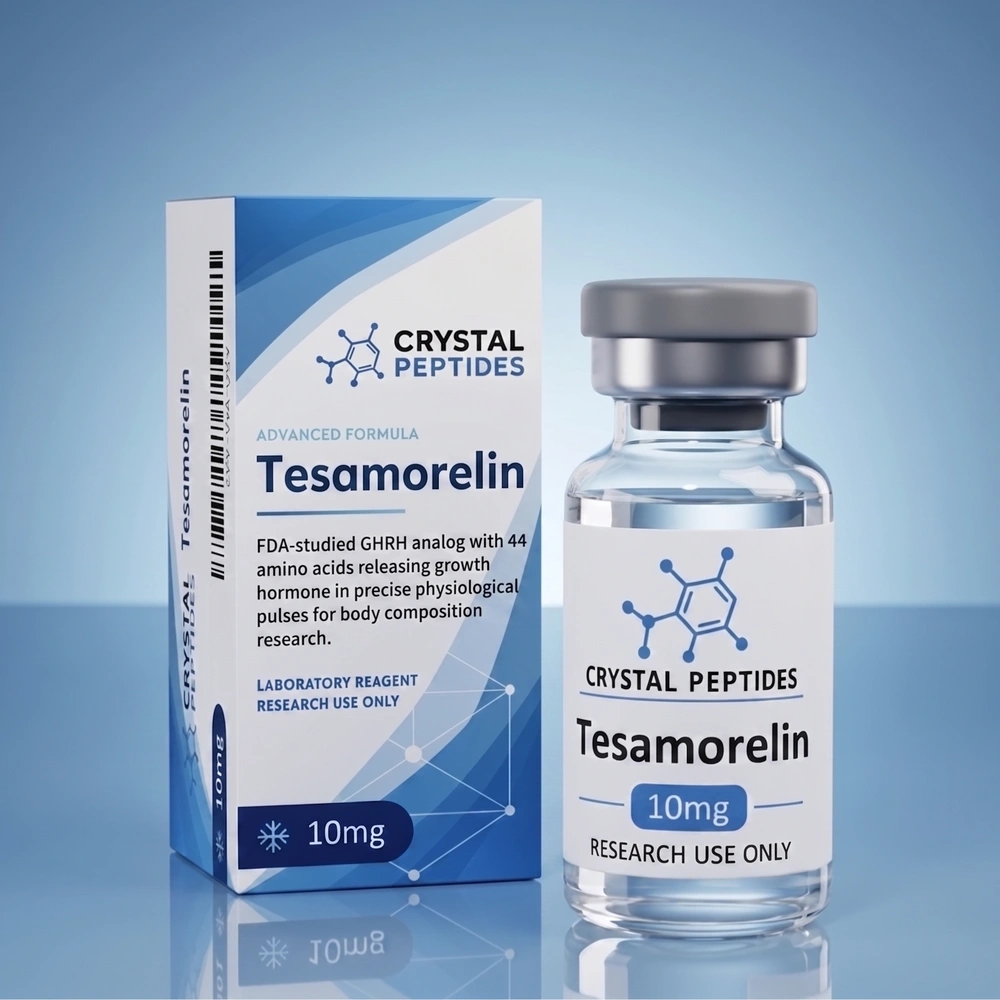
Tesamorelin (10mg)
❄️Lyophilized powder (not reconstituted)
Size:
Total: 61.14 GBP
Discount per Quantity
| Quantity | Discount | Price per Unit |
|---|---|---|
| 5 - 10 | 10% | 55.03 GBP |
| 11 - 20 | 15% | 51.97 GBP |
| 21+ | 20% | 48.91 GBP |
Rigorous third-party testing
Every batch of our research chemicals and peptides undergoes independent third-party laboratory testing for purity and identity.
Total: 61.14 GBP
What Is Tesamorelin?
Tesamorelin is a synthetic 44-amino-acid peptide analogue of growth hormone-releasing hormone (GHRH). Its modified molecular structure is designed to retain activity at GHRH receptors, making the tesamorelin peptide relevant to research investigating receptor interactions, intracellular signalling and the regulation of the growth hormone–insulin-like growth factor 1 (GH–IGF-1) axis. Tesamorelin has a substantial body of preclinical research, including animal and in vitro studies examining its pharmacological properties and associated signalling pathways. This research provides a foundation for further investigation into GHRH-related mechanisms and their potential relationship with metabolic regulation.
You can now buy Tesamorelin 10mg in the UK/EU from Crystal Peptides, a supplier of high-purity research peptides committed to quality and analytical transparency. Working with recognised labs, such as Janoshik, Crystal Peptides conducts analytical tests for product quality assessment. As a result, every batch comes with a Certificate of Analysis (CoA) with the reported analytical results covering parameters such as identity, purity, sterility, endotoxins and heavy metals.
Crystal Peptides also offers fast, discreet shipping across the UK, Europe and to international destinations. This product is intended exclusively for laboratory research and is not for human or veterinary use.
What’s Included
Each Tesamorelin 10mg order from Crystal Peptides is supplied in a clear, well labelled glass vial containing a white lyophilised peptide. It comes in discreet, protective packaging designed to protect the product during storage and transit. The product is accompanied by batch-specific documentation to support traceability and independent assessment of its reported quality parameters.
- Tesamorelin 10mg vial: Contains the stated quantity of lyophilised synthetic peptide for laboratory research (confirm quantities on CoA)
- Protective packaging: Helps protect the vial during handling, packing and shipping.
- Certificate of Analysis (CoA): Provides batch-specific analytical results for reviewing product quality. Available testing documentation covers purity, endotoxins, sterility and heavy metals. Refer to the relevant report for the specific results and testing methods applicable to the batch supplied.
The lyophilised powder format may require reconstitution before use in research. For that, you can also order Bacteriostatic Water 10mL or Acetic Acid 0.6% Mixing Water separately from our online shop. Crystal Peptides makes ordering and delivery convenient and easy, with consistent quality from batch to batch.
All products are intended exclusively for laboratory research and are not for human or veterinary use.
Tesamorelin: Technical Specifications
Specification | Details |
Product names | Tesamorelin (10mg), TH9507, tesamorel |
Peptide classification | Synthetic growth hormone-releasing hormone (GHRH) analogue |
Amino acid length | 44 amino acids |
Amino acid sequence | YADAIFTNSYRKVLGQLSARKLLQDIMSRQQGESNQERGARARL |
Structural modifications | N-terminal trans-3-hexenoyl modification and C-terminal amidation |
Molecular formula | C221H366N72O67S (free peptide) |
Molecular mass | ~ 5,136 g/mol (free peptide) |
CAS Registry Number | 218949-48-5 (free peptide) |
PubChem CID | |
Physical presentation | White to off-white lyophilised powder |
Purity and identity | Refer to the applicable batch-specific Certificate of Analysis (CoA) |
Intended use | Laboratory research only; not for human or veterinary use |
Note: The specifications above describe the registry information for the tesamorelin free-peptide formulation, not the acetate salt form. The exact product details should be confirmed from the documentation for the supplied batch, including the CoA and safety data sheet (SDS).
Tesamorelin: Overview and Mechanism of Action
Tesamorelin belongs to the class of synthetic growth hormone-releasing hormone (GHRH) analogues, a group of peptides studied for their interactions with the GHRH receptor and the signalling pathways associated with the growth hormone axis. Originally designated TH9507, tesamorelin is based on the full 44-amino-acid sequence of human GHRH, with a trans-3-hexenoyl modification at the N-terminal tyrosine. This structural modification was developed to improve resistance to enzymatic degradation compared with native GHRH.
Research on tesamorelin forms part of the broader investigation into synthetic GHRH analogues, peptide stability and growth hormone-related signalling. Preclinical studies have examined its molecular properties and receptor activity, while subsequent research has characterised its pharmacological profile in greater detail. This background provides a foundation for examining tesamorelin’s structure, receptor interactions and downstream signalling mechanisms in laboratory research.
Molecular Structure and Classification
Tesamorelin is a synthetic analogue of human growth hormone-releasing hormone (GHRH), also referred to as growth hormone-releasing factor (GRF). The peptide consists of 44 amino acids and incorporates a trans-3-hexenoyl group attached to its N-terminal tyrosine residue, along with C-terminal amidation. These structural features distinguish tesamorelin from the native GHRH sequence and form part of its molecular identity. [1]
Tesamorelin is commonly supplied in acetate salt form in pharmaceutical formulations, therefore researchers should confirm the exact chemical composition and counter-ion content against the provided documentation.
GHRH Receptor Binding and Signalling
Tesamorelin has been characterised as an agonist of the growth hormone-releasing factor receptor. In vitro research shows that it binds to and stimulates human GRF receptors with potency comparable to that of endogenous GRF.
GHRH receptors are G protein-coupled receptors expressed on somatotroph cells in the anterior pituitary. Receptor activation initiates intracellular signalling involving cyclic adenosine monophosphate (cAMP) and protein kinase A (PKA), which are involved in the regulation of growth hormone synthesis and secretion.
Research on tesamorelin can therefore examine receptor binding, agonist activity, concentration–response relationships and downstream signalling events in defined experimental systems. Results depend on the assay conditions, receptor expression system and analytical methods used. [1]
The GH–IGF-1 Signalling Axis
The growth hormone (GH)–insulin-like growth factor 1 (IGF-1) axis comprises interconnected endocrine and peripheral signalling pathways. GHRH receptor activity is one component of the regulatory system governing pituitary growth hormone secretion. Growth hormone, in turn, interacts with receptors in multiple tissues, while IGF-1 is produced in the liver and peripheral tissues and mediates some, but not all, downstream effects of growth hormone signalling.
In this research context, this axis provides a framework for investigating relationships between receptor activation, hormone signalling and associated molecular responses. Relevant measurements may include receptor activity, intracellular signalling markers and concentrations of specific hormones or binding proteins, depending on the experimental model.
Molecular Pharmacology
Tesamorelin provides a defined molecular system for studying GHRH receptor agonism and related signalling processes. Its structural characteristics, receptor-binding properties and activity in experimental systems are relevant when comparing synthetic GHRH analogues or investigating structure–activity relationships.
However, findings from a particular pharmaceutical formulation or experimental preparation should not automatically be attributed to the research peptide form without appropriate analytical evidence. The mechanisms described here provide scientific context for studying tesamorelin in controlled laboratory settings; Crystal Peptides supplies Tesamorelin for laboratory research and is not for human or veterinary use.
Tesamorelin Research Applications
Research on tesamorelin spans peptide pharmacology, receptor signalling, molecular stability and metabolic regulation. As a synthetic growth hormone-releasing hormone (GHRH) analogue, it provides a defined model for investigating interactions between peptide structure, receptor activity and downstream endocrine signalling. The following research areas highlight its relevance across in vitro and preclinical studies.
GHRH Receptor Pharmacology
Tesamorelin provides a model for investigating how synthetic GHRH analogues interact with the growth hormone-releasing hormone receptor (GHRHR). In vitro studies have shown that tesamorelin binds to and activates human GHRH receptors, with potency comparable to endogenous GHRH. This makes it relevant to research examining whether structural modifications to a peptide can preserve receptor activity while altering other properties, such as susceptibility to enzymatic degradation. [2]
Researchers can investigate these properties by measuring receptor activation, cAMP production and concentration-dependent responses in cellular systems. Comparing tesamorelin with native GHRH or other synthetic analogues can help characterise differences in functional potency and signalling activity. These experiments provide a basis for studying the relationship between peptide structure and receptor function, although results remain dependent on the assay system and experimental conditions.
Peptide Stability and Structure–Activity Research
The molecular structure of tesamorelin includes a 44-amino-acid sequence, an N-terminal hexenoyl modification and C-terminal amidation. These features are relevant to research examining how chemical modifications influence peptide stability and interactions with biological systems.
Preclinical research has investigated the susceptibility of tesamorelin to enzymatic degradation, including degradation involving dipeptidyl peptidase-4 (DPP-4). Such work contributes to broader investigations into the relationship between peptide structure, enzymatic stability and pharmacological activity. Comparisons with native GHRH and other synthetic analogues can help researchers identify how specific structural features affect these properties. [3]
GH–IGF-1 Axis and Endocrine Signalling
Tesamorelin research provides a framework for examining the relationship between GHRH receptor activation and the growth hormone (GH)–insulin-like growth factor 1 (IGF-1) axis. GHRH signalling regulates GH release from pituitary somatotroph cells, while GH acts on multiple tissues, including the liver, where it promotes IGF-1 production. Investigating this signalling cascade helps researchers distinguish the initial receptor-mediated response from downstream endocrine changes. [4]
Experimental studies can measure circulating GH and IGF-1 concentrations, assess response patterns over time and examine relationships between hormone exposure and associated molecular markers. These measurements are particularly relevant when investigating the timing and variability of endocrine responses. However, results must be interpreted in the context of the experimental model, sampling schedule and assay methods, as individual measurements capture different aspects of this interconnected signalling system.
Metabolic Regulation and Lipid-Related Pathways
Tesamorelin has been investigated in studies examining the relationship between GHRH signalling, lipid metabolism and energy regulation. Research has explored lipolysis, lipid mobilisation and changes in lipid-related biomarkers, providing a basis for investigating how growth hormone-related pathways interact with metabolic processes. These areas are relevant to understanding the biological links between endocrine signalling and lipid turnover. [2]
Experimental endpoints may include circulating lipid markers, measures of lipid turnover and changes in metabolic indicators over time, but their interpretation depends on the study model, measurement methods and experimental conditions.
Pharmacokinetics and Exposure Profiles
Tesamorelin pharmacokinetic research examines how the peptide enters the circulation, how quickly it is cleared and how its concentration changes over time. Published studies of pharmaceutical formulations have characterised parameters including peak plasma concentration (Cmax), total exposure (area under the concentration–time curve, or AUC) and elimination half-life. These measurements provide a basis for investigating the relationship between peptide structure, systemic exposure and degradation. Regulatory documentation also reports a short plasma elimination half-life, consistent with the rapid clearance observed in studies of tesamorelin. [3]
An important distinction in this research is that plasma exposure and downstream biological activity are not interchangeable measurements. Pharmacokinetic studies characterise the presence of the peptide in circulation, whereas pharmacodynamic studies examine associated biological responses. Moreover, results obtained with a specific pharmaceutical formulation cannot automatically be extrapolated to a separately supplied research material. Its identity, purity, stability and other relevant characteristics must be evaluated using product-specific analytical documentation.
Tesamorelin vs Sermorelin vs CJC-1295 Comparison
Tesamorelin, Sermorelin and CJC-1295 are synthetic peptides associated with growth hormone-releasing hormone (GHRH) receptor research. Although they share a broad pharmacological context, they differ in amino acid sequence, chemical modifications and the research questions they are used to investigate. These distinctions are important when comparing their molecular properties, receptor activity and stability.
Feature | Tesamorelin | ||
Peptide classification | Synthetic GHRH analogue | Synthetic GHRH fragment | Modified, long-acting GHRH analogue |
Sequence basis | Full-length 44-amino-acid GHRH sequence | First 29 amino acids of GHRH | Modified 29-amino-acid GHRH analogue |
Key structural features | N-terminal trans-3-hexenoyl modification and C-terminal amidation | Truncated GHRH sequence with C-terminal amidation | Multiple amino acid substitutions and a drug-affinity complex (DAC) modification |
Principal receptor target | GHRH receptor (GHRHR) | GHRH receptor (GHRHR) | GHRH receptor (GHRHR) |
Primary research focus | Receptor pharmacology, peptide stability and GH–IGF-1 signalling | GHRH fragment structure–activity relationships and receptor activation | Albumin binding, extended systemic exposure and GHRH analogue pharmacology |
Stability research | Investigated for resistance to enzymatic degradation, including DPP-4-mediated cleavage | Studied in relation to degradation of shorter GHRH-derived peptides | DAC-mediated albumin binding has been investigated as a means of extending circulation time |
Important distinction | Full-length, chemically modified GHRH analogue | Shorter GHRH-derived fragment | Extended-exposure design; the DAC-containing molecule is distinct from preparations marketed as CJC-1295 without DAC |
The appropriate compound chosen for research depends on the experimental question. Tesamorelin provides a model for investigating a chemically modified, full-length GHRH analogue; Sermorelin is relevant to studies of the shorter GHRH(1–29) fragment; and CJC-1295 with DAC is particularly relevant to research examining albumin binding and extended peptide exposure.
Researchers investigating related GHRH analogues may also wish to explore related peptides such as IGF1-LR3 and CJC-1295 (no DAC).
Tesamorelin Storage and Handling
Proper storage and handling help preserve the integrity of lyophilised peptides and reduce the risk of contamination or degradation. Follow general laboratory guidelines for peptides, while paying attention to any special instructions as stated in the provided product documentation for Tesamorelin 10mg.
- Storage temperature: Store according to the temperature specified in the product documentation. As a lyophilised peptide, tesamorelin can usually be refrigerated or frozen in its original container until needed.
- Moisture protection: Keep the vial tightly sealed and protect the contents from humidity, as moisture exposure may affect peptide stability.
- Light exposure: Retain the vial in its original packaging or place the vial in another suitable light-protective container.
- Temperature fluctuations: Minimise unnecessary warming and cooling, and avoid prolonged exposure to ambient conditions unless supported by the product's stability data.
- Handling precautions: Use clean laboratory equipment, appropriate personal protective equipment and procedures designed to minimise contamination.
- Freeze–thaw cycles: Minimise repeated freeze–thaw cycles, which may contribute to degradation or changes in sample integrity.
- Reconstitution and solution stability: Follow the relevant documentation and validated procedures for reconstitution.
- Shelf life: Observe the stated expiry date and accepted storage periods for reconstituted solutions.
- Container integrity: Inspect the vial and packaging for damage before use, and keep the container properly closed when not being handled.
- Disposal: Dispose of unused material and contaminated consumables according to institutional laboratory procedures and applicable regulations.
These are general peptide-handling principles; always prioritise the supplied product documentation and any available batch-specific stability data.
For laboratory research only. Not for human or veterinary use.
Tesamorelin Certificate of Analysis
A Certificate of Analysis (CoA) provides batch-specific analytical results that help researchers assess the identity, purity and documented quality parameters of a research peptide.
Crystal Peptides provides easy access to laboratory reports on the product pages, and you can also find all Certificates of Analysis on our Lab Tests page. Find the report corresponding to the exact batch of Tesamorelin 10mg you purchased to review the reported results, testing methods and scope of analysis.
Depending on the product, analytical tests carried out may include purity, identity, sterility, endotoxins and heavy metals. A CoA supports analytical assessment but does not independently establish biological activity, stability under all storage conditions or suitability for human or veterinary use.
For laboratory research only. Not for human or veterinary use.
Frequently Asked Questions About Tesamorelin 10mg
1. What is the tesamorelin peptide?
Tesamorelin is a synthetic 44-amino-acid analogue of growth hormone-releasing hormone (GHRH). Its molecular structure includes an N-terminal trans-3-hexenoyl modification and C-terminal amidation. The tesamorelin peptide is studied in laboratory research examining GHRH receptor activity, peptide stability and the signalling pathways associated with the growth hormone–IGF-1 axis.
2. What is the price of Tesamorelin 10mg?
Crystal Peptides has Tesamorelin for sale at very competitive prices on research peptides, with volume discounts available for qualifying orders. Better still, our products are third-party tested and come with Certificates of Analysis, potentially saving researchers hundreds of Euros on testing. Visit ouronline for current pricing, availability, and shipping information.
3. Where can I buy Tesamorelin 10mg in Europe?
You can order Tesamorelin 10mg directly from Crystal Peptides on our online shop. We serve customers in Europe and offer fast, discreet shipping options, with delivery arrangements depending on the destination. Our product listings provide the latest availability and ordering information, while our CoA library gives access to available batch-testing documentation.
4. Does Crystal Peptides provide third-party testing for Tesamorelin?
Yes, Crystal Peptides works with recognised labs, such as Janoshik, to conduct analytical testing for every product batch as part of our strict quality standards. Certificates of Analysis are available on product pages as well as our Lab Tests page, where you can review the reported results. The specific laboratory and tests performed may vary, so we recommend checking the applicable Tesamorelin report rather than assuming every batch undergoes an identical testing programme.
5. What is the difference between Tesamorelin and native GHRH?
Tesamorelin is a synthetic analogue of human growth hormone-releasing hormone (GHRH), retaining its 44-amino-acid sequence while incorporating an N-terminal trans-3-hexenoyl modification and C-terminal amidation. These structural modifications distinguish it from native GHRH and are relevant to research examining peptide stability, enzymatic degradation and receptor activity. Comparing the two molecules helps researchers investigate how chemical modifications influence the properties of GHRH-derived peptides.
6. What factors influence Tesamorelin peptide stability in laboratory research?
Tesamorelin stability can be influenced by temperature, moisture, light exposure, solution conditions and enzymatic degradation. Its susceptibility to enzymatic cleavage, including degradation involving dipeptidyl peptidase-4 (DPP-4), has been examined in pharmacological research. The extent of degradation depends on the experimental conditions and material formulation. Researchers should therefore follow product-specific storage documentation and use appropriate analytical methods when evaluating peptide integrity over time.
References
- Tomlinson, B. (2006). Drug evaluation: Tesamorelin, a synthetic human growth hormone releasing factor. Current Opinion in Investigational Drugs, 7(10), 936–945.
- Adrian, S., Scherzinger, A., Sanyal, A., Lake, J. E., Falutz, J., Dubé, M. P., Stanley, T., Grinspoon, S., Mamputu, J. C., Marsolais, C., Brown, T. T., & Erlandson, K. M. (2019). The growth hormone releasing hormone analogue, tesamorelin, decreases muscle fat and increases muscle area in adults with HIV. The Journal of Frailty & Aging, 8(3), 154–159.https://doi.org/10.14283/jfa.2018.45
- Wang, Y., & Tomlinson, B. (2009). Tesamorelin, a human growth hormone releasing factor analogue. Expert Opinion on Investigational Drugs, 18(3), 303–310.https://doi.org/10.1517/13543780802707658
- Aguiar-Oliveira, M. H., Boguszewski, M. C. S., Rovaris, D. L., & Donato, J., Jr. (2026). Growth hormone and IGF-1 actions in the brain and neuropsychiatric diseases. Physiology, 41(1).https://doi.org/10.1152/physiol.00009.2025