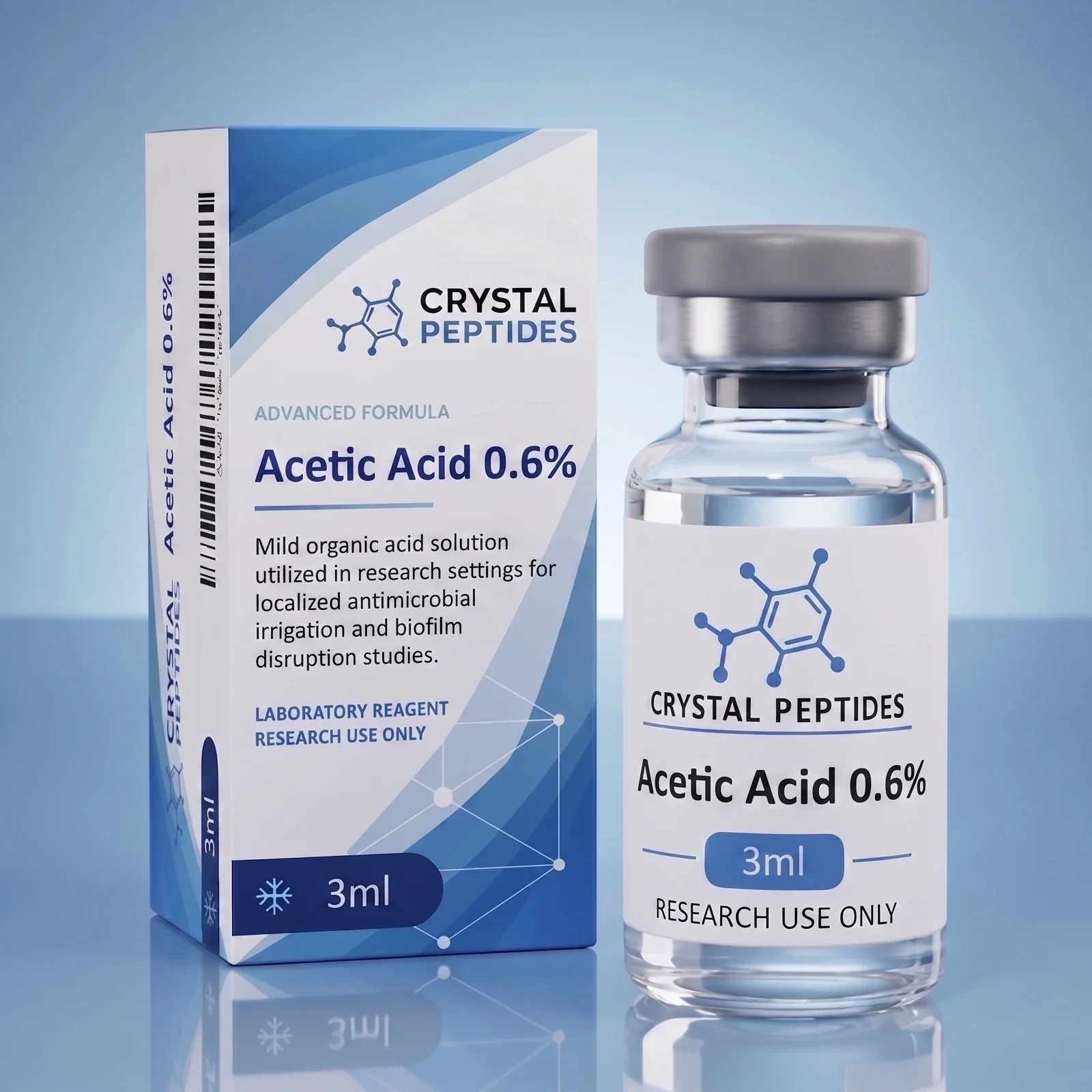
Acetic Acid 0.6%
3ml
❄️Lyophilized powder (not reconstituted)
Total: 4.29 GBP
Discount per Quantity
| Quantity | Discount | Price per Unit |
|---|---|---|
| 5 - 10 | 10% | 3.86 GBP |
| 11 - 20 | 15% | 3.65 GBP |
| 21+ | 20% | 3.43 GBP |
Rigorous third-party testing
Every batch of our research chemicals and peptides undergoes independent third-party laboratory testing for purity and identity.
Total: 4.29 GBP
Acetic Acid 0.6% Mixing Water is an acidified aqueous diluent for laboratory protocols in which the documented solubility or stability of a specific material requires a mildly acidic medium. The stated 0.6% concentration describes the catalogue preparation; the concentration basis, measured pH, fill volume and microbiological specifications must be confirmed on the product label and matching batch documentation.
Product characteristics
| Material type | Acidified aqueous laboratory diluent |
| Nominal concentration | 0.6% acetic acid; verify the concentration basis in the batch specification |
| Appearance | Clear, colourless liquid when it meets specification |
| Compatibility | Material- and formulation-specific; not interchangeable with sterile water or bacteriostatic water unless the applicable protocol explicitly permits it |
| Physical form | Catalogue vial; use the labelled fill volume and batch record as authoritative |
Selection and compatibility
A mildly acidic diluent can be useful when a validated method identifies poor aqueous solubility or instability at neutral pH. Compatibility cannot be inferred from a peptide family name: salt form, concentration, target pH, container and analytical method can all change the result. Use only a documented procedure for the exact material being studied.
Quality and handling
A concentration claim alone does not establish sterility, endotoxin level, preservative content or suitability for a particular application. Check the matching CoA, SDS and label for the available tests and handling conditions. Use only if the container is intact and the liquid matches the documented appearance.
Keep the vial closed, correctly identified and protected from contamination. Follow the labelled storage conditions and the laboratory's approved chemical-handling and waste-disposal procedures.
Frequently Asked Questions
Is 0.6% acetic acid suitable for every peptide?
No. Diluents are not universally interchangeable. Use it only when the exact material specification or validated protocol calls for an acidified medium.
Does “mixing water” automatically mean sterile?
No. Sterility and endotoxin status are separate quality attributes and should be accepted only when they are explicitly supported by the matching batch documentation.
Regulatory notice
This catalogue preparation is supplied for qualified laboratory work. It is not presented as a medicine or as instructions for administration to humans or animals.
Used solely for in vitro experiments and cannot be:
- Used in clinical trials involving humans
- Administered to humans as part of an experiment or investigation
- Supplied to another party for human investigational use.