Epithalon and Telomerase: What Cell Experiments Actually Show
A four-amino-acid peptide, not a pineal extract
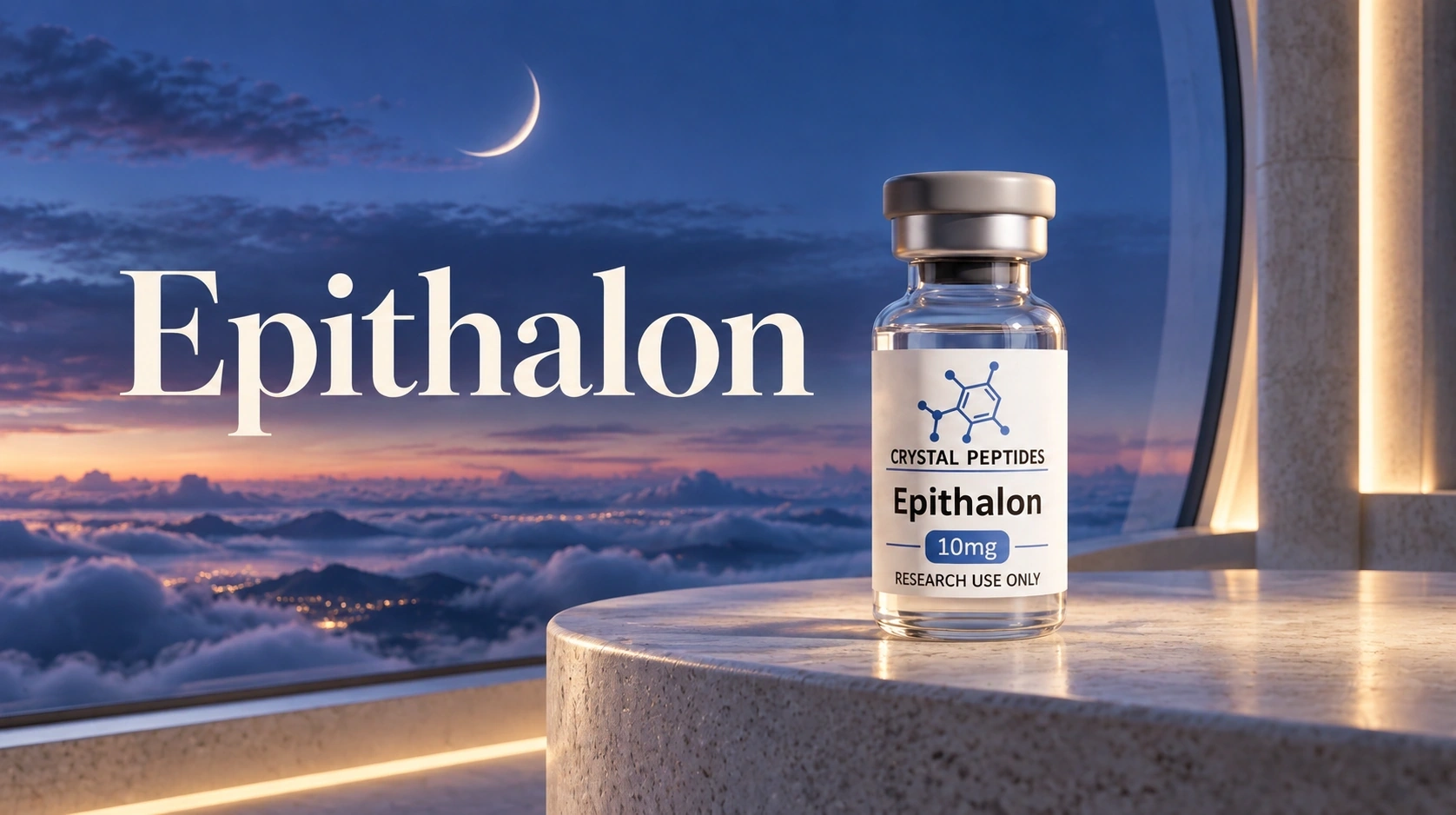
Epithalon, also written Epitalon or Epithalone, is a synthetic tetrapeptide with the sequence alanine–glutamate–aspartate–glycine, abbreviated Ala-Glu-Asp-Gly. It is distinct from epithalamin, a pineal-derived peptide extract associated with the same research tradition. A defined synthetic molecule and a biological extract are not interchangeable materials, so findings attributed to one should not automatically be assigned to the other.
Epithalon's connection to ageing research rests partly on experiments involving telomerase and telomeres. Understanding those experiments requires separating three things: an enzyme's activity, the condition of a cell's chromosomes and the health of an entire person.
What telomerase can—and cannot—tell us
Telomeres are repetitive DNA sequences and associated proteins at chromosome ends. They help distinguish natural chromosome ends from broken DNA. Telomeres often shorten as cells divide, although their behaviour also depends on cell type, stress and maintenance mechanisms.
When telomeres become critically dysfunctional, they can contribute to signals that stop cell division. This is one route to cellular senescence, not a complete explanation of ageing. Cells can become senescent for other reasons, and tissue function depends on much more than telomere length.
Telomerase is an enzyme complex that can add telomeric DNA repeats. Its activity is usually low or undetectable in many differentiated human cells, while some stem cells and many cancers maintain telomeres through telomerase. Consequently, a rise in telomerase activity is a mechanistic observation—not, by itself, a favourable clinical outcome.
The foundational fibroblast experiment
In a 2003 study, researchers investigated Epithalon in cultured human fetal fibroblasts that initially lacked detectable telomerase activity. They reported induction of telomerase activity and telomere elongation following exposure.
Fibroblasts are connective-tissue cells. Studying them in culture lets researchers examine cellular responses under controlled conditions, without the many interacting processes present in a whole organism. Here, the result supports a specific proposition: Epithalon exposure was associated with changes in telomere-maintenance biology in that experimental model.
It does not establish that the same response occurs in adult human tissues after administration. Nor did the experiment measure sleep, physical function, age-related disease or human survival. Even sustained cell division would be a property of the cultured cells, not proof that a person lives longer.
Newer work adds complexity
A 2025 investigation examined normal IBR.3 and HMEC cultures alongside cancer-derived 21NT and BT474 cultures, assessing telomere-related endpoints, hTERT and alternative lengthening of telomeres, or ALT. hTERT is the catalytic protein component of telomerase; ALT is a different route by which cells can maintain telomeres.
Including both normal and cancer-derived cells matters because telomere maintenance has different implications across biological settings. Such experiments should not be compressed into the claim that longer telomeres always mean healthier cells. The paper also has a published correction replacing incorrect Figures 1–3. This was a correction, not a retraction, and the corrected figures belong with any interpretation of the study.
The missing bridge to longevity
These studies make Epithalon a subject of cellular research. They do not validate human lifespan extension, clinical rejuvenation or a particular delivery formulation. Moving from a culture finding to a health claim would require evidence of relevant tissue exposure, reproducible biological effects and meaningful human outcomes.
The useful conclusion is therefore specific: Epithalon has been investigated for effects on telomere-maintenance mechanisms in cells. Whether those effects translate into a net health benefit in people remains a separate, unanswered question in the evidence discussed here.
Explore the Products from This Article
All products are >99% purity, manufactured in a certified EU laboratory, with accompanying lab analysis.
Research Disclaimer
This article is for informational and research purposes only. The content is not intended as medical advice, diagnosis, or treatment recommendation.