
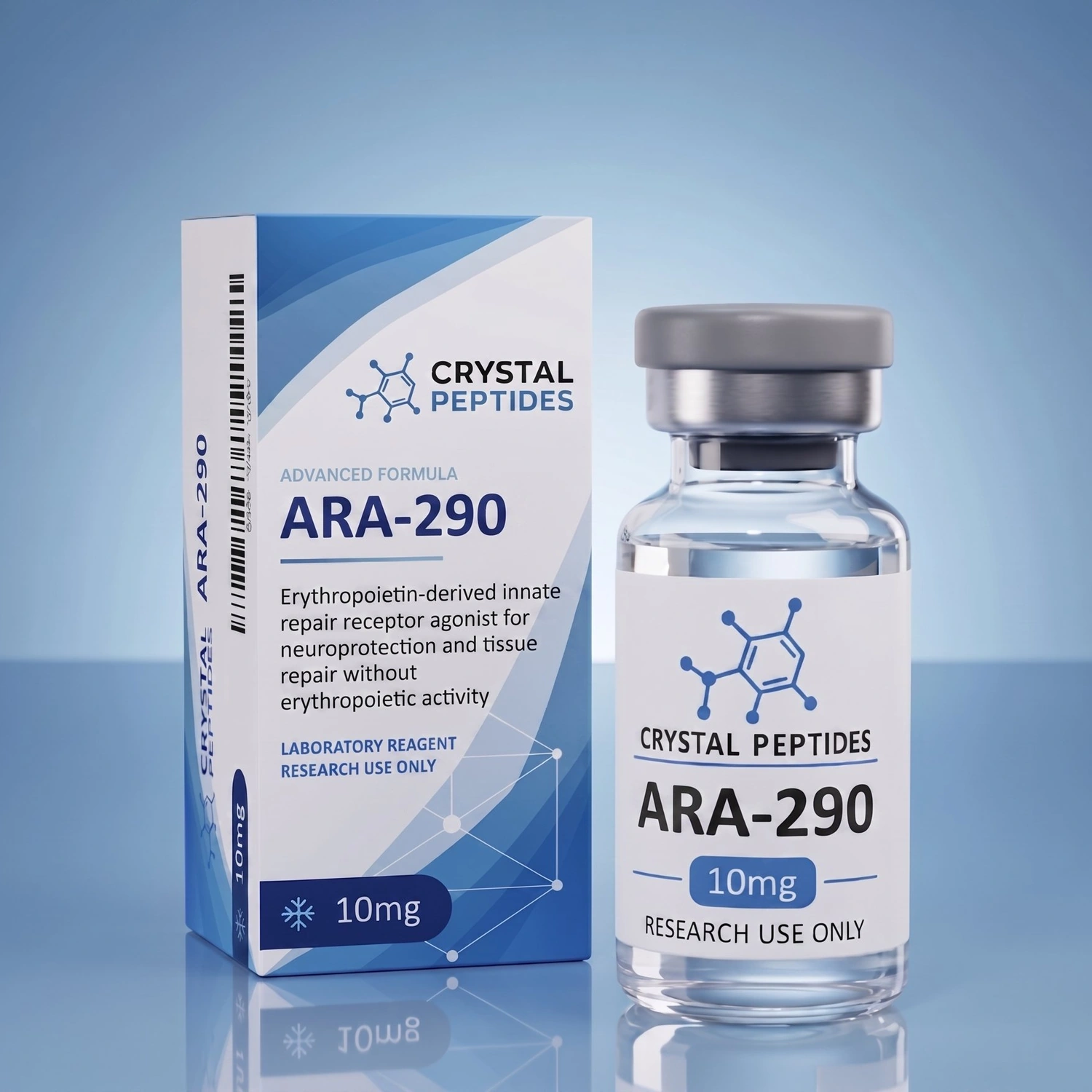
ARA 290 (10mg)
10mg
❄️Lyophilized powder (not reconstituted)
Total: 37.85 GBP
Discount per Quantity
| Quantity | Discount | Price per Unit |
|---|---|---|
| 5 - 10 | 10% | 34.07 GBP |
| 11 - 20 | 15% | 32.17 GBP |
| 21+ | 20% | 30.28 GBP |
Rigorous third-party testing
Every batch of our research chemicals and peptides undergoes independent third-party laboratory testing for purity and identity.
Total: 37.85 GBP
What Is ARA 290?
ARA 290, also known as cibinetide or pyroglutamate helix B surface peptide (pHBSP), is an 11-amino-acid peptide derived from the helix B region of erythropoietin (EPO). Unlike EPO, ARA 290 was designed to investigate the tissue-protective signalling associated with EPO without reproducing its primary erythropoietic activity. Research has focused on its interactions with the EPO/CD131 receptor complex and downstream pathways involved in cellular protection, inflammation, and tissue responses.
Researchers in Europe can buy ARA 290 as a high-purity research compound tested by independent third-party laboratories (Janoshik). Every new product batch is independently tested, with a batch-specific Certificate of Analysis supplied to document reported results for parameters such as peptide identity and purity, together with other applicable quality attributes. This product is sold for research use only and is not approved for human or veterinary use.
What’s Included
ARA 290 is supplied as a lyophilised powder in a sealed glass vial. The material is typically white to off-white in appearance.
A Certificate of Analysis (CoA) is available for every product lot following third-party testing by independent laboratories. Depending on the laboratory and the product being tested, the CoA may include analytical results such as:
Identity testing: Confirms that the material corresponds to ARA 290 (cibinetide) and helps distinguish it from unrelated peptides.
HPLC purity: Measures the proportion of the principal ARA 290 component relative to detectable chromatographic impurities.
Mass spectrometry (MS): Provides molecular-mass data to support peptide identity and structural characterisation.
Peptide content: Helps establish the amount of ARA 290 present in the tested material.
Related peptide impurities: Where reported, identifies or quantifies truncated sequences, synthesis-related impurities or other peptide variants.
Endotoxin testing: Where performed, assesses bacterial endotoxin levels, which can be relevant to laboratory experiments involving sensitive biological systems.
Sterility testing: Where applicable, evaluates the material for detectable microbial contamination.
Residual solvents or other process-related impurities: Where applicable, helps assess contaminants originating from peptide synthesis or purification.
The CoA should be used as the definitive source for the analytical results and specifications of the ARA 290 lot supplied. Testing parameters can vary according to the product and independent laboratory performing the analysis.
Please note that reconstitution solution is not included with the product. If required for your laboratory work, you can buy BAC Water 10ml from Crystal Peptides and add it to your order separately.
Technical Specifications
Specification | ARA 290 |
Product name | ARA 290 10mg |
Alternative names | ARA-290; cibinetide; pHBSP; pyroglutamate helix B surface peptide |
Peptide class | EPO-derived synthetic peptide |
Peptide length | 11 amino acids |
Sequence | Pyr-Glu-Gln-Leu-Glu-Arg-Ala-Leu-Asn-Ser-Ser |
Molecular formula | C51H84N16O21 |
Molecular weight | 1,257.3 g/mol* |
CAS number | 1208243-50-8 |
PubChem CID | 91810664 |
Purity | Please check current COA |
Appearance | White to off-white lyophilised powder |
Quantity | 10mg |
Intended use | Laboratory research only. Not for human or veterinary use. |
*The molecular formula and molecular weight shown correspond to the parent cibinetide structure. There are also salt forms, including acetate and TFA forms, which have different molecular weights and compositions. Please confirm the exact product details from the COA.
ARA 290 Mechanism of Action
ARA 290, also known as cibinetide or pyroglutamate helix B surface peptide (pHBSP), is a synthetic 11-amino-acid peptide derived from the helix B region of erythropoietin (EPO). It was developed from structural research into EPO's non-erythropoietic signalling and is studied as a model for investigating tissue-protective and repair-related pathways without reproducing EPO's classical erythropoietic activity. [1]
Research has investigated ARA 290 in relation to the receptor system commonly described as the innate repair receptor (IRR). This receptor complex is associated with the erythropoietin receptor (EPOR) and the β-common receptor (CD131), and differs functionally from the classical EPO receptor homodimer responsible for erythropoietic signalling. [2]
Interaction with the Innate Repair Receptor
ARA 290 was designed to reproduce structural features of the EPO helix B surface involved in non-erythropoietic signalling. Research suggests that the peptide interacts with the EPOR/CD131 receptor complex, initiating signalling pathways distinct from those associated with EPO-mediated red blood cell production. [2]
This distinction is central to ARA 290 research. Whereas EPO has well-established erythropoietic activity through the classical EPOR homodimer, ARA 290 has been investigated specifically as a tool for studying the alternative receptor system and its downstream cellular responses.
Downstream Signalling
Studies of ARA 290 have examined signalling pathways associated with cellular survival, inflammatory regulation, oxidative stress and tissue responses. Depending on the experimental system, research has investigated pathways involving intracellular kinase signalling, transcriptional regulation and interactions between neural, vascular and immune processes. [1][3]
The precise downstream effects can vary according to cell type and experimental conditions, so ARA 290 should not be understood as activating a single universal pathway. Its research value lies in examining how EPO-derived signalling through the EPOR/CD131 system influences cellular and tissue responses.
ARA 290 and EPO
Although ARA 290 is derived from the structure of EPO, it is not simply a shorter form of the hormone. It was specifically designed around a surface region of EPO's helix B to investigate non-erythropoietic signalling.
This distinction makes ARA 290 useful in comparative research examining EPO versus EPO-derived peptides, particularly where researchers want to investigate the biological functions associated with EPO's tissue-protective signalling separately from its classical role in erythropoiesis.
Research Applications & Scientific Background
ARA 290 has been investigated across several areas of experimental and translational research, particularly where researchers are studying the relationship between inflammation, tissue injury, neural signalling and repair. Its development as an EPO-derived peptide has led to research spanning molecular biology, neuroscience, immunology, vascular biology and peripheral nerve research.
Peripheral Nerve and Neural Research
ARA 290 has been studied extensively in experimental models of peripheral nerve injury and neuropathy. Research has examined its interaction with inflammatory and repair processes following nerve injury, including effects on Schwann cells, spinal microglia and other components of the neuroimmune response. [1][2]
More recent experimental work has investigated ARA 290 in relation to the NLRP3 inflammasome, NF-κB signalling and reactive oxygen species (ROS) following sciatic nerve injury, providing further insight into potential cellular mechanisms involved in EPO-derived peptide signalling. [4]
Neuroinflammation and Immune Signalling
The interaction between the nervous and immune systems is another important area of ARA 290 research. Experimental studies have investigated inflammatory-cell activity, cytokine signalling and immune responses in models of peripheral nerve inflammation and autoimmune neuritis. [5]
These studies provide a research framework for examining how activation of the EPOR/CD131 receptor system may influence inflammatory signalling and cellular responses under conditions of tissue stress or injury.
Tissue Protection and Repair Research
ARA 290 was developed from research into the non-erythropoietic, tissue-protective signalling associated with EPO. Researchers have therefore investigated the peptide in experimental models involving tissue injury, cellular stress and repair.
Research in this area includes investigation of cellular survival pathways, inflammatory regulation, oxidative stress and processes associated with tissue regeneration. [1][4] The proposed involvement of the innate repair receptor makes ARA 290 a useful research tool for studying these pathways independently of classical erythropoietic EPO signalling.
Receptor and Molecular Signalling Research
ARA 290 is also relevant to receptor pharmacology and molecular biology research. Studies have examined the EPOR/CD131 receptor complex, often referred to as the innate repair receptor (IRR), and the downstream signalling associated with its activation.
This makes ARA 290 useful in comparative experiments examining EPO-derived signalling, receptor activation, inflammatory pathways and the distinction between erythropoietic and non-erythropoietic EPO responses.
In summary, ARA 290 provides a defined peptide model for investigating EPO-derived non-erythropoietic signalling, EPOR/CD131 biology, neuroimmune interactions, inflammation and tissue-repair mechanisms.
ARA 290 vs. BPC-157 vs. TB-500 Comparison
ARA 290, BPC-157 and TB-500 are all encountered in research concerning tissue responses, inflammation, cellular protection and repair, but they represent very different experimental compounds. Their sequences, molecular origins, proposed targets and evidence bases differ, making a direct comparison useful when selecting a peptide for a particular research question.
Property | ARA 290 | ||
Molecular origin | Synthetic peptide derived from the helix B region of EPO | Synthetic 15-amino-acid peptide | Thymosin β4-derived peptide |
Peptide length | 11 amino acids | 15 amino acids | Fragment derived from thymosin β4 |
Primary molecular target | EPOR/CD131 receptor complex | Multiple proposed molecular targets | Primarily associated with thymosin β4-related pathways |
Key signalling focus | Tissue-protective and anti-inflammatory signalling | Multiple proposed cellular signalling pathways | Actin-associated and cell-migration pathways |
Cellular processes studied | Neuroprotection, inflammatory responses and tissue protection | Cell survival, angiogenesis, inflammation and tissue responses | Actin dynamics, cell migration and cytoskeletal organisation |
Main research fields | Neurobiology, neuroimmune signalling and tissue-protection research | Gastrointestinal, vascular, connective-tissue and injury research | Cell biology, cytoskeletal research and tissue-repair studies |
Relationship to endogenous molecules | Synthetic EPO-derived peptide | Synthetic peptide with no established endogenous BPC-157 equivalent | Derived from the sequence of endogenous thymosin β4 |
Intended research use | Investigating EPO-derived non-erythropoietic signalling | Investigating cellular and tissue-response mechanisms | Investigating actin, migration and tissue-response mechanisms |
Research note: These peptides should not be treated as interchangeable research materials. ARA 290 is principally investigated in relation to EPO-derived, non-erythropoietic signalling and the EPOR/CD131 receptor complex, whereas BPC-157 and TB-500 have different molecular origins and research targets. The appropriate compound depends on the specific pathway, model system and experimental endpoint being investigated.
Storage & Laboratory Handling
ARA 290 is supplied as a lyophilised powder in a sealed vial. Maintaining appropriate storage and handling conditions is important for preserving the material's analytical integrity during laboratory research.
Keep the vial sealed and protected from unnecessary exposure to moisture.
Store ARA 290 according to the temperature and handling conditions specified in the applicable product documentation or batch-specific Certificate of Analysis.
Minimise unnecessary exposure to heat, light and repeated temperature fluctuations.
Once prepared for an experiment, handling and storage conditions should be determined according to the requirements of the specific research protocol and the stability of the resulting preparation.
Avoid repeated freeze-thaw cycles where applicable, as temperature changes and handling can affect peptide stability.
Because peptide stability can vary with sequence, formulation, concentration, pH, temperature and other environmental factors, generic storage recommendations should not be treated as a substitute for the applicable product documentation.
When you buy ARA 290, the batch-specific documentation should take precedence where it provides storage or handling instructions for the material supplied.
Certificate of Analysis & Quality Assurance
For research peptides, a Certificate of Analysis (COA) provides an important link between the material described on a product page and the specific batch supplied. ARA 290 is a structurally defined peptide, so confirming the identity, termini and material form is particularly important when interpreting registry information or comparing analytical results.
Researchers who buy ARA 290 from Crystal Peptides can be confident that every batch undergoes independent third-party testing for purity and identity. Additional analytical testing may also be available for parameters such as peptide amount, sterility, endotoxin and heavy metals, allowing researchers to assess the material supplied rather than relying solely on general product specifications.
What to Check on an ARA 290 COA
When reviewing the documentation for an ARA 290 batch, researchers should distinguish between different analytical measurements rather than treating a single purity figure as a complete quality assessment.
Identity: Confirms that the material analysed corresponds to the intended peptide.
Chromatographic purity: Reports the proportion of the detected material represented by the principal chromatographic peak under the stated analytical method.
Peptide or analyte content: Provides information about the amount of material measured by the applicable analytical method.
Intact mass or structural confirmation: Where reported, can provide additional evidence supporting the expected molecular identity and termini.
Endotoxin testing: Provides a separate measurement of endotoxin levels and should not be inferred from chromatographic purity.
Sterility testing: Where performed, provides separate microbiological information about the tested sample.
Elemental or heavy-metal analysis: Where available, addresses a different category of potential impurities.
Verify the Exact Batch
The report should correspond to the same product, quantity and batch or lot being supplied. A COA for another vial size, lot number or related peptide should not automatically be treated as evidence for the material being purchased.
This is particularly relevant for ARA 290 because its registry identity depends on details such as the peptide sequence, N-terminal pyroglutamate, C-terminal group and salt or counter-ion.
Disclaimer: Research Use Only
ARA 290 is supplied exclusively for laboratory research and development. It is not intended for human or veterinary use, clinical diagnosis, treatment, consumption, or any other application outside controlled research environments. Researchers are responsible for assessing the material’s suitability for their specific experimental requirements and for following appropriate laboratory handling, storage, safety, and disposal procedures.
Frequently Asked Questions
What is ARA 290 (cibinetide)?
ARA 290, also known as cibinetide or pyroglutamate helix B surface peptide (pHBSP), is a synthetic 11-amino-acid peptide derived from the helix B region of erythropoietin (EPO). It is primarily studied as a research tool for investigating non-erythropoietic EPO signalling and the EPOR/CD131 receptor system.
What is ARA 290 studied for?
Research has investigated ARA 290 in areas including peripheral nerve biology, neuroinflammation, tissue-protection mechanisms, vascular biology and cellular responses to injury or stress. Studies have also examined its effects on inflammatory and intracellular signalling pathways in experimental models.
How does ARA 290 work?
ARA 290 was designed to interact with the receptor system commonly described as the innate repair receptor, involving EPOR and the β-common receptor (CD131). Research has investigated the downstream cellular signalling associated with this receptor system, including pathways related to inflammation, cellular stress and tissue responses.
Is ARA 290 the same as cibinetide?
Yes. Cibinetide is the name used for ARA 290 in scientific and regulatory literature. ARA-290, cibinetide and pHBSP are names associated with the same EPO-derived research peptide, but the exact molecular form should always be verified against the applicable batch documentation.
What is the difference between ARA 290 and EPO?
ARA 290 is a small peptide derived from structural features of EPO, while EPO is a much larger glycoprotein hormone. ARA 290 was designed to investigate non-erythropoietic EPO signalling rather than the classical EPO pathway associated with red blood cell production.
How is ARA 290 different from BPC-157?
ARA 290 is derived from EPO and is studied in relation to the EPOR/CD131 signalling system, whereas BPC-157 is a separate 15-amino-acid peptide investigated across different experimental models and proposed signalling pathways. They should therefore be treated as distinct research compounds rather than interchangeable materials.
How is ARA 290 quality and purity tested?
Researchers in the EU can buy ARA 290 from Crystal Peptides evaluated using several analytical parameters, including peptide identity and chromatographic purity. Depending on the batch and testing programme, additional analyses may include peptide content, mass confirmation, endotoxin, sterility and elemental or heavy-metal testing. A batch-specific Certificate of Analysis is available to provide more detailed information for the product.
Where can I buy ARA 290 for research in Europe?
Researchers looking for ARA 290 in Europe can buy ARA 290 from Crystal Peptides as a laboratory research material. The ARA 290 10mg product is a high-purity product supplied in lyophilised form. It is intended exclusively for laboratory research use only; it is not intended or approved for human or veterinary use.
Scientific References
1. Brines, M., Dunne, A. N., van Velzen, M., Proto, P. L., Ostenson, C. G., Kirk, R. I., Petropoulos, I. N., Javed, S., Malik, R. A., Cerami, A., & Dahan, A. (2015). ARA 290, a nonerythropoietic peptide engineered from erythropoietin, improves metabolic control and neuropathic symptoms in patients with type 2 diabetes. Molecular Medicine, 20(1), 658–666. PubMed | PMC full text
2. Dahan, A., Brines, M., Niesters, M., Cerami, A., & van Velzen, M. (2016). Targeting the innate repair receptor to treat neuropathy. Pain Reports, 1(1), e566. PubMed | PMC full text
3. Motafeghi, F., Fakhri, B. M. S., & Ghassemi Barghi, N. (2025). Mechanisms of ARA290 in counteracting cadmium-triggered neurotoxicity in PC12 cells. Toxicology Research, 14(1), tfaf023. PubMed | PMC full text
4. Liu, G., Li, W., Jiang, S., Liang, J., Song, M., Wang, L., Wang, X., Liu, X., Yang, Z., Zhang, L., Yang, Y., & Zhang, B. (2025). ARA290, an alternative of erythropoietin, inhibits activation of NLRP3 inflammasome in Schwann cells after sciatic nerve injury. European Journal of Pharmacology, 997, 177610. PubMed
5. Swartjes, M., van Velzen, M., Niesters, M., Aarts, L., Brines, M., Dunne, A., Cerami, A., & Dahan, A. (2014). ARA 290, a peptide derived from the tertiary structure of erythropoietin, produces long-term relief of neuropathic pain coupled with suppression of the spinal microglia response. Molecular Pain, 10, 13. PubMed | PMC full text
Used solely for in vitro experiments and cannot be:
- Used in clinical trials involving humans
- Administered to humans as part of an experiment or investigation
- Supplied to another party for human investigational use.