
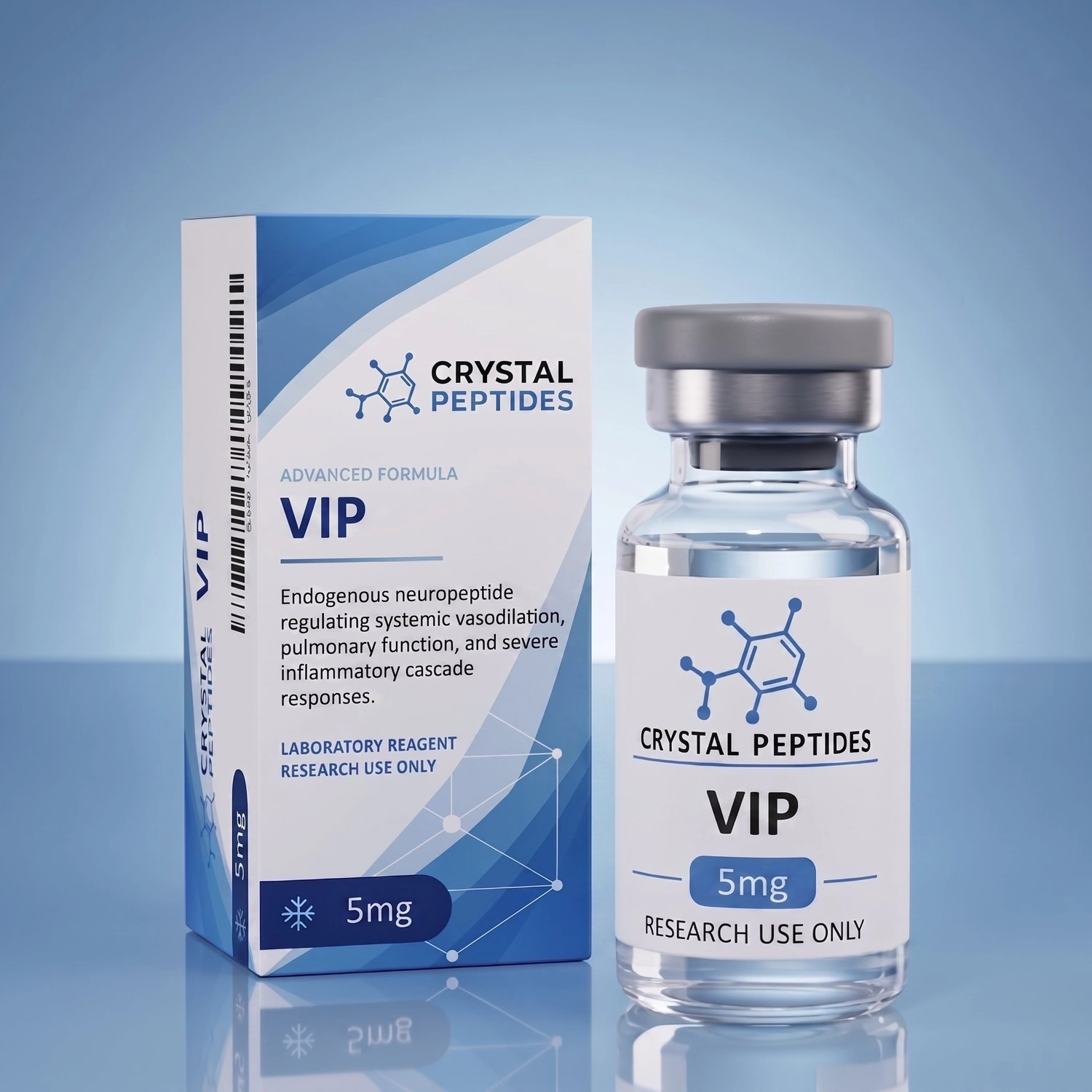
VIP (5mg)
5mg
❄️Lyophilized powder (not reconstituted)
Total: 36.11 GBP
Discount per Quantity
| Quantity | Discount | Price per Unit |
|---|---|---|
| 5 - 10 | 10% | 32.49 GBP |
| 11 - 20 | 15% | 30.69 GBP |
| 21+ | 20% | 28.88 GBP |
Rigorous third-party testing
Every batch of our research chemicals and peptides undergoes independent third-party laboratory testing for purity and identity.
Total: 36.11 GBP
What Is VIP?
Vasoactive intestinal peptide (VIP) is a synthetic 28-amino-acid peptide corresponding to the naturally occurring neuropeptide found in the nervous and gastrointestinal systems of vertebrates. VIP is a potent vasodilator involved in the regulation of vascular smooth muscle tone and plays important roles in gastrointestinal secretion and motility, water and electrolyte transport, as well as endocrine signalling and immune regulation.
Researchers study VIP primarily through its interactions with the VPAC1 and VPAC2 receptors and the intracellular signalling pathways associated with these class B G protein-coupled receptors. Research applications include neurobiology, gastrointestinal physiology, vascular biology, neuroendocrine signalling and immunology.
Buy high-purity VIP peptide 5mg from Crystal Peptides, with each product lot third-party tested by independent analytical laboratories for parameters such as identity, purity, endotoxins and heavy metals. A Certificate of Analysis is available for every batch to verify the product’s quality and purity. This product is sold for research use only and is not approved for human or veterinary use.
What’s Included
VIP is supplied as a lyophilized powder in a sealed glass vial. The material is typically white to off-white in appearance.
Please note that reconstitution solution is not included with the product. If required for your laboratory work, BAC Water is available from Crystal Peptides and can be added to your order separately.
A Certificate of Analysis (CoA) is also available for the most recent batch tested. Depending on the laboratory and the product being tested, the CoA may include analytical results such as:
- Identity testing: Confirms that the material corresponds to vasoactive intestinal peptide (VIP).
- HPLC purity: Measures the proportion of the principal VIP component relative to detectable chromatographic impurities.
- Mass spectrometry (MS): Provides molecular-mass data to support peptide identity and characterisation.
- Peptide content: Helps establish the amount of VIP present in the tested material.
- Related peptide impurities: Where reported, identifies or quantifies truncated sequences, synthesis-related impurities or other peptide variants.
- Endotoxin testing: Where performed, assesses bacterial endotoxin levels, which can be relevant to laboratory experiments involving sensitive biological systems.
- Sterility testing: Where applicable, evaluates the material for detectable microbial contamination.
- Residual solvents or other process-related impurities: Where applicable, helps assess contaminants originating from peptide synthesis or purification.
The batch-specific CoA should be used as the definitive source for the analytical results and specifications of the VIP lot supplied. Note that testing parameters can vary according to the product and independent laboratory performing the analysis.
Technical Specifications
Specification | Details |
Product name | VIP 5mg |
Alternative names | Vasoactive intestinal peptide; vasoactive intestinal polypeptide, VIP peptide |
Peptide class | Neuropeptide / signalling peptide |
Peptide length | 28 amino acids |
Sequence | HSDAVFTDNYTRLRKQMAVKKYLNSILN |
Molecular formula | C147H237N43O43S |
Molecular weight | 3326.8 g/mol |
CAS number | 37221-79-7 |
PubChem CID | 53314964 |
Purity | Please confirm by checking current product COA |
Appearance | White to off-white lyophilised powder |
Intended use | Laboratory research only. Not for human or veterinary use. |
Mechanism of Action
VIP produces its biological effects primarily by binding to the VPAC1 and VPAC2 receptors, which are members of the class B G protein-coupled receptor (GPCR) family. [1] Activation of these receptors initiates intracellular signalling pathways, particularly those involving cyclic adenosine monophosphate (cAMP). Research into these pathways has helped characterise how VIP signalling influences cellular activity across several physiological systems.
VPAC1 and VPAC2 receptor activation
VIP binds to both VPAC1 and VPAC2 receptors with high affinity. These receptors are expressed in a variety of tissues, including the gastrointestinal tract, nervous system, and immune system. Their distribution contributes to the broad range of biological processes investigated in VIP research.
cAMP signalling
Following VIP binding, VPAC1 and VPAC2 primarily couple to Gs proteins, stimulating adenylate cyclase and increasing intracellular cAMP. This second-messenger pathway can activate downstream signalling mechanisms, including protein kinase A (PKA), providing a well-characterised model for studying peptide-mediated cellular signalling. [1]
VIP receptor selectivity
VIP shares its VPAC1 and VPAC2 receptors with the closely related peptide PACAP, while PACAP also activates the PAC1 receptor. This difference in receptor preference makes VIP useful for comparative research examining ligand-receptor interactions, receptor selectivity, and downstream signalling pathways.
Research Applications & Scientific Background
VIP has been investigated across a broad range of biological systems since its discovery. Its widespread distribution and activity through VPAC1 and VPAC2 receptors have made it a useful research model for studying neuropeptide signalling, gastrointestinal physiology, endocrine communication, vascular biology, and neuroimmune interactions.
Gastrointestinal research
VIP is extensively studied within gastrointestinal research, particularly for its involvement in enteric nervous system signalling. Research has examined VIP-containing neurons and their interactions with intestinal smooth muscle, epithelial cells, and secretory processes. VIP signalling has also been investigated in relation to gastrointestinal motility and the regulation of intestinal function. [2]
Neurobiology and neurotransmission
VIP functions as a neuropeptide and neurotransmitter in both the central and peripheral nervous systems. Researchers study VIP-containing neuronal pathways, receptor distribution, and the role of VPAC signalling in communication between neurons and other cell types. VIP has also been investigated in relation to circadian signalling and neural regulation.
Receptor pharmacology
VIP is an established research model for studying peptide-receptor interactions. Investigations have examined VPAC1 and VPAC2 receptor activation, ligand binding, receptor selectivity, G protein coupling, and downstream intracellular signalling. Comparisons between VIP and related peptides such as PACAP are particularly useful for understanding how structurally related ligands interact with overlapping receptor systems.
Neuroendocrine research
VIP signalling has been investigated across several neuroendocrine pathways, reflecting the peptide's distribution throughout neural and endocrine tissues. Research has examined interactions between VIP signalling and hormone secretion, autonomic neurotransmission, and communication between the nervous and endocrine systems. [3]
Immune and inflammatory research
The relationship between VIP signalling and the immune system is another important area of investigation. Research has examined VIP and its receptors in immune cells and investigated their involvement in signalling pathways associated with cytokine production, immune-cell activity, and communication between the nervous and immune systems.
Vascular and smooth-muscle research
VIP was originally characterised in connection with vascular activity, and its effects on smooth muscle continue to be an important area of research. Researchers have investigated VIP receptor signalling in vascular and gastrointestinal smooth muscle, including the relationship between receptor activation, intracellular cAMP signalling, and changes in smooth-muscle activity.
VIP vs. PACAP vs. Ipamorelin Comparison
VIP is part of the broader family of peptide hormones and neuropeptides that interact with class B GPCRs, but these related peptides can differ substantially in receptor selectivity and biological activity. This VIP vs PACAP vs ipamorelin comparison helps distinguish closely related receptor ligands from peptides that act through a separate growth-hormone secretagogue system.
Property | VIP | PACAP | |
Peptide type | Neuropeptide | Neuropeptide | Synthetic growth hormone secretagogue |
Peptide length | 28 amino acids | 27 or 38 amino acids | 5 amino acids |
Primary receptor(s) | VPAC1, VPAC2 | PAC1, VPAC1, VPAC2 | GHS-R1a (ghrelin receptor) |
Receptor family | Class B GPCR | Class B GPCR | Class A GPCR |
Primary research focus | Neurobiology, gastrointestinal, vascular, endocrine and immune signalling | Neurobiology, neuroendocrine signalling and receptor pharmacology | Growth hormone secretion and secretagogue pharmacology |
Receptor overlap with VIP | — | VPAC1 and VPAC2 | None |
Principal signalling | Primarily cAMP/PKA through VPAC receptors | Primarily cAMP with additional context-dependent pathways | GHS-R signalling involving Gq/11 and intracellular calcium pathways |
Relationship to GH signalling | Not a primary GH secretagogue | Not a primary GH secretagogue | Directly studied as a GH secretagogue |
Note: PACAP = pituitary adenylate cyclase-activating polypeptide; GHS-R1a = growth hormone secretagogue receptor 1a.
VIP and PACAP have substantial sequence and receptor-pharmacology overlap: both activate VPAC1 and VPAC2, while PACAP additionally activates PAC1 with high affinity. Ipamorelin is pharmacologically distinct, acting through the growth hormone secretagogue receptor rather than the VPAC/PAC1 receptor system.
Storage & Laboratory Handling: VIP Peptide
VIP peptide is supplied as a lyophilised peptide in a sealed glass vial. To help maintain the integrity of the research material, store the unopened product according to the temperature and handling conditions specified on the product documentation.
When you buy VIP peptide, check the product documentation and applicable Certificate of Analysis for any batch-specific recommendations before preparing the material for laboratory use.
Additionally, follow all basic laboratory handling regulations as well as institutional guidelines, which may include:
- Keep the vial sealed until the material is required for laboratory use.
- Protect the lyophilised peptide from moisture, which can affect the stability of the dry material.
- Avoid unnecessary exposure to heat and direct light.
- Allow refrigerated or frozen material to reach an appropriate temperature before opening where necessary to minimise condensation inside the vial.
- Use appropriate laboratory-grade solvents and containers when preparing VIP for an experiment.
- Minimise unnecessary transfers of prepared solutions to reduce potential material loss.
- Avoid repeated freeze-thaw cycles where applicable, as repeated temperature changes can affect peptide stability.
- Follow established laboratory procedures for handling, storage and disposal of peptide research materials.
- Use the batch-specific documentation when more specific storage or handling information is provided.
VIP stability in solution can vary according to factors including concentration, pH, temperature, solvent and storage duration. Researchers should therefore establish appropriate conditions for their particular experimental system rather than assuming that a single stability period applies to every preparation.
Certificate of Analysis & Quality Assurance
For every batch of VIP peptide you buy from Crystal Peptides, you get a batch-specific Certificate of Analysis (COA) from an independent testing facility. The COA provides analytical results for the exact batch supplied, allowing researchers to verify the material rather than relying solely on a stated purity figure.
The applicable testing documentation may include:
- Compound identity: confirmation that the tested material corresponds to VIP
- HPLC purity: measurement of chromatographic purity and related impurities
- Endotoxin testing: analytical assessment of endotoxin levels
- Sterility testing: where included in the applicable batch testing
- Heavy-metal analysis: where included in the applicable testing panel
- Batch identification: documentation linking the analytical results to the specific product batch
Remember that a high purity percentage alone does not establish compound identity or provide information about other analytical parameters. Reviewing the complete COA will give you a more useful picture of the identity, purity, and quality characteristics of the material supplied.
Researchers should review the batch-specific COA made available on the product page as well as on the Lab Tests page to verify the reported analytical results before using the material in laboratory research.
Disclaimer: Research Use Only
This material is not intended for human or veterinary use, clinical diagnosis, treatment, or consumption, and researchers are responsible for determining whether the material is suitable for their specific experimental application. Crystal Peptides does not make any claim that research materials are suitable for any particular experimental protocol or application.
Frequently Asked Questions
What is VIP peptide?
VIP, or vasoactive intestinal peptide, is a 28-amino-acid neuropeptide belonging to the secretin family of signalling peptides. It has been extensively studied in relation to gastrointestinal physiology, neurobiology, endocrine signalling, vascular biology, and immune regulation. VIP primarily interacts with the VPAC1 and VPAC2 receptors.
What is VIP peptide used for in research?
VIP is used as a research model for investigating peptide-receptor pharmacology, intracellular signalling, gastrointestinal function, neurobiology, neuroendocrine communication, vascular signalling, and interactions between the nervous and immune systems. Research has also examined VIP signalling in relation to circadian biology and other physiological processes.
What receptors does VIP activate?
VIP primarily activates the VPAC1 and VPAC2 receptors, which are class B G protein-coupled receptors. Both receptors respond to VIP and PACAP with high affinity, while PAC1 is preferentially activated by PACAP. VPAC receptor activation is primarily associated with adenylate cyclase and cAMP signalling, although additional signalling pathways have also been identified.
What is the difference between VIP and PACAP?
VIP and PACAP (pituitary adenylate cyclase-activating polypeptide) are closely related neuropeptides that share the VPAC1 and VPAC2 receptors. PACAP additionally activates the PAC1 receptor with high affinity, whereas VIP has substantially lower affinity for PAC1. Their overlapping but distinct receptor profiles make them useful for comparative research into peptide-receptor interactions and signalling pathways.
How is VIP peptide quality tested?
Crystal Peptides supplies research-grade VIP tested by independent labs using analytical techniques such as high-performance liquid chromatography (HPLC) to evaluate purity, and mass spectrometry for molecular identity. Additional testing, such as endotoxin, sterility, or heavy-metal analysis, may also be conducted to provide further information about the characteristics of a particular batch. Researchers should review the applicable Certificate of Analysis for the exact testing performed and results for that batch.
Does Crystal Peptides provide a COA for VIP peptide?
Yes, Crystal Peptides provides a batch-specific Certificate of Analysis for every product lot. The COA may be found on the product page and the Lab Tests Page. It provides researchers with important analytical information for the product as per the most recent batch tested, allowing them to review reported compound identity, purity, endotoxin results, and other applicable testing before using the material in laboratory research.
Where can I buy VIP peptide for research in Europe?
Researchers looking to buy VIP peptide in Europe can find research-grade quality from Crystal Peptides. VIP 5mg is supplied as a high-purity compound in lyophilised form, with safe and secure shipping within a few days of making your order.
Scientific References
- Langer, I. (2012). Mechanisms involved in VPAC receptors activation and regulation: Lessons from pharmacological and mutagenesis studies. Frontiers in Endocrinology, 3, 129. https://doi.org/10.3389/fendo.2012.00129. PMID: 23115557; PMCID: PMC3483716.
- Baccari, M. C., Conti, D., Vannucchi, M. G., & Idrizaj, E. (2025). Contribution of vasoactive intestinal peptide to the depressant effects of glucagon-like peptide-2 on neurally induced contractile responses in mouse ileal preparations. International Journal of Molecular Sciences, 26(24), 11797. https://doi.org/10.3390/ijms262411797.
- Martínez, C., Juarranz, Y., Gutiérrez-Cañas, I., Carrión, M., Pérez-García, S., Villanueva-Romero, R., Castro, D., Lamana, A., Mellado, M., González-Álvaro, I., & Gomariz, R. P. (2019). A clinical approach for the use of VIP axis in inflammatory and autoimmune diseases. International Journal of Molecular Sciences, 21(1), 65. https://doi.org/10.3390/ijms21010065. PMID: 31861827; PMCID: PMC6982157.
Used solely for in vitro experiments and cannot be:
- Used in clinical trials involving humans
- Administered to humans as part of an experiment or investigation
- Supplied to another party for human investigational use.