
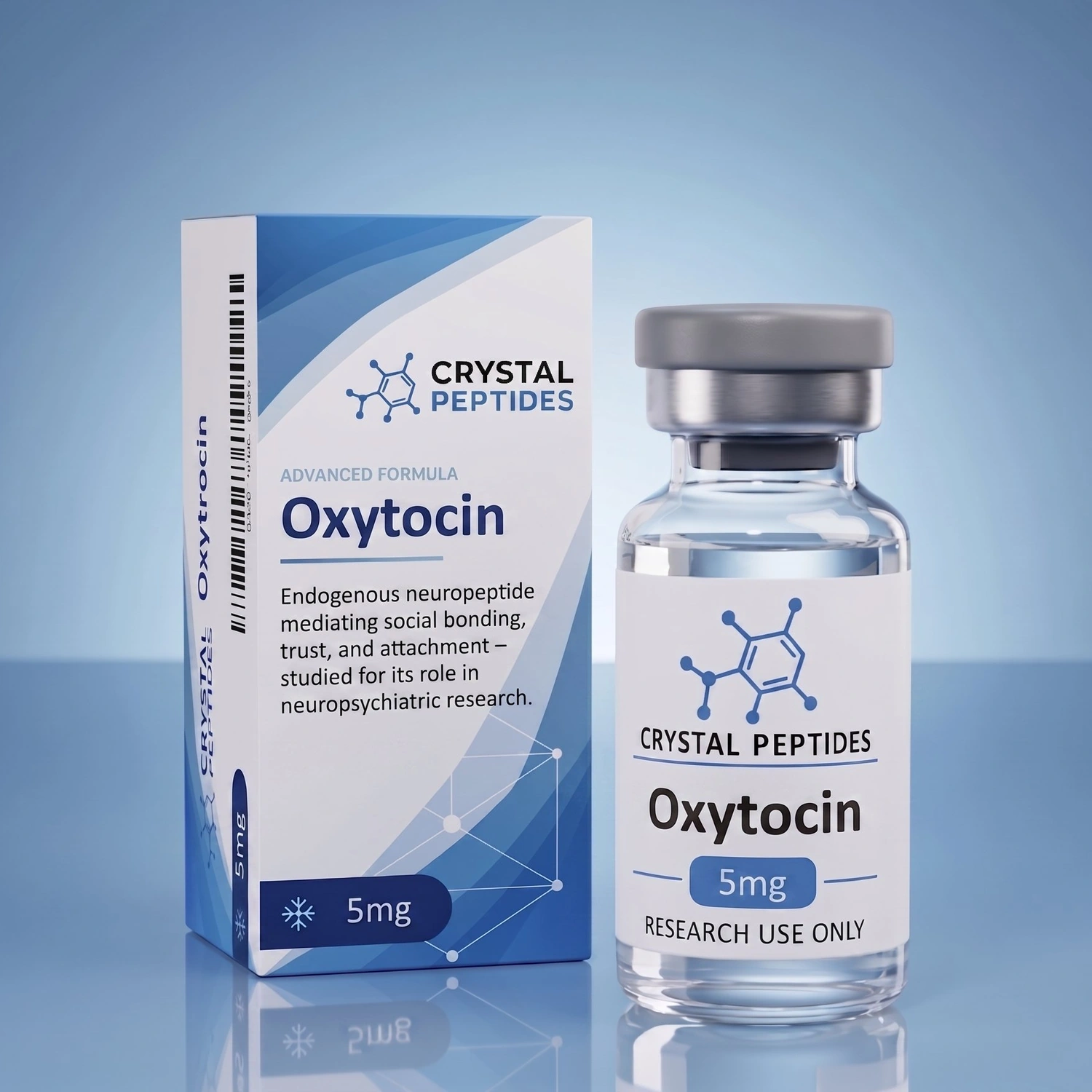
Oxytocin (5mg)
5mg
❄️Lyophilized powder (not reconstituted)
Total: 24.01 GBP
Discount per Quantity
| Quantity | Discount | Price per Unit |
|---|---|---|
| 5 - 10 | 10% | 21.61 GBP |
| 11 - 20 | 15% | 20.41 GBP |
| 21+ | 20% | 19.21 GBP |
Rigorous third-party testing
Every batch of our research chemicals and peptides undergoes independent third-party laboratory testing for purity and identity.
Total: 24.01 GBP
What Is Oxytocin?
Oxytocin peptide is a synthetic analogue of the naturally occurring oxytocin hormone, consisting of the same nine-amino-acid cyclic structure with a disulfide bridge between two cysteine residues. Oxytocin is extensively studied as a signalling molecule that acts primarily through the oxytocin receptor (OXTR), a G protein-coupled receptor, whose extensive research applications cut across neuroendocrine signalling, neuroscience, reproductive biology, receptor pharmacology, cellular signalling and behavioural research.
Buy oxytocin peptide from Crystal Peptides, a leading supplier in Europe known for strict third-party testing standards. Every new batch is independently tested by leading laboratories, such as Janoshik, and a Certificate of Analysis is available to verify identity, purity and sterility. Secure, reliable and discreet shipping is available throughout the EU.
This product is sold for research use only and is not for human or veterinary use.
What’s Included
Oxytocin is supplied as a lyophilized powder in a sealed glass vial. The material is typically white to off-white in appearance.
A Certificate of Analysis (CoA) is available for every product lot following analytical testing by independent laboratories. Depending on the laboratory and the product being tested, the CoA may include analytical results such as:
Identity testing: Confirms that the material corresponds to oxytocin and distinguishes it from unrelated peptides.
HPLC purity: Measures the proportion of the principal oxytocin component relative to detectable chromatographic impurities.
Mass spectrometry (MS): Provides molecular-mass data to support peptide identity and characterization.
Peptide content: Helps establish the amount of oxytocin present in the tested material.
Structural characterization (Disulfide-bond): Where performed, helps assess the integrity of oxytocin's characteristic cyclic structure and disulfide bridge.
Endotoxin testing: Where performed, assesses bacterial endotoxin levels, which can be relevant to laboratory experiments involving sensitive biological systems.
Sterility testing: Where applicable, evaluates the material for detectable microbial contamination.
Residual solvents or related impurities: Where applicable, helps identify and quantify specified process-related contaminants.
The batch-specific CoA should be used as the definitive source for the analytical results and specifications of the oxytocin lot supplied. Note that testing parameters can vary according to the product and independent laboratory performing the analysis.
Reconstitution solution is not included with the order. If required for your research work, buy BAC Water (10ml) from Crystal Peptides to add it to your order.
Technical Specifications
Specification | Oxytocin |
Product name | Oxytocin |
Alternative names | Oxytocin peptide; OXT, OT, Pitocin, Syntocinon, alpha-Hypophamine |
Peptide class | Neurohypophysial peptide hormone / cyclic nonapeptide |
Peptide length | 9 amino acids |
Sequence | CYIQNCPLG-NH₂ |
Structural feature | Disulfide bridge between Cys1 and Cys6 |
Molecular formula | C43H66N12O12S2 |
Molecular weight | 1007.2 g/mol |
CAS number | 50-56-6 |
PubChem CID | 439302 |
Purity | Please confirm by checking current product COA |
Appearance | White to off-white lyophilised powder |
Quantity | 5mg |
Intended use | Laboratory research only. Not for human or veterinary use. |
Oxytocin Mechanism of Action
Oxytocin peptide is a synthetic form of the naturally occurring oxytocin hormone. The endogenous hormone is a cyclic nonapeptide produced primarily by neurons in the hypothalamus and synthesised initially as part of a larger precursor molecule. Processing produces the mature nine-amino-acid peptide, which contains a disulfide bridge between its two cysteine residues. [1] The hormone is then released both into the circulation and within the central nervous systems, where it functions as a neuroendocrine and signalling molecule.
Although synthetic oxytocin peptide can reproduce the molecular structure of the endogenous hormone, the effects observed in laboratory research may vary depending on factors such as the experimental concentration, formulation, model system and biological context. Differences in these conditions can influence receptor activation and downstream signalling and may produce effects that do not necessarily reflect the physiological actions of endogenous oxytocin.
Therefore, in this context, oxytocin peptide is used as a defined research material to investigate the molecular and cellular mechanisms of the oxytocin system and should not be interpreted as directly reproducing its physiological effects in every experimental setting.
That said, research on the oxytocin system extends well beyond its established role in reproductive physiology. Oxytocin signalling has been investigated in neuroendocrinology, reproductive biology, neuroscience, behavioural research, smooth-muscle physiology, vascular biology and receptor pharmacology. Its diverse biological effects are mediated primarily through the oxytocin receptor (OXTR), a G protein-coupled receptor, although interactions with related signalling systems have also been investigated.
Oxytocin Receptor Activation
The oxytocin receptor (OXTR) is a class I G protein-coupled receptor (GPCR) expressed in a range of peripheral tissues and within the central nervous system. When oxytocin binds to OXTR, the receptor undergoes a conformational change that promotes interaction with intracellular G proteins.
The best-characterised signalling pathway involves Gαq/11 and phospholipase C (PLC). Activation of PLC promotes the breakdown of phosphatidylinositol 4,5-bisphosphate (PIP₂), generating the second messengers inositol trisphosphate (IP₃) and diacylglycerol (DAG). [2]
Calcium and Intracellular Signalling
The generation of IP₃ and DAG initiates the next stage of OXTR signalling. IP₃ promotes the release of calcium ions from intracellular stores, while DAG contributes to the activation of protein kinase C (PKC). The resulting changes in intracellular calcium can influence calcium-dependent enzymes, ion channels and other cellular processes, linking receptor activation to downstream cellular responses.
The signalling cascade is not limited to the Gαq/11–PLC pathway. Depending on the cell type and experimental conditions, OXTR signalling can also involve Gi/o proteins, MAP kinase pathways, Rho kinase and other downstream mechanisms. [2] This signalling diversity helps explain why activation of the same receptor can produce different cellular responses across different tissues and experimental systems.
Oxytocin and Vasopressin
Oxytocin is structurally related to arginine vasopressin, another neurohypophysial peptide. The two peptides share considerable sequence similarity and their receptors belong to the same broader GPCR family. [3] This relationship is important in receptor pharmacology research because oxytocin and vasopressin signalling systems can exhibit overlapping ligand-receptor interactions.
Comparative studies of oxytocin and vasopressin therefore provide useful models for investigating peptide-receptor selectivity, receptor activation and downstream signalling.
Research Applications & Scientific Background
Oxytocin is one of the most extensively studied neuropeptides in biological research. Its well-characterised receptor system and activity in both the central and peripheral nervous systems have made it a useful model for investigating neuroendocrine signalling, reproductive physiology, neural circuits, social behaviour and peptide-receptor pharmacology.
Neuroendocrine and Reproductive Research
Oxytocin research has a long history in reproductive biology. Studies investigate oxytocin release, oxytocin receptor expression and receptor signalling in tissues involved in parturition and lactation, including uterine and mammary tissues. [4]
The oxytocin receptor is particularly well studied in the myometrium, where receptor activation can increase intracellular calcium through PLC/IP₃-dependent signalling. This makes the oxytocin system an established model for investigating peptide-regulated smooth-muscle activity and calcium signalling.
Neuroscience and Neural Circuit Research
Within the central nervous system, oxytocin is studied as a neuromodulator involved in communication between hypothalamic neurons and other neural circuits. Research has examined oxytocin receptor distribution, neuronal signalling, synaptic plasticity and the regulation of neural responses to social and environmental stimuli. [5]
Modern experimental approaches have also enabled researchers to investigate oxytocin-producing neurons and oxytocin-responsive circuits at the cellular and circuit levels. These studies have expanded understanding of how neuropeptide signalling can influence complex behaviours.
Social and Behavioural Research
Oxytocin has been extensively investigated in relation to social recognition, maternal and parental behaviour, social interaction, pair bonding and the processing of social stimuli. [6]
The underlying biology is complex, however, and research findings can vary according to species, brain region, receptor distribution and experimental conditions. Consequently, oxytocin is best viewed as a model for studying neuropeptide modulation of social and behavioural circuits, rather than as a simple molecular explanation for any particular behaviour.
Oxytocin Receptor Pharmacology
The oxytocin receptor (OXTR) is a class I G protein-coupled receptor and an important subject of molecular pharmacology research. Studies examine ligand binding, receptor activation, G-protein coupling, intracellular signalling, receptor trafficking and desensitisation.
Because OXTR belongs to the broader vasopressin/oxytocin receptor family, receptor selectivity is an important consideration in experimental work. Oxytocin and vasopressin can interact with related receptor systems, making comparative ligand and receptor studies particularly relevant. [3]
Oxytocin and Vasopressin Research
Oxytocin and vasopressin are closely related neurohypophysial peptides with structurally similar receptors. Research comparing the two signalling systems examines receptor selectivity, ligand-receptor cross-talk, neural signalling and differences in physiological and behavioural responses.
This makes oxytocin useful in studies investigating peptide-receptor specificity and cross-reactivity, particularly where researchers need to distinguish OXTR signalling from signalling through vasopressin receptor subtypes. [3]
Cellular and Molecular Signalling
At the cellular level, oxytocin research encompasses calcium signalling, PLC and PKC pathways, MAP kinase signalling and other downstream mechanisms associated with OXTR activation. Researchers can use oxytocin to investigate how GPCR activation is translated into changes in cellular activity across different experimental systems. [2]
Because OXTR signalling is context-dependent, the resulting cellular response can differ between tissues and cell types. This variability is an important consideration when interpreting experimental findings and designing receptor pharmacology studies.
Oxytocin vs. Vasopressin (AVP) vs. Carbetocin
Oxytocin belongs to the broader family of neurohypophysial peptides that includes arginine vasopressin (AVP). Carbetocin is a synthetic oxytocin analogue developed by modifying the oxytocin structure to alter its pharmacological properties. Comparing these compounds is useful for research into peptide structure, receptor selectivity, GPCR signalling and oxytocin-receptor pharmacology.
Property | Oxytocin | Vasopressin (AVP) | Carbetocin |
Peptide type | Cyclic nonapeptide | Cyclic nonapeptide | Modified oxytocin analogue |
Peptide length | 9 amino acids | 9 amino acids | 9 amino acids |
Primary receptor(s) | OXTR | V1a, V1b and V2 receptors | OXTR |
Principal receptor activity | Agonist | Agonist | OXTR agonist |
Structural relationship | Endogenous oxytocin | Closely related endogenous peptide | Synthetic oxytocin analogue |
Key research focus | Oxytocin signalling, neuroendocrinology, neuroscience and receptor pharmacology | Vasopressin signalling, neuroendocrinology and receptor pharmacology | Oxytocin-receptor pharmacology and analogue design |
Oxytocin vs. Carbetocin
Carbetocin is a synthetic oxytocin analogue in which structural modifications have been introduced to alter the properties of the parent peptide. Among other changes, carbetocin replaces the disulfide linkage found in oxytocin with a more stable carbon-containing linkage and modifies the tyrosine residue, contributing to greater resistance to enzymatic degradation.
Although both compounds activate OXTR, their pharmacological profiles are not identical. Experimental receptor studies have found carbetocin to display functional selectivity in its OXTR signalling, including preferential activation of the Gq pathway under the conditions tested. [7] This makes carbetocin useful in research investigating how structural modifications to an oxytocin analogue can alter receptor signalling.
Oxytocin vs. VIP
Oxytocin primarily activates OXTR, whereas VIP acts principally through the VPAC1 and VPAC2 receptors, which are class B GPCRs associated particularly with cAMP-mediated signalling. This makes the two peptides useful comparative research materials when investigating how different GPCR families and signalling pathways can produce distinct cellular responses. Researchers studying neuropeptide receptor pharmacology may therefore compare oxytocin and VIP in areas such as receptor activation, intracellular signalling, smooth-muscle responses and neuroendocrine communication.
Oxytocin vs. Kisspeptin
Both peptides have important research applications in neuroendocrine biology, while acting through fundamentally different receptor systems. Oxytocin signals primarily through OXTR, whereas Kisspeptin-10 is a KISS1-derived decapeptide studied as a ligand of the KISS1R/GPR54 receptor. This distinction allows researchers to examine different points of neuroendocrine signalling, with oxytocin research commonly focusing on OXTR-mediated cellular responses and kisspeptin research providing a model for KISS1R signalling and reproductive neuroendocrine pathways.
In short, oxytocin, VIP and Kisspeptin-10 differ in sequence, receptor class, signalling pathways and experimental applications, making exact peptide identity and receptor selectivity important considerations when designing comparative studies.
Storage & Laboratory Handling
Oxytocin is supplied as a lyophilised peptide in a sealed vial. Appropriate storage and handling help minimise degradation and preserve the material's analytical characteristics during laboratory research.
Keep the vial sealed and protected from moisture.
Store the material according to the temperature and handling conditions specified in the applicable product documentation or batch-specific Certificate of Analysis.
Minimise unnecessary exposure to heat and prolonged temperature fluctuations.
Protect the material from unnecessary exposure to light.
Where a laboratory preparation has been made, follow the stability and handling requirements appropriate to the specific experimental protocol.
Avoid unnecessary repeated freeze-thaw cycles where applicable.
Oxytocin is known to be sensitive to temperature, and published stability studies have demonstrated increased degradation under elevated-temperature conditions. [8] However, stability can depend on the formulation and physical state of the material.
The Crystal Peptides team takes appropriate measures to help preserve the stability and viability of research peptides throughout storage and fulfilment. This includes suitable protective packaging, careful handling, efficient order processing and shipping, and temperature-controlled (cold-chain handling) where appropriate for the material and shipping conditions. These measures are intended to minimise exposure to factors such as excessive heat, moisture and prolonged transit conditions before the research material reaches the laboratory.
Certificate of Analysis & Quality Assurance
A Certificate of Analysis (COA) provides batch-specific analytical information about the oxytocin supplied for laboratory research. Rather than relying on a general purity statement, researchers can use the applicable COA to verify the identity and measured quality characteristics of the specific batch.
What to Check on an Oxytocin COA
Several analytical parameters can be relevant when evaluating synthetic oxytocin:
Identity: Confirms that the analysed material corresponds to oxytocin.
HPLC purity: Measures the principal oxytocin peak relative to detected chromatographic impurities.
Mass confirmation: Mass spectrometry can provide additional evidence that the observed molecular mass corresponds to the expected oxytocin structure.
Peptide content: Where reported, indicates the measured amount of oxytocin in the tested sample.
Endotoxin testing: Provides a separate measurement of bacterial endotoxin and should not be inferred from HPLC purity.
Sterility testing: Where performed, provides separate microbiological information about the tested material.
Other impurity testing: Additional analytical methods may be used to investigate related substances or other potential contaminants.
Oxytocin presents particular analytical considerations because its structure includes a disulfide bond and synthetic preparations can contain structurally related peptide impurities. Research has therefore used techniques including liquid chromatography, mass spectrometry and other quantitative approaches to characterise synthetic oxytocin materials.
Verify the Exact Batch
The COA should correspond to the same product and batch (lot) being supplied. A certificate for a different batch does not establish the analytical characteristics of the material in another vial.
When you buy oxytocin peptide, compare the batch identifier (or product SKU) on the product packaging with the identifier on the analytical report and review which tests were actually performed. The Certificate of Analysis should therefore be used as the primary source for verifying the analytical characteristics of the specific research compound supplied.
Frequently Asked Questions
What is oxytocin peptide?
Oxytocin is a naturally occurring cyclic nonapeptide consisting of nine amino acids. It is studied extensively as a signalling molecule, particularly through the oxytocin receptor (OXTR), with research spanning neuroendocrinology, neuroscience, reproductive biology and receptor pharmacology.
What is oxytocin studied for in research?
Oxytocin has been investigated across a broad range of research areas, including neuroendocrine signalling, reproductive biology, neuroscience, social and behavioural research, smooth-muscle physiology and GPCR pharmacology. Researchers also study oxytocin and related receptor systems to better understand peptide signalling and ligand-receptor interactions.
How does oxytocin work?
Oxytocin produces its primary cellular effects by binding to the oxytocin receptor (OXTR), a G protein-coupled receptor. OXTR activation can initiate Gq/11-mediated PLC signalling, resulting in the formation of IP₃ and DAG and changes in intracellular calcium. Other downstream pathways can also be involved depending on the cell type and experimental conditions.
What receptors does oxytocin activate?
Oxytocin primarily activates the oxytocin receptor (OXTR). Because OXTR belongs to the same broader receptor family as vasopressin receptors, oxytocin can also interact with vasopressin receptor subtypes under certain experimental conditions. Receptor selectivity and cross-reactivity are therefore important considerations in oxytocin pharmacology research.
What is the difference between oxytocin and vasopressin?
Oxytocin and arginine vasopressin (AVP) are closely related cyclic nonapeptides, but they have different primary receptor systems. Oxytocin primarily acts through OXTR, whereas vasopressin signals through V1a, V1b and V2 receptors. Their structural similarity and receptor cross-reactivity make them useful compounds for comparative receptor research.
What is the difference between oxytocin and carbetocin?
Carbetocin is a synthetic analogue of oxytocin with structural modifications designed to alter its pharmacological properties. Both compounds interact with OXTR, but their molecular structures and receptor-signalling characteristics are not identical. Comparing oxytocin and carbetocin can therefore be useful in research into oxytocin receptor pharmacology and peptide structure–activity relationships.
How is oxytocin purity and identity tested?
Oxytocin can be characterised using analytical techniques including high-performance liquid chromatography (HPLC) and mass spectrometry. HPLC can assess chromatographic purity, while mass-based analysis can provide evidence supporting molecular identity. Other batch-specific testing may assess parameters such as peptide content, endotoxin, sterility or additional impurities.
Does Crystal Peptides provide a COA for oxytocin?
When you buy oxytocin peptide from Crystal Peptides, we provide batch-specific analytical documentation in the form of a Certificate of Analysis. You can always verify that CoA corresponds to the specific oxytocin batch being supplied and review the identity, purity and other reported analytical parameters as reported by the independent testing facility, rather than relying solely on a general product specification.
Where can I buy oxytocin for research in Europe?
Researchers in Europe can buy oxytocin from Crystal Peptides as a laboratory research material. The peptide is supplied in lyophilised form and is intended exclusively for research and development. It is not for human or veterinary use.
Scientific References
- Lawson, E. A. (2024). Understanding oxytocin in human physiology and pathophysiology: A path towards therapeutics. Comprehensive Psychoneuroendocrinology, 19, 100242.PubMedPMC full text
- Fisher, I. J., Jenkins, M. L., Tall, G. G., Burke, J. E., & Smrcka, A. V. (2020). Activation of phospholipase C β by Gβγ and Gαq involves C-terminal rearrangement to release autoinhibition. Structure, 28(7), 810–819.e5.PubMedPMC full text
- Baribeau, D. A., & Anagnostou, E. (2015). Oxytocin and vasopressin: Linking pituitary neuropeptides and their receptors to social neurocircuits. Frontiers in Neuroscience, 9, 335.PubMedPMC full text
- Uvnäs-Moberg, K. (2024). The physiology and pharmacology of oxytocin in labor and in the peripartum period. American Journal of Obstetrics and Gynecology, 230(3, Supplement), S740–S758.ScienceDirect
- Mitre, M., Minder, J., Morina, E. X., Chao, M. V., & Froemke, R. C. (2018). Oxytocin modulation of neural circuits. Current Topics in Behavioral Neurosciences, 35, 31–53.PubMedPMC full text
- Paletta, P., Bass, N., Kavaliers, M., & Choleris, E. (2022). The role of oxytocin in shaping complex social behaviours: Possible interactions with other neuromodulators. Philosophical Transactions of the Royal Society B: Biological Sciences, 377(1858), 20210058.PubMedPMC full text
- Passoni, I., Leonzino, M., Gigliucci, V., Chini, B., & Busnelli, M. (2016). Carbetocin is a functional selective Gq agonist that does not promote oxytocin receptor recycling after inducing β-arrestin-independent internalisation. Journal of Neuroendocrinology, 28(4).PubMedPMC full text
- Hagen, N., Bizimana, T., Kayumba, P. C., Khuluza, F., & Heide, L. (2020). Stability of oxytocin preparations in Malawi and Rwanda: Stabilizing effect of chlorobutanol. The American Journal of Tropical Medicine and Hygiene, 103(5), 2129–2141.PubMedPMC full text
Used solely for in vitro experiments and cannot be:
- Used in clinical trials involving humans
- Administered to humans as part of an experiment or investigation
- Supplied to another party for human investigational use.