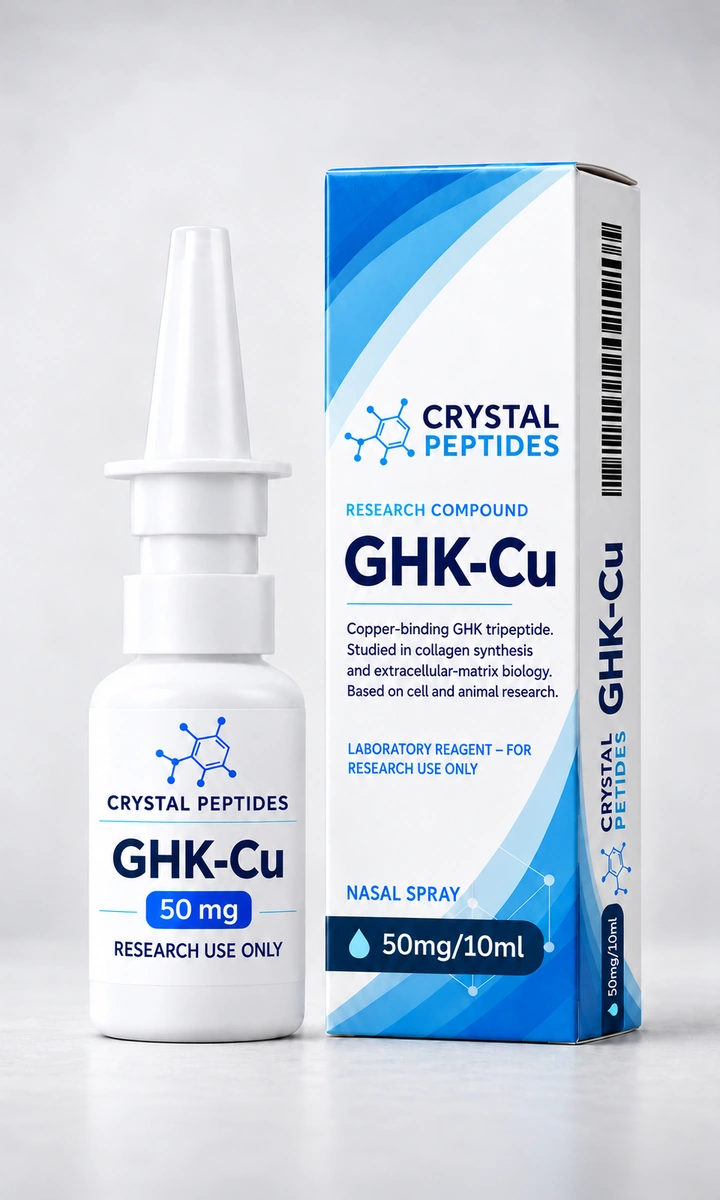
GHK-CU
50mg/10ml
💧Ready-to-use (pre-reconstituted with bacteriostatic water and stabilizers for extended shelf life)
Total: 41.86 GBP
Discount per Quantity
| Quantity | Discount | Price per Unit |
|---|---|---|
| 5 - 10 | 10% | 37.67 GBP |
| 11 - 20 | 15% | 35.58 GBP |
| 21+ | 20% | 33.48 GBP |
Rigorous third-party testing
Every batch of our research chemicals and peptides undergoes independent third-party laboratory testing for purity and identity.
Total: 41.86 GBP
GHK-Cu Nasal Spray is supplied as a catalogued research material in the following format and strength: nasal spray, 50mg/10ml. This catalogue presentation identifies the supplied formulation; it does not establish equivalence to materials described in published studies.
GHK-Cu refers to copper complexes of the tripeptide glycyl-L-histidyl-L-lysine (Gly-His-Lys). The name does not uniquely define peptide:copper stoichiometry, counter-ion composition or the chemical species present in a formulation. Public records describe materially different complexes, so a single molecular formula, molecular mass or registry identifier cannot be assigned to this product without matching batch documentation.
Chemical properties and registry information
| Property | Value |
|---|---|
| Name and synonyms | GHK-Cu; Copper Tripeptide-1; glycyl-L-histidyl-L-lysine copper complex; copper peptide |
| Material category | Copper–peptide research material |
| Peptide sequence | H-GHK-OH; Gly-His-Lys |
| Coordination component | Copper(II); complex stoichiometry requires batch-specific confirmation |
| Catalogue format and strength | nasal spray, 50mg/10ml |
| Physical form | Nasal spray formulation; batch-specific excipients and counter-ion composition must be verified in the matching CoA/SDS. |
Registry identifiers and molecular properties apply only to a defined chemical entity. They are omitted here because the supplied information does not establish which registered complex corresponds to this formulation.
Research background and published evidence
Published research
Published work on GHK-Cu includes investigations of copper binding and coordination involving the Gly-His-Lys tripeptide. Pickart and colleagues described copper-binding properties of this tripeptide in 1980. These observations provide background for chemical identity, complex characterisation and analytical-method research, rather than evidence specific to this catalogue spray.
The broader literature also discusses GHK-Cu in tissue-remodelling and skin-related research, including studies involving separately manufactured topical or preclinical materials. Interpretation requires attention to the actual test material, experimental model and formulation. A shared compound name is not sufficient to establish comparability between studies or products.
Current scientific understanding
Peptide identity, copper content and coordination state are distinct characteristics. Total copper alone does not establish the proportion bound to GHK, while peptide identification alone does not define the copper complex. Free copper, counter-ions and formulation components therefore require separate consideration when interpreting analytical observations.
The catalogue strength does not resolve these chemical distinctions. Conclusions about this material should remain limited to attributes demonstrated by formulation-specific records and measurements.
Formulation note
Published research mostly used other materials or routes rather than this nasal spray formulation. Findings from injected or differently formulated material cannot be transferred to this nasal spray formulation. Differences in excipients, chemical composition and experimental context prevent assumptions of equivalence. The presentation name is a catalogue descriptor, not an instruction for use.
Quality and testing
Quality information must be supported by a batch-specific certificate of analysis (CoA) matching this product, format and lot. Documentation for another presentation or similarly named complex does not establish the characteristics of this spray. The matching CoA and safety data sheet (SDS) should identify the material and formulation components.
Relevant analytical attributes include peptide identity and content, total copper, Cu:GHK molar ratio, free copper, counter-ions and elemental impurities. Chromatographic purity, analyte content, sterility and endotoxin status are separate measurements; one result does not establish another. Only tests documented in a matching report should be regarded as available.
For laboratory research use only by qualified professionals. Not for human or veterinary use. No dosing directions are provided.