
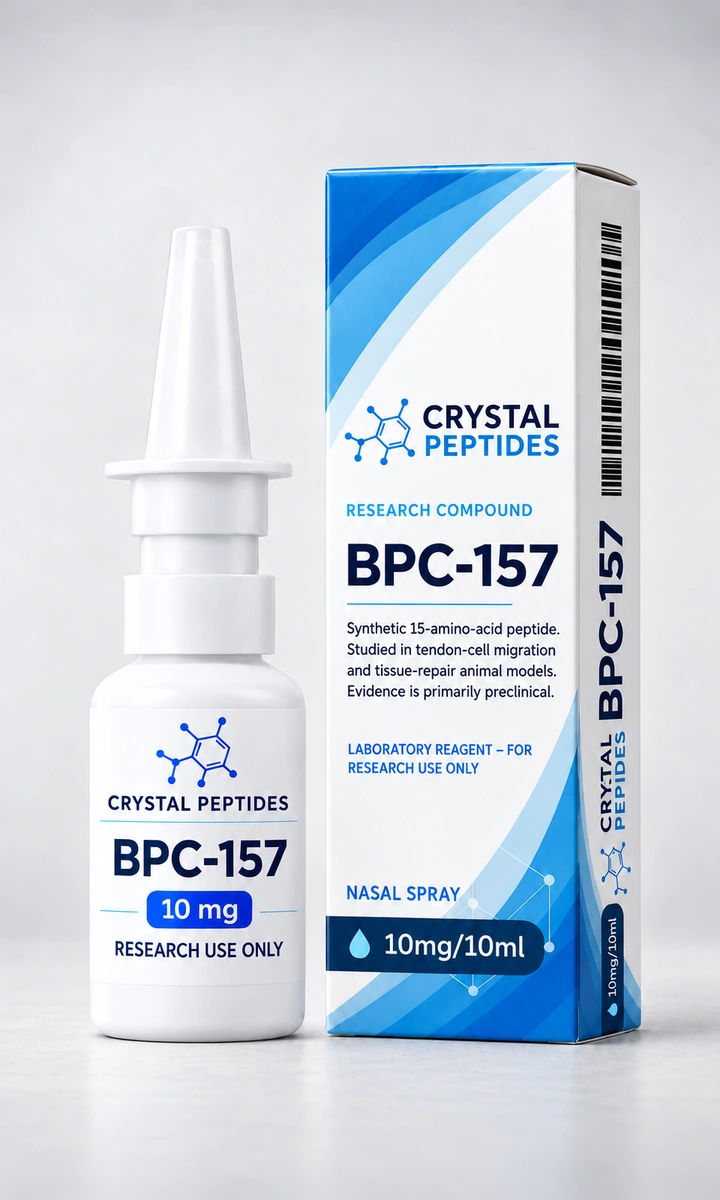
BPC 157
10mg/10ml
💧Ready-to-use (pre-reconstituted with bacteriostatic water and stabilizers for extended shelf life)
Total: 57.77 GBP
Discount per Quantity
| Quantity | Discount | Price per Unit |
|---|---|---|
| 5 - 10 | 10% | 52.00 GBP |
| 11 - 20 | 15% | 49.11 GBP |
| 21+ | 20% | 46.22 GBP |
Rigorous third-party testing
Every batch of our research chemicals and peptides undergoes independent third-party laboratory testing for purity and identity.
Total: 57.77 GBP
BPC-157 Nasal Spray is supplied by Crystal Peptides as a catalogued research material in the format nasal spray, 10mg/10ml. This catalogue entry identifies the supplied formulation for laboratory research and development. The format and labelled strength describe the product presentation, not an established experimental application or suitability for clinical use.
BPC-157, also known as Body Protection Compound-157, is a synthetic pentadecapeptide consisting of 15 amino acids. It is described in the research literature as derived from a naturally occurring gastric protein fragment. Its compound identity should be distinguished from the composition of the finished nasal spray, which includes formulation components requiring batch-specific documentation.
Chemical properties and registry information
Specification | Details |
Product name and synonyms | BPC-157; Body Protection Compound-157; Pentadecapeptide BPC-157 |
Peptide sequence | GEPPPGKPADDAGLV |
CAS number | 137525-51-0 |
PubChem CID | 9941957 |
Molecular formula | C62H98N16O22 |
Molecular weight | 1419.54 g/mol |
Peptide length | 15 amino acids (pentadecapeptide) |
Physical form | Nasal spray; batch-specific excipients must be verified in the Certificate of Analysis (CoA) and Safety Data Sheet (SDS). |
Format and strength | nasal spray, 10mg/10ml |
Research background and published evidence
Published research
Published BPC-157 research primarily concerns preclinical models of connective tissue physiology, gastrointestinal biology, angiogenesis, and cellular responses associated with tissue remodelling. Chang and colleagues’ 2011 work examined tendon explants, fibroblast migration, cell survival, and focal adhesion kinase–paxillin signalling. Their 2014 study investigated growth hormone receptor expression and related JAK2 signalling in tendon fibroblasts. These studies concern defined experimental systems rather than validation of this catalogued nasal spray.
Other areas discussed in the literature include nitric oxide signalling, endothelial biology, inflammatory regulation, and responses to oxidative stress. These topics describe the scope of scientific investigation; they do not establish product performance or a therapeutic application.
Current scientific understanding
The precise molecular target of BPC-157 has not been conclusively established. Multiple signalling pathways remain under investigation, and their relative contributions depend on the experimental context. The evidence base is predominantly preclinical. Observations from isolated cells, tissue explants, or animal models cannot establish clinical conclusions or characterise this finished formulation without directly relevant evidence.
Formulation note
Published research has mostly used other materials and routes rather than this nasal spray formulation. Findings from injected or differently formulated material cannot be transferred to this nasal spray formulation. Differences in excipients, formulation composition, peptide integrity, and experimental conditions limit comparisons between preparations. The cited research does not establish formulation-specific absorption, distribution, stability, or biological behaviour for this product.
Quality and testing
The batch-specific CoA is the reference for analytical characteristics of the material supplied. Review it alongside the SDS to establish documented identity, composition, and the scope of testing performed. Methods and results should be attributed only to the batch and sample actually examined, distinguishing peptide raw-material testing from analysis of the finished nasal spray.
Identity, chromatographic purity, and peptide content are distinct analytical measurements. No purity value, microbiological specification, independent laboratory verification, or finished-formulation stability should be assumed unless supported by the relevant batch documentation. Registry identifiers describe the peptide and do not independently verify the contents of an individual product batch.
For laboratory research and development only. Not for human or veterinary use. No dosing directions are provided. This catalogue description summarises compound identity and research context, not therapeutic suitability.