
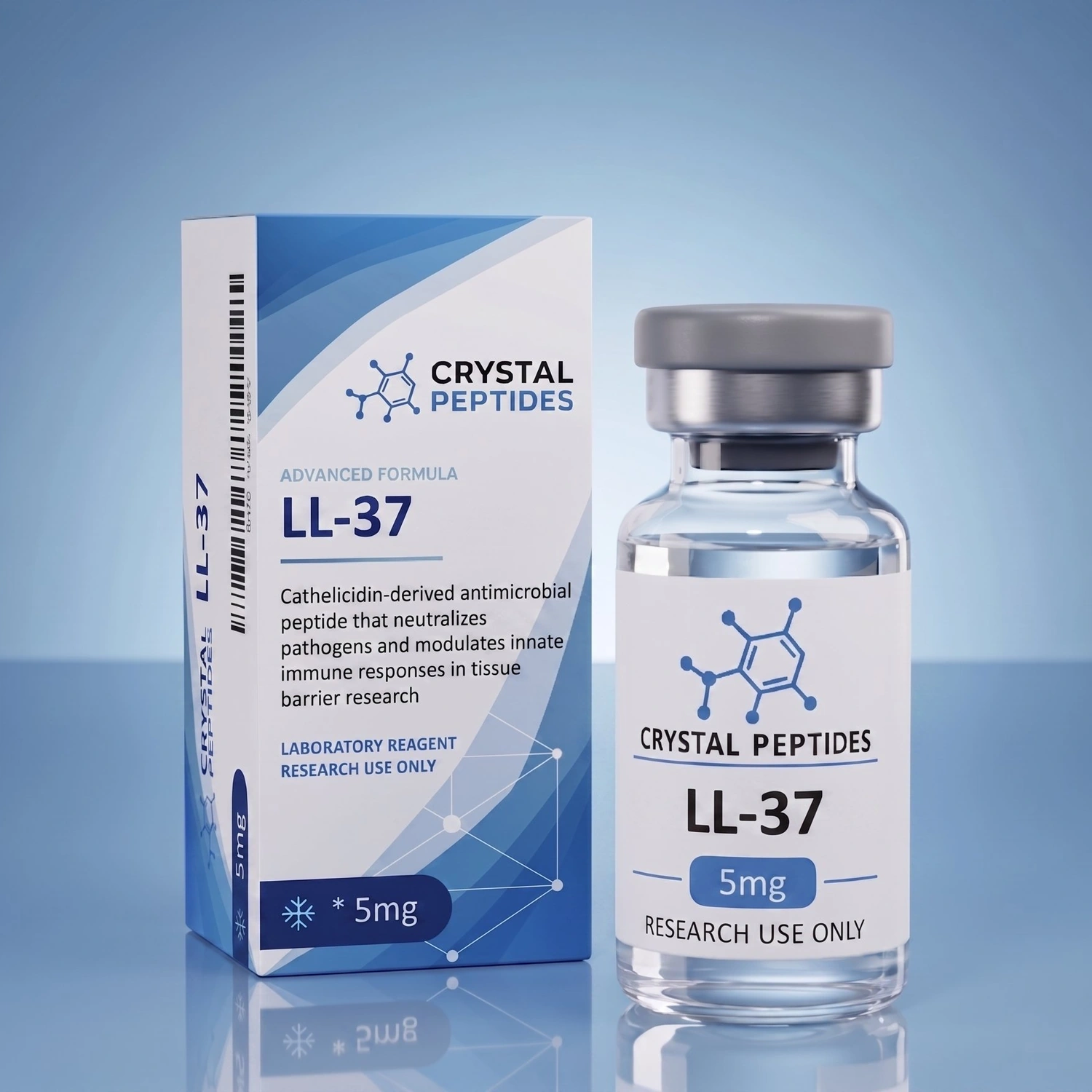
LL-37 (5mg)
5mg
❄️Lyophilized powder (not reconstituted)
Total: 38.69 GBP
Discount per Quantity
| Quantity | Discount | Price per Unit |
|---|---|---|
| 5 - 10 | 10% | 34.82 GBP |
| 11 - 20 | 15% | 32.88 GBP |
| 21+ | 20% | 30.95 GBP |
Rigorous third-party testing
Every batch of our research chemicals and peptides undergoes independent third-party laboratory testing for purity and identity.
Total: 38.69 GBP
What Is LL-37?
LL-37 is a 37-amino-acid human cathelicidin peptide derived from the C-terminal region of the hCAP18 precursor, which is encoded by the CAMP gene. As the only known human cathelicidin, LL-37 has become an important research subject in innate immunity, antimicrobial peptide biology, membrane interactions and cellular signalling. Its cationic and amphipathic structure also makes it useful for investigating peptide–membrane interactions and host defence mechanisms.
Buy LL-37 from Crystal Peptides Europe as a lyophilized, high-purity research compound corresponding to the mature 37-residue LL-37 sequence with free termini, rather than the longer hCAP18 precursor or shorter LL-37 fragments. Crystal Peptides maintains strict purity and quality standards, with independent third-party analytical testing performed by leading laboratories such as Janoshik and a Certificate of Analysis provided for every product batch.
The product is supplied exclusively for research and development and is not for human or veterinary use.
What's Included?
LL-37 is supplied as a lyophilized powder in a sealed glass vial, usually white to off-white in appearance.
Analytical testing is conducted for every new batch through independent labs, such as Janoshik, and a Certificate of Analysis (CoA) provided for verification. Depending on the laboratory and the product being tested, the CoA may include analytical results such as:
- Identity testing: Confirms that the material corresponds to the mature 37-amino-acid LL-37 peptide.
- HPLC purity: Measures the proportion of the principal LL-37 component relative to detectable chromatographic impurities.
- Mass spectrometry (MS): Provides molecular-mass data to support peptide identity and characterisation.
- Peptide content: Helps establish the amount of LL-37 present in the tested material.
- Related peptide impurities: Where reported, identifies or quantifies truncated sequences, deletion products or other synthesis-related peptide variants.
- Endotoxin testing: Where performed, assesses bacterial endotoxin levels in the tested sample.
- Sterility testing: Where applicable, evaluates the material for detectable microbial contamination.
- Residual solvents or other process-related impurities: Where applicable, helps assess contaminants associated with peptide synthesis and purification.
The batch-specific CoA should be used as the definitive source for the analytical results and specifications of the LL-37 lot supplied.
Testing parameters can vary according to the laboratory and the product being tested. For LL-37 in particular, researchers should distinguish the mature 37-residue peptide from its precursor protein hCAP18 and from shorter LL-37-derived fragments. LL-37 is the mature C-terminal peptide generated from hCAP18 through proteolytic processing.
Please note that the reconstitution solution is not included with the product. If required for your laboratory work, buy BAC Water from our catalogue to be added to your order separately.
Technical Specifications
Property | Specification |
Product name | LL-37 |
Alternative names | LL-37 peptide, human cathelicidin LL-37, CAP18, cathelicidin LL-37, ropocamptide |
Molecule type | Human cathelicidin-derived peptide |
Peptide length | 37 amino acids |
Sequence | LLGDFFRKSKEKIGKEFKRIVQRIKDFLRNLVPRTES |
Molecular formula | C205H340N60O53 |
Molecular weight | 4,493 g/mol |
PubChem CID | 16198951 |
Precursor protein | hCAP18, encoded by the CAMP gene |
Appearance | Lyophilized powder |
Product quantity | 5 mg |
Purity | Please check COA for batch-specific information |
CAS number | 154947-66-7 |
Intended use | Laboratory research only. Not for human or veterinary use. |
Note: The sequence and molecular characteristics above refer specifically to the mature LL-37 peptide rather than the full-length hCAP18 precursor or shorter LL-37-derived fragments. Since the exact molecular mass reported for a supplied research material can vary slightly depending on the terminal groups, check the provided CoA to confirm the molecular form of the material supplied.
LL-37 Overview and Mechanism of Action
LL-37 is the mature C-terminal peptide generated from the human cathelicidin precursor hCAP18. Cathelicidins are a family of antimicrobial peptides produced as larger precursor proteins and processed to release their mature, biologically active peptide forms. In humans, the CAMP gene encodes the cathelicidin precursor hCAP18, which is processed to generate LL-37, the only known human cathelicidin. [1]
As such, LL-37 is a 37-residue, positively charged and amphipathic peptide. When associated with biological membranes, it adopts a predominantly alpha-helical structure, a property that contributes to its interactions with lipid membranes. These structural and physicochemical characteristics are central to research investigating LL-37's interactions with microbial membranes, as well as its effects on host cells and cellular signalling pathways.
LL-37 and Microbial Membranes
The antimicrobial activity of LL-37 is strongly influenced by its cationic charge and amphipathic structure. Many bacterial membranes contain negatively charged lipids and other anionic surface components that attract the positively charged peptide. [2]
After binding to the microbial surface, LL-37 can associate with and disrupt the lipid membrane. Experimental models have described several possible membrane-disruption mechanisms, including surface carpeting, membrane thinning, pore formation and lipid reorganization. The precise mechanism can vary according to the membrane composition and experimental conditions.
Membrane Interaction and Peptide Structure
LL-37 can exist in different structural states depending on its environment. In solution, the peptide can adopt relatively disordered conformations, while interaction with membranes promotes formation of an alpha-helical structure.
LL-37 can also oligomerize under some conditions. These structural transitions are important areas of research because peptide concentration, lipid composition, ionic conditions and membrane properties can all influence how LL-37 interacts with its target. [3]
Immunomodulatory Signalling
LL-37's activity extends beyond direct antimicrobial effects. Research has associated the peptide with modulation of innate and adaptive immune responses, including chemotaxis and regulation of inflammatory signalling. [2]
Several cell-surface receptors and intracellular signalling systems have been implicated in LL-37 responses, including FPR2/ALX, P2X7 and EGFR-related signalling. However, LL-37 does not behave like a conventional ligand for a single receptor. Evidence suggests that membrane interactions, receptor transactivation and changes in membrane organization can all contribute to its cellular effects.
LL-37 and Inflammatory Research
LL-37 can influence the production and activity of inflammatory mediators, with experimental studies reporting both pro-inflammatory and inflammation-modulating effects. The direction and magnitude of these responses depend on the cell type, concentration, surrounding molecular environment and experimental conditions. [4]
This context dependence is an important consideration when interpreting LL-37 research, particularly when comparing results from different experimental models.
LL-37 and Tissue Biology
Research has also examined LL-37 in relation to cell migration, angiogenesis, epithelial responses and tissue repair. These effects are thought to involve interactions between the peptide, cell membranes and multiple signalling pathways rather than a single defined molecular target. [5]
Overall, LL-37 is best understood as a multifunctional host-defence peptide whose biological activity emerges from a combination of membrane interactions and context-dependent effects on cellular signalling and immune responses.
Research Applications & Scientific Background
LL-37 has been extensively studied as a human host-defence peptide, with research spanning antimicrobial peptide biology, innate immunity, membrane biophysics, inflammation and tissue repair. Its broad research profile reflects the ability of the peptide to interact with both microbial membranes and mammalian cells.
Antimicrobial Peptide Research
One of the principal areas of LL-37 research is its activity against microorganisms. Studies have investigated interactions with Gram-positive and Gram-negative bacteria as well as fungi and viruses.
Research suggests that LL-37 can associate with microbial membranes through electrostatic and hydrophobic interactions, with membrane composition influencing the resulting response. Studies have also examined LL-37 in relation to bacterial biofilms and antimicrobial resistance. [2]
Innate Immunity Research
LL-37 is an important component of human innate immune defence. It is produced by epithelial cells and immune cells and can participate in host responses to microbial exposure. [4]
Research has examined how LL-37 interacts with immune cells, chemokines and inflammatory mediators. These studies have established LL-37 as more than a membrane-active antimicrobial peptide, with its biological effects extending into regulation of immune signalling.
Immunomodulation and Inflammatory Signalling
LL-37 has been investigated for its ability to influence inflammatory responses, including cytokine and chemokine production and immune-cell migration. Importantly, its effects can be context dependent: experimental studies have reported both pro-inflammatory and inflammation-limiting activities depending on the cell type and surrounding biological environment. [6]
This makes LL-37 useful for research into the relationship between antimicrobial defence and inflammatory signalling.
Membrane Biophysics and Structure-Function Research
The cationic and amphipathic nature of LL-37 makes it a useful model for studying peptide–membrane interactions. Researchers have investigated how peptide concentration, lipid composition, ionic conditions and peptide oligomerization affect membrane binding and structural behaviour.
These studies can involve membrane permeabilization, pore formation, lipid reorganization and changes in peptide conformation.
Tissue Repair and Angiogenesis
Research has also investigated LL-37 in relation to cell migration, epithelial responses, angiogenesis and wound repair. Experimental studies have reported effects on endothelial-cell proliferation and vessel formation, while other work has examined LL-37 expression and activity during epithelial wound healing. [7]
These findings make LL-37 relevant to laboratory studies examining the connections between innate immunity, inflammation and tissue-remodelling processes.
Receptor and Cellular Signalling Research
Although membrane interaction is central to many LL-37 activities, research has identified several receptor and signalling systems that can contribute to cellular responses. These include FPR2/ALX, P2X7 and EGFR-associated pathways, among others.
The diversity of reported signalling mechanisms reflects the multifunctional nature of LL-37 and the influence of cell type and experimental conditions on its biological activity.
LL-37 and Host–Microbe Interactions
LL-37 is also studied as part of the broader interaction between host tissues and microorganisms. Research has examined how the peptide can simultaneously influence microbial viability, immune-cell behaviour and inflammatory signalling. [8]
This makes LL-37 a useful experimental model for investigating how antimicrobial peptides connect direct pathogen defence with broader host-response mechanisms.
LL-37 Comparison With Related Host-Defence Peptides
LL-37 belongs to the cathelicidin family of human host-defence peptides and differs structurally from the defensin families. The comparison below highlights the main differences relevant to antimicrobial peptide and innate-immunity research.
Property | LL-37 | α-Defensins | β-Defensins | hCAP18 |
Peptide family | Cathelicidin | Defensin | Defensin | Cathelicidin precursor |
Human examples | LL-37 | HNP-1 to HNP-4 | Multiple human β-defensins | hCAP18 |
Mature form | 37-amino-acid peptide | Typically ~30–40 amino acids | Typically ~40–50 amino acids | Precursor protein; not the mature LL-37 peptide |
Defining structure | Cationic, amphipathic, predominantly α-helical | Disulfide-stabilized β-sheet structure | Disulfide-stabilized β-sheet structure | Contains an N-terminal cathelin domain and C-terminal LL-37 precursor region |
Disulfide bonds in mature peptide | None | Three conserved disulfide bonds | Three conserved disulfide bonds | Precursor protein rather than mature peptide |
Antimicrobial research | Extensive | Extensive | Extensive | Requires proteolytic processing to release LL-37 |
Host-defence role studied | Membrane interactions, innate immunity and immune signalling | Innate immune defence and microbial killing | Epithelial defence and immune signalling | Biosynthesis and processing of LL-37 |
Primary research areas | Antimicrobial peptide biology, membrane biophysics, innate immunity and cellular signalling | Neutrophil-mediated defence and antimicrobial mechanisms | Epithelial immunity and host–microbe interactions | LL-37 production and precursor processing |
LL-37 and BPC-157
LL-37 and BPC-157 are structurally distinct research peptides that have both been investigated in cellular and tissue-based research. LL-37 is a 37-amino-acid cathelicidin primarily studied in innate immunity, antimicrobial peptide biology and membrane interactions, while BPC-157 has been investigated across a range of cellular and tissue-response models. Researchers can compare these compounds to explore how structurally different peptides influence cellular processes and tissue-related responses.
LL-37 and Thymosin Alpha-1
LL-37 and Thymosin Alpha-1 provide another useful comparison within immune-related research. LL-37 is an endogenous human host-defence peptide involved in innate immune responses and interactions with microbial membranes, whereas Thymosin Alpha-1 is a synthetic 28-amino-acid peptide studied in relation to immune-cell function and immune signalling. Their distinct structures and biological roles make them useful research materials for investigating different aspects of peptide-mediated immune regulation.
LL-37 and TB-500
LL-37 and TB-500 have also been investigated in areas of cellular and tissue biology, although they belong to different peptide families and have distinct molecular properties. LL-37 is primarily studied as a cathelicidin and host-defence peptide, while TB-500 is a thymosin β4-derived research peptide associated with studies of cellular migration, cytoskeletal processes and tissue responses. Comparing their research profiles can help distinguish antimicrobial peptide biology from other peptide-mediated cellular processes.
Storage & Laboratory Handling
LL-37 is supplied as a lyophilized peptide. Keeping the material sealed and protected from moisture, heat and unnecessary environmental exposure helps preserve its analytical characteristics during storage.
- Store the sealed lyophilized material according to the product documentation and batch-specific recommendations.
- For longer-term storage, frozen storage is commonly used for lyophilized LL-37.
- Protect from moisture and direct light.
- Allow a cold vial to reach an appropriate temperature before opening where necessary to reduce condensation on the lyophilized material.
- Once prepared for laboratory use, follow the storage and stability conditions established for the specific preparation and experimental protocol.
- Avoid unnecessary repeated freeze-thaw cycles when working with prepared solutions.
- Use appropriate laboratory procedures to minimise contamination during preparation and handling.
LL-37 is a highly cationic peptide, and adsorption to laboratory surfaces can be an important consideration, particularly when working with dilute solutions. When you buy LL-37 for laboratory research, selecting appropriate laboratory materials and minimising unnecessary transfers can help reduce potential material loss.
There is no single universally applicable in-use stability period for all LL-37 research preparations. Stability can depend on factors such as formulation, concentration, container, solvent and storage conditions, so the product documentation and experimental protocol should take precedence over generalised storage periods.
Certificate of Analysis & Quality Assurance
A Certificate of Analysis (CoA) provides batch-specific analytical information about the LL-37 material supplied. For a defined 37-amino-acid peptide, identity and purity are particularly important for confirming that the material corresponds to the intended LL-37 sequence.
What to Check on an LL-37 CoA
Depending on the product and testing laboratory, a CoA may report:
- Identity: Confirms the material corresponds to LL-37.
- Purity: Indicates the proportion of the principal peptide component relative to detectable impurities.
- Peptide content: Provides information about the actual peptide content of the tested material.
- Additional quality parameters: May include endotoxins, sterility or microbial limits, water content, residual solvents and elemental impurities where applicable.
The CoA should correspond to the specific LL-37 lot being purchased or studied. Researchers should use the batch documentation to review the reported results, analytical methods and specifications applicable to that material.
Testing parameters can vary between independent laboratories, so the batch-specific CoA should be treated as the definitive source for the analytical characteristics of the LL-37 material supplied.
Frequently Asked Questions
What is LL-37?
LL-37 is a 37-amino-acid human cathelicidin peptide produced from the C-terminal region of the hCAP18 precursor protein, which is encoded by the CAMP gene. It is the only known human cathelicidin and has been extensively studied in antimicrobial peptide biology, innate immunity, membrane interactions and immunomodulation.
What is the difference between LL-37 and hCAP18?
hCAP18 is the precursor protein from which mature LL-37 is produced. Proteolytic processing of hCAP18 releases the 37-amino-acid LL-37 peptide from its C-terminal region. The two should therefore not be treated as interchangeable research materials: hCAP18 is the precursor protein, while LL-37 is the mature peptide.
What is LL-37 studied for in research?
LL-37 has been studied extensively in antimicrobial peptide research, including interactions with bacterial and other microbial membranes. Other research areas include innate immunity, inflammatory signalling, host–microbe interactions, membrane biophysics, cell migration and tissue biology.
How does LL-37 work?
LL-37 has a cationic, amphipathic structure that allows it to interact with negatively charged components of microbial membranes. Studies have reported membrane insertion, lipid reorganization and membrane permeabilization, although the precise mechanism can vary with membrane composition and experimental conditions. Proposed models include carpet-like membrane disruption and pore formation rather than one universally applicable mechanism.
What receptors does LL-37 interact with?
LL-37 can influence host-cell signalling through several receptor systems and membrane-associated processes. Research has implicated receptors and pathways including FPR2/ALX, P2X7 and EGFR-related signalling. LL-37 is therefore not best understood as a conventional ligand acting through one single receptor; its cellular effects can involve both direct membrane interactions and receptor-dependent signalling.
What is the difference between LL-37 and LL-37 fragments?
LL-37 fragments are shorter peptides derived from portions of the full 37-amino-acid sequence. Examples studied in research include fragments such as KR-12 and LL-32. Removing or altering parts of LL-37 can change its structure, membrane interactions and biological properties, so a fragment should not be assumed to have the same characteristics as full-length LL-37.
How is LL-37 purity and identity tested?
LL-37 can be characterised using analytical methods including HPLC and mass spectrometry. HPLC provides information about chromatographic purity and related peptide species, while mass spectrometry provides molecular-mass information supporting the identity of the 37-residue peptide. Additional testing may assess peptide content, endotoxins, sterility, residual solvents or other process-related impurities.
Where can I buy LL-37 for research in Europe?
If you're in Europe, you can buy LL-37 from Crystal Peptides as a lyophilized laboratory research peptide. The material is supplied in lyophilized powder form with batch-specific Certificates of Analysis provided for verification. The product is intended exclusively for research and development and is not for human or veterinary use.
Scientific References
- Méndez-Samperio, P. (2010). The human cathelicidin hCAP18/LL-37: A multifunctional peptide involved in mycobacterial infections. Peptides, 31(9), 1791–1798. doi: 10.1016/j.peptides.2010.06.016.
- Bhattacharjya, S., Zhang, Z., & Ramamoorthy, A. (2024). LL-37: Structures, antimicrobial activity, and influence on amyloid-related diseases. Biomolecules, 14(3), 320. doi: 10.3390/biom14030320.
- Sancho-Vaello, E., Gil-Carton, D., François, P., Bonetti, E. J., Kreir, M., Pothula, K. R., Kleinekathöfer, U., & Zeth, K. (2020). The structure of the antimicrobial human cathelicidin LL-37 shows oligomerization and channel formation in the presence of membrane mimics. Scientific Reports, 10(1), 17356. doi: 10.1038/s41598-020-74401-5.
- Pahar, B., Madonna, S., Das, A., Albanesi, C., & Girolomoni, G. (2020). Immunomodulatory role of the antimicrobial LL-37 peptide in autoimmune diseases and viral infections. Vaccines, 8(3), 517. doi: 10.3390/vaccines8030517.
- Kahlenberg, J. M., & Kaplan, M. J. (2013). Little peptide, big effects: The role of LL-37 in inflammation and autoimmune disease. Journal of Immunology, 191(10), 4895–4901. doi: 10.4049/jimmunol.1302005.
- Yang, B., Good, D., Mosaiab, T., Liu, W., Ni, G., Kaur, J., Liu, X., Jessop, C., Yang, L., Fadhil, R., Yi, Z., & Wei, M. Q. (2020). Significance of LL-37 on immunomodulation and disease outcome. BioMed Research International, 2020, 8349712. doi: 10.1155/2020/8349712.
- Yang, Y., Wu, G., Wang, Y., Mao, Q., Zhang, D., & Wu, J. (2025). LL37 promotes angiogenesis: A potential therapeutic strategy for lower limb ischemic diseases. Frontiers in Pharmacology, 16, 1587351. doi: 10.3389/fphar.2025.1587351.
- Svensson, D., & Nilsson, B. O. (2025). Human antimicrobial/host defense peptide LL-37 may prevent the spread of a local infection through multiple mechanisms: An update. Inflammation Research, 74(1), 36. doi: 10.1007/s00011-025-02005-8.
Used solely for in vitro experiments and cannot be:
- Used in clinical trials involving humans
- Administered to humans as part of an experiment or investigation
- Supplied to another party for human investigational use.