
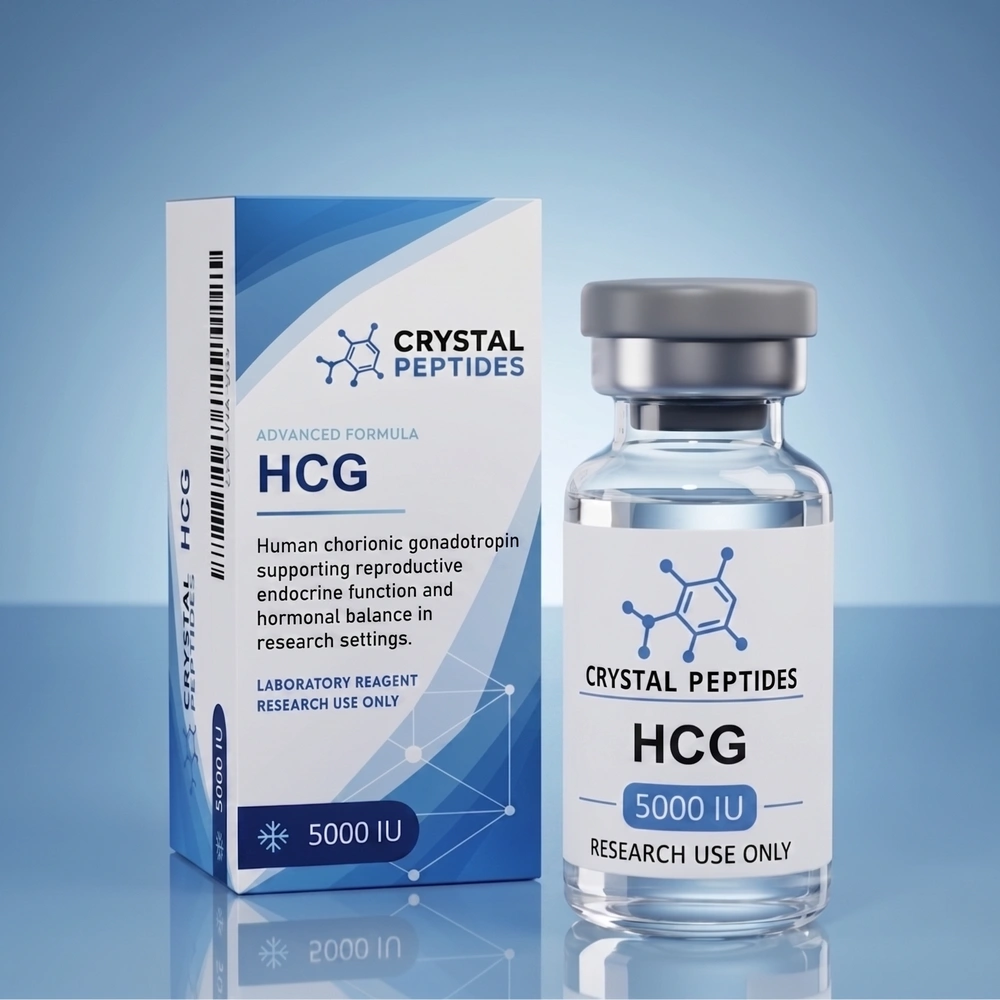
HCG (5000IU)
❄️Lyophilized powder (not reconstituted)
Size:
Total: 37.85 GBP
Discount per Quantity
| Quantity | Discount | Price per Unit |
|---|---|---|
| 5 - 10 | 10% | 34.07 GBP |
| 11 - 20 | 15% | 32.17 GBP |
| 21+ | 20% | 30.28 GBP |
Rigorous third-party testing
Every batch of our research chemicals and peptides undergoes independent third-party laboratory testing for purity and identity.
Total: 37.85 GBP
What Is HCG?
HCG peptide is a synthetic analogue of human chorionic gonadotropin (HCG), a naturally occurring glycoprotein hormone composed of two non-covalently associated subunits: a shared alpha subunit and a hormone-specific beta subunit. The complex structure of HCG makes it an important subject of research in reproductive endocrinology, glycoprotein hormone biology, LHCGR receptor pharmacology, signal transduction and the analytical characterization of protein hormones.
Synthetic HCG research materials can differ from one supplier to another due to differences in glycosylation profile and other physicochemical characteristics. Researchers should therefore review analytical results for every material batch to ensure consistency. When you buy HCG peptide from Crystal Peptides Europe, you get a research-grade product synthesised under strict manufacturing standards and independently tested by third-party laboratories for identity, purity, sterility and other quality parameters.
This product is sold for research use only and is not for human or veterinary use. Secure and discreet shipping available throughout Europe.
What’s Included
HCG 5,000 IU is supplied as a lyophilized powder in a sealed glass vial, a typically white to off-white solid in appearance.
A Certificate of Analysis (CoA) is available for every product lot after third-party testing by independent laboratories. Depending on the laboratory and the product being tested, the CoA may include analytical results such as:
- Identity testing: Confirms that the material corresponds to human chorionic gonadotropin (HCG).
- Purity testing: Assesses the proportion of the principal HCG material relative to detectable impurities or related components.
- Potency or biological activity: Particularly important for HCG because the product is specified in International Units (IU), which describe biological activity rather than protein mass.
- Protein or molecular-mass characterization: Helps assess the molecular characteristics of the HCG preparation and distinguish it from unrelated proteins.
- Endotoxin testing: Conducted where applicable to assess bacterial endotoxin levels, which can be important for laboratory applications involving sensitive biological systems.
- Sterility testing: Conducted where applicable to evaluate the material for detectable microbial contamination.
- Heavy metals or elemental analysis: Conducted where applicable to screen for specified elemental contaminants.
Because HCG is a glycosylated heterodimeric protein hormone, analytical characterization can be more complex than for a conventional synthetic peptide. The batch-specific CoA should therefore be used as the definitive source for the analytical results and specifications of the HCG lot supplied. Testing parameters may vary according to the product and independent laboratory performing the analysis.
Please note that reconstitution solution is not included with the product, but you can order BAC Water separately right here on our online shop.
Technical Specifications
HCG Technical Specifications
Specification | HCG |
Product name | Human Chorionic Gonadotropin (HCG) |
Alternative names | hCG; chorionic gonadotropin; choriogonadotropin |
Molecule type | Glycoprotein hormone |
Molecular structure | Heterodimeric glycoprotein composed of non-covalently associated alpha and beta subunits |
Alpha subunit | 92 amino acids; shared with LH, FSH and TSH |
Beta subunit | 145 amino acids; hormone-specific |
Glycosylation | Heavily glycosylated |
Primary receptor | Luteinizing hormone/choriogonadotropin receptor (LHCGR) |
Available quantities | 5,000 IU |
Unit | International Units (IU), representing biological activity rather than mass |
Molecular formula | Not assigned as a single definitive formula for intact HCG |
Molecular mass | Approximately 36,700 Da; preparation-dependent |
CAS number | 9002-61-3 |
Appearance | White to off-white lyophilised powder |
Purity & identity | See the batch-specific Certificate of Analysis |
Intended use | Laboratory research only; not for human or veterinary use |
Note: HCG is a glycosylated heterodimer rather than a single-chain peptide with one fixed molecular formula. Its molecular characteristics can vary according to the specific preparation, including source and glycosylation profile. The applicable batch documentation should therefore be used for definitive information about the material supplied.
HCG Overview and Mechanism of Action
Synthetic human chorionic gonadotropin (hCG) is a research form of the naturally occurring glycoprotein hormone belonging to the same broader family as luteinizing hormone (LH), follicle-stimulating hormone (FSH) and thyroid-stimulating hormone (TSH) [1]. The intact hormone consists of two non-covalently associated subunits: a common alpha subunit and a hormone-specific beta subunit. Both subunits carry carbohydrate groups, making the glycosylation pattern an important part of hCG's molecular characteristics.
The biological activity of hCG is mediated primarily through the luteinizing hormone/choriogonadotropin receptor (LHCGR), a G protein-coupled receptor expressed in reproductive tissues and other experimental systems. Although hCG and LH act through the same receptor, their molecular structures and glycosylation patterns differ, and research has demonstrated differences in their receptor signalling profiles.
HCG Binding to LHCGR
LHCGR has a large extracellular domain that recognises the glycoprotein hormone before receptor activation is transmitted through the transmembrane portion of the receptor. Structural studies indicate that interactions between hCG and the extracellular receptor domain induce conformational changes that are communicated to the intracellular portion of the GPCR. [2]
This receptor architecture is important for understanding why the carbohydrate structures and three-dimensional organisation of hCG matter in addition to its amino-acid sequence. The intact glycoprotein provides the structural information required for high-affinity receptor binding and signal generation.
cAMP and PKA Signalling
The best-characterised LHCGR signalling pathway involves Gs-mediated activation of adenylyl cyclase, resulting in increased intracellular cyclic AMP (cAMP). cAMP can subsequently activate protein kinase A (PKA) and other downstream effectors.
Research has established cAMP/PKA signalling as an important component of hCG responses, particularly in studies of steroidogenic signalling. However, LHCGR signalling is not limited to this pathway. [3]
Additional LHCGR Signalling Pathways
LHCGR can interact with several classes of intracellular signalling proteins. Depending on the cell type, receptor environment and experimental conditions, gonadotropin binding can engage Gq/11-mediated phospholipase C signalling, Gi-associated pathways and β-arrestin-dependent signalling. [2]
These pathways can influence intracellular calcium, protein kinase C (PKC), ERK/MAPK signalling, receptor internalisation and other cellular responses. Modern research therefore considers LHCGR signalling as a network of interconnected pathways rather than a single linear cAMP response.
HCG vs. LH Signalling
HCG and LH share LHCGR as their principal receptor, but they are not molecularly identical. Their beta subunits evolved separately in primates, and differences in structure and glycosylation contribute to distinct receptor interactions and intracellular signalling profiles.
Comparative studies have reported differences in the relative activation of cAMP/PKA, ERK1/2, AKT and other pathways by hCG and LH. This makes the two hormones valuable comparative tools for investigating glycoprotein hormone structure, receptor activation, ligand selectivity and biased signalling.
HCG IU Strength
HCG and similar biological research materials are commonly described in International Units (IU) rather than solely by protein mass. You can buy HCG peptide from Crystal Peptides in 5,000 IU and 10,000 IU formats, with the IU designation referring to the assigned biological activity of the material.
The International Unit is a standardized measure used for substances whose biological activity cannot be adequately described by mass alone and is commonly used for biological agents such as vaccines and drugs (e.g. penicillin, vitamins, etc). In practical terms, the IU value can be thought of as a measure of the material's standardized biological activity or potency.
Research Applications & Scientific Background
Human chorionic gonadotropin has a broad research history spanning reproductive endocrinology, glycoprotein hormone biology, receptor pharmacology and analytical science. Because hCG interacts with the same primary receptor as luteinizing hormone (LH) while possessing distinct structural and glycosylation characteristics, it provides a useful model for investigating how glycoprotein structure influences receptor activation and cellular signalling.
Reproductive Endocrinology
HCG is extensively studied in reproductive endocrinology because of its interaction with the luteinizing hormone/choriogonadotropin receptor (LHCGR). Research examines hCG-LHCGR signalling in reproductive tissues and uses the hormone to investigate gonadotropin receptor biology, steroidogenic signalling and cellular responses to receptor activation. [4]
Comparative studies with LH are particularly relevant because both hormones activate LHCGR but have distinct molecular structures and glycosylation patterns.
LHCGR Receptor Pharmacology
HCG is an important ligand for studying the structure and function of LHCGR, a G protein-coupled receptor with a large extracellular hormone-binding domain. Structural studies have used hCG-LHCGR complexes to investigate how binding at the extracellular domain produces conformational changes that activate the receptor and promote interaction with intracellular G proteins. [2]
Research also examines the different signalling pathways that can be recruited following LHCGR activation. These include Gs/cAMP signalling, Gq/11-dependent phospholipase pathways, Gi-associated signalling and β-arrestin pathways, with the relative contribution of each pathway depending on the experimental system.
Steroidogenic and Cellular Signalling Research
HCG-LHCGR signalling is studied in cellular systems where researchers investigate changes in intracellular cAMP, protein kinase activity, calcium signalling, MAPK pathways and other downstream responses.
This makes hCG useful for studying how activation of a glycoprotein hormone receptor is translated into cellular responses, including signalling associated with steroidogenic tissues. The precise response can vary with receptor expression, cell type and experimental conditions. [4]
Glycosylation and Glycoform Research
One of the most distinctive aspects of hCG research is its glycosylation. The intact hormone contains multiple glycosylation sites, producing a population of molecular isoforms rather than a single uniform molecular species. Analytical studies have used liquid chromatography and high-resolution mass spectrometry to characterise hCG at the intact-protein level and investigate its different glycoforms. [5]
Researchers have also investigated how differences in glycosylation affect receptor binding, biological activity and the analytical detection of different hCG forms. Hyperglycosylated hCG, for example, has been studied as a distinct molecular form with measurable differences in LHCGR activation compared with reference hCG preparations.
HCG and LH Comparative Research
HCG and LH provide a particularly useful comparative system because both act through LHCGR while having evolved distinct beta subunits. Research has investigated how differences in their molecular structure and glycosylation influence receptor interaction and downstream signalling. [1]
Comparative hCG/LH research can therefore be used to investigate ligand selectivity, receptor activation, biased signalling and structure-function relationships in glycoprotein hormones.
Analytical and Assay Development
HCG is also widely used in research involving immunoassays, reference preparations and analytical characterization. Multiple hCG forms can occur as a result of glycosylation, peptide cleavage and metabolic processing, creating challenges for selectively detecting and quantifying particular molecular species.
Researchers have consequently developed analytical methods capable of distinguishing intact hCG, hCG isoforms and related fragments. These approaches include immunometric assays, liquid chromatography and mass spectrometry, providing useful models for studying the characterization of complex glycoprotein hormones. [6]
HCG vs LH vs FSH vs TSH Comparison
HCG belongs to a distinct family of heterodimeric glycoprotein hormones that also includes luteinizing hormone (LH), follicle-stimulating hormone (FSH) and thyroid-stimulating hormone (TSH). These hormones share a common alpha subunit but have different hormone-specific beta subunits, which contribute to their receptor interactions and signalling characteristics.
This comparison is useful for understanding HCG's molecular biology and receptor pharmacology rather than treating these hormones as interchangeable research materials.
Property | HCG | LH | FSH | TSH |
Molecule type | Glycoprotein hormone | Glycoprotein hormone | Glycoprotein hormone | Glycoprotein hormone |
Subunit structure | Common α + HCG-specific β | Common α + LH-specific β | Common α + FSH-specific β | Common α + TSH-specific β |
Primary receptor | LHCGR | LHCGR | FSHR | TSHR |
Primary research context | Reproductive endocrinology and LHCGR pharmacology | Gonadotropin and LHCGR signalling | FSH receptor and reproductive biology | TSH receptor and thyroid signalling |
Shared α-subunit | Yes | Yes | Yes | Yes |
Hormone-specific β-subunit | Yes | Yes | Yes | Yes |
HCG vs. Kisspeptin-10
Kisspeptin-10 provides an interesting comparison with HCG because both are studied in reproductive and neuroendocrine research, but they act at very different points in endocrine signalling. HCG is a glycoprotein hormone that primarily activates the LHCGR, whereas Kisspeptin-10 is a synthetic decapeptide derived from the KISS1 precursor and studied as a ligand of the KISS1R/GPR54 receptor.
Comparing the two can therefore help researchers distinguish downstream gonadotropin-receptor signalling from upstream neuroendocrine regulation, while also illustrating the substantial structural differences between a glycosylated heterodimeric hormone and a short synthetic peptide.
HCG vs. Oxytocin
Oxytocin offers a useful structural comparison to hCG because, despite both being endocrine signalling molecules, both have fundamentally different molecular architectures. HCG is a heavily glycosylated heterodimeric protein hormone composed of alpha and beta subunits, while oxytocin is a cyclic, disulfide-bridged nonapeptide that acts primarily through the OXTR receptor. Comparing these materials can help researchers distinguish glycoprotein hormone biology from small-peptide GPCR signalling, including differences in molecular structure, receptor recognition, analytical characterization and downstream cellular signalling.
Storage & Laboratory Handling
HCG is supplied as a lyophilised glycoprotein hormone in a sealed vial. Because hCG is a complex, glycosylated protein, appropriate storage and handling are important for maintaining the material's structural and analytical characteristics.
- Keep the vial sealed and protected from moisture.
- Store HCG according to the temperature and handling conditions specified in the applicable product documentation or batch-specific Certificate of Analysis.
- Protect the material from unnecessary exposure to heat and prolonged temperature fluctuations.
- Protect the lyophilised material from unnecessary exposure to light.
- Once prepared for laboratory use, follow the storage and stability requirements appropriate to the specific preparation and experimental protocol.
- Avoid unnecessary repeated freeze-thaw cycles where applicable.
Note that hCG preparations can contain multiple molecular forms and glycoforms, making preservation of the original material important when the research depends on structural or analytical characterization.
When you buy HCG from Crystal Peptides in Europe, you can find all relevant information about the research compound from the provided documentation (CoA) to guide you in your research.
Certificate of Analysis & Quality Assurance
A Certificate of Analysis (COA) is particularly important for HCG because the material is a complex glycoprotein rather than a single, structurally uniform peptide. A meaningful quality assessment should consider the identity and composition of the preparation, its reported activity, and the analytical methods used to characterise it.
What to Check on an HCG COA
When reviewing documentation for an HCG research material, researchers should consider several distinct parameters:
- Identity: Confirms that the material corresponds to human chorionic gonadotropin and, where applicable, identifies the relevant alpha and beta subunits.
- Potency or activity: HCG is commonly specified in International Units (IU), which relate to biological activity rather than simply the mass of protein present.
- Purity: Indicates the measured proportion of the principal HCG material according to the stated analytical method.
- Source and molecular form: Where provided, identifies whether the material is recombinant, urinary-derived or another defined preparation.
- Glycosylation: Where characterised, provides information about the carbohydrate structures attached to the HCG subunits. Glycosylation can contribute substantially to the molecular heterogeneity of HCG preparations.
- Related proteins and variants: Where tested, can provide information about subunit variants, fragments, oxidised forms or other related species.
- Endotoxin and microbiological testing: Where included, provides separate information about endotoxin levels and microbiological characteristics.
Advanced characterisation of HCG can involve techniques such as liquid chromatography, high-resolution mass spectrometry, peptide mapping, glycan analysis and electrophoretic methods. These approaches can provide information that a conventional purity assay alone cannot establish.
Frequently Asked Questions
What is HCG (human chorionic gonadotropin)?
Human chorionic gonadotropin (HCG or hCG) is a naturally occurring glycoprotein hormone consisting of two non-covalently associated subunits: a common alpha subunit and a hormone-specific beta subunit. Research on HCG includes reproductive endocrinology, glycoprotein hormone biology, LHCGR receptor pharmacology and signal transduction.
What is the difference between HCG and HCG peptide?
HCG, or human chorionic gonadotropin, is a glycosylated heterodimeric protein hormone consisting of alpha and beta subunits. The term “HCG peptide” is sometimes used commercially to describe HCG as a research peptide, but it does not refer to a separate form of the hormone. Scientifically, HCG is more accurately described as a glycoprotein hormone rather than a conventional synthetic peptide.
What is HCG studied for in research?
HCG is studied across reproductive endocrinology, LHCGR receptor pharmacology, steroidogenic signalling, glycoprotein hormone biology and analytical characterization. Research also examines HCG structure, glycosylation, receptor interactions and differences between HCG and related hormones such as LH.
How does HCG work?
HCG primarily produces its biological effects by binding to the luteinizing hormone/choriogonadotropin receptor (LHCGR), a G protein-coupled receptor. LHCGR activation can stimulate cAMP/PKA signalling as well as other intracellular pathways, with the resulting response depending on the receptor environment and experimental system.
What receptor does HCG activate?
HCG primarily activates LHCGR, which is also the principal receptor for luteinizing hormone (LH). Research has shown that LHCGR can engage multiple intracellular signalling pathways following hormone binding, making HCG useful for studying gonadotropin receptor pharmacology.
What is the difference between HCG and LH?
HCG and LH are closely related glycoprotein hormones that both primarily interact with LHCGR. They share a common alpha subunit but have distinct beta subunits and can differ in glycosylation and receptor-signalling characteristics. These differences make them useful comparative materials for studying glycoprotein hormone structure and receptor activity.
What does 5,000 IU of HCG mean?
5,000 IU refers to the biological activity assigned to the HCG preparation rather than 5,000 mg or another direct measurement of protein mass. International Units are based on an established biological activity standard, so an IU value should not be converted directly into a mass value without information about the specific preparation and applicable reference standard.
How is HCG purity and identity tested?
HCG can be characterised using analytical methods including chromatography, immunoassays and mass spectrometry. Identity, chromatographic purity, biological activity, glycosylation and the presence of related molecular forms represent different analytical questions, so a single purity percentage does not provide a complete characterization of an HCG preparation.
Why does HCG glycosylation matter?
HCG is a glycosylated protein, meaning carbohydrate structures are attached to its alpha and beta subunits. These glycans contribute to the hormone's molecular characteristics, and different HCG preparations can contain different glycoforms. Researchers may therefore consider glycosylation when investigating HCG structure, receptor interactions, biological activity or analytical differences between preparations.
Where can I buy HCG for research in Europe?
Researchers in Europe can buy HCG from Crystal Peptides as a laboratory research material. HCG is supplied in lyophilised form and is available in 5,000 IU and 10,000 IU catalogue formats. The material is intended exclusively for research and development and is not for human or veterinary use.
Scientific References
- Nwabuobi, C., Arlier, S., Schatz, F., Guzeloglu-Kayisli, O., Lockwood, C. J., & Kayisli, U. A. (2017). hCG: Biological functions and clinical applications. International Journal of Molecular Sciences, 18(10), 2037. PubMed PMC full text
- Grzesik, P., Kreuchwig, A., Rutz, C., Furkert, J., Wiesner, B., Schülein, R., Kleinau, G., Gromoll, J., & Krause, G. (2015). Differences in signal activation by LH and hCG are mediated by the LH/CG receptor's extracellular hinge region. Frontiers in Endocrinology, 6, 140. PubMed PMC full text
- Mann, O. N., Kong, C. S., Lucas, E. S., Brosens, J. J., Hanyaloglu, A. C., & Brighton, P. J. (2022). Expression and function of the luteinizing hormone choriogonadotropin receptor in human endometrial stromal cells. Scientific Reports, 12(1), 8624. PubMed PMC full text
- Li, J., Zhu, X., Zhu, W., Li, L., Wei, H., & Zhang, S. (2024). Research progress on the impact of human chorionic gonadotropin on reproductive performance in sows. Animals, 14(22), 3266. PubMed PMC full text
- Fournier, T. (2016). Human chorionic gonadotropin: Different glycoforms and biological activity depending on its source of production. Annales d'Endocrinologie, 77(2), 75–81. PubMed
- Woldemariam, G. A., & Butch, A. W. (2014). Immunoextraction-tandem mass spectrometry method for measuring intact human chorionic gonadotropin, free β-subunit, and β-subunit core fragment in urine. Clinical Chemistry, 60(8), 1089–1097. PubMed PMC full text
Used solely for in vitro experiments and cannot be:
- Used in clinical trials involving humans
- Administered to humans as part of an experiment or investigation
- Supplied to another party for human investigational use.