
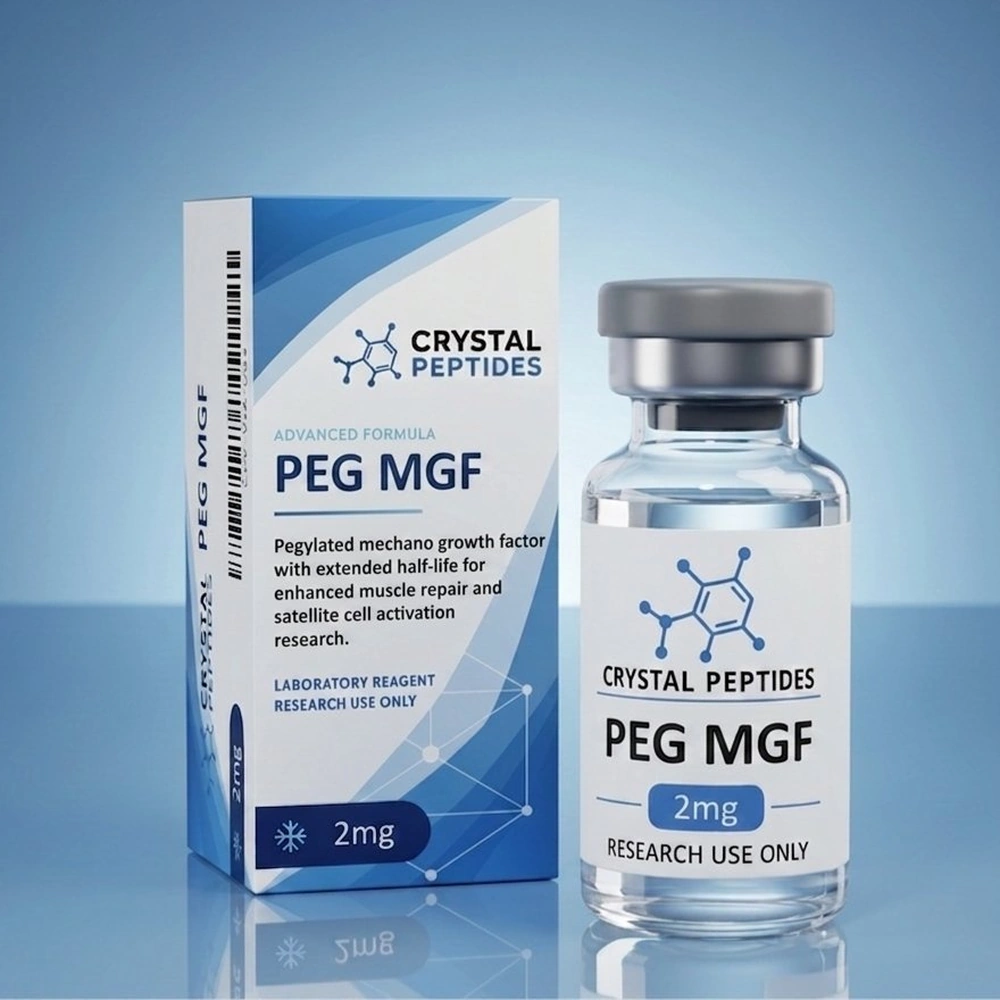
PEG MGF
2mg
❄️Lyophilized powder (not reconstituted)
Total: 42.13 GBP
Discount per Quantity
| Quantity | Discount | Price per Unit |
|---|---|---|
| 5 - 10 | 10% | 37.92 GBP |
| 11 - 20 | 15% | 35.81 GBP |
| 21+ | 20% | 33.71 GBP |
Rigorous third-party testing
Every batch of our research chemicals and peptides undergoes independent third-party laboratory testing for purity and identity.
Total: 42.13 GBP
PEG MGF is supplied as a 2 mg catalogue research material. The name is commonly used for PEGylated peptide constructs related to the IGF1 Ec-domain, but it does not by itself define one standardized molecular entity. The exact peptide sequence, PEG architecture and conjugation chemistry should be confirmed from the matching batch documentation.
Chemical properties and registry information
| Property | Value |
|---|---|
| Name and synonyms | PEGylated Mechano Growth Factor, PEG-Mechano Growth Factor |
| Material category | Growth Factor |
| Sequence | PEG-YQPPSTNKNTKSQKRKGSTFEERK |
| Structural features | A synthetic, PEGylated version of the C-terminal peptide of human Mechano Growth Factor (MGF), an IGF-1 splice variant. The 24-amino acid peptide (YQPPSTNKNTKSQKRKGSTFEERK) is conjugated to a polyethylene glycol (PEG) chain, typically at the N-terminus, to increase its circulatory half-life. |
| Appearance | White to off-white lyophilised powder |
| Solubility | Soluble in bacteriostatic water or sterile water. |
| Physical form | Catalogue vial; exact salt/counter-ion and excipients are batch-specific and must be verified in the CoA and SDS. |
Registry values apply only to the specific molecular entity, sequence, termini and material form. Batch records take precedence over family-level literature identifiers.
The exact molecular weight and formula are variable and depend on the length of the polyethylene glycol (PEG) chain, which is polydisperse. The peptide component is the 24-amino acid C-terminal of human MGF (sequence: YQPPSTNKNTKSQKRKGSTFEERK, MW: ~2866.3 g/mol, PubChem CID: 16132423).
Research background and published evidence
Published research
IGF1 Ec-domain-derived peptides and various synthetic or PEGylated constructs have been examined in preclinical models [1,2]. “PEG MGF,” however, is not a uniform literature material, and PEG architecture or conjugation chemistry can alter analytical and experimental comparisons.
Current scientific understanding
Published findings are construct-specific and include inconsistent results and analytical ambiguity around MGF-related species [3,4]. Data for an unPEGylated peptide, a different PEG conjugate or full-length IGF1Ec cannot authenticate the catalogue material without direct structural comparability.
Technical comparison
| Aspect | PEG MGF catalogue material | UnPEGylated MGF-related peptide |
|---|---|---|
| Identity | Depends on both peptide identity and the complete PEG conjugation specification | Defined by the peptide sequence and terminal form without a PEG moiety |
| Structural distinction | Includes polymer mass distribution, architecture, linkage, site and stoichiometry | Lacks PEG-related distribution and conjugation-site heterogeneity |
| Analytical implication | May require peptide mapping, conjugation-site evidence, PEG distribution, substitution, free-peptide and aggregate analysis | Detection of the peptide alone does not define the intact PEG conjugate |
Quality and testing
Quality information is batch- and presentation-specific. Use only a report linked to the exact size and lot.
Peptide identity, conjugate identity, PEG distribution, chromatographic purity, net content, free peptide, aggregates, water or counter-ion content, sterility, endotoxin and elemental impurities are different measurements. One result does not establish the others.
Laboratory handling and storage
Store and handle only under the conditions stated on the product label, matching CoA and SDS. Do not infer stability or solvent compatibility from an unPEGylated peptide or another conjugate.
Laboratory preparation, analytical-method selection, risk assessment, personal protective equipment and waste disposal should follow the applicable SDS and the institution's approved procedures.
Regulatory and legal status
| Research-use notice | This material is supplied exclusively for laboratory research by qualified professionals and is not intended for human or veterinary use. Purchasers are responsible for compliance with applicable local requirements. |
Sources and references
- [1] UniProt P05019 — human IGF1 precursor and Ec-domain sequence context.
- [2] Mechanisms of Ageing and Development — preclinical study of an MGF-related peptide construct.
- [3] American Journal of Physiology-Endocrinology and Metabolism — MGF-related research.
- [4] Growth Hormone & IGF Research — analytical ambiguity of MGF-related molecular species.
Frequently Asked Questions
Does PEG MGF have one universal molecular formula or mass?
Not without an exact peptide and PEG-conjugation specification. Polymer distribution, architecture, site and substitution stoichiometry can change the applicable values.
What testing is relevant to a PEG–peptide conjugate?
Testing may need to distinguish peptide identity, intact conjugate identity, PEG distribution, free peptide, aggregates and net content. Consult the matching batch report.
How should the material be stored and handled?
Follow the exact label, batch CoA and SDS together with the institution's risk assessment.
Used solely for in vitro experiments and cannot be:
- Used in clinical trials involving humans
- Administered to humans as part of an experiment or investigation
- Supplied to another party for human investigational use.