
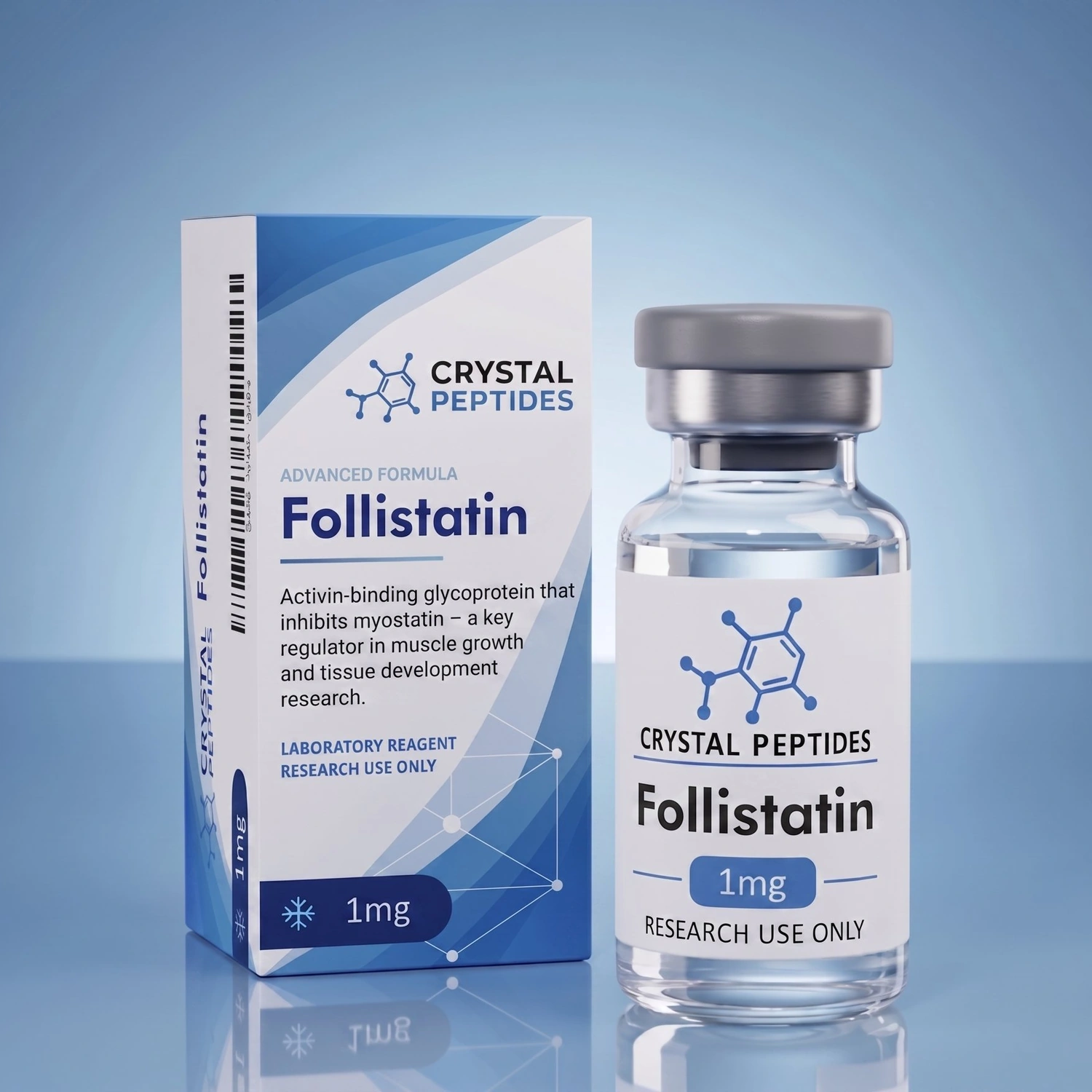
Follistatin
1mg
❄️Lyophilized powder (not reconstituted)
Total: 103.17 GBP
Discount per Quantity
| Quantity | Discount | Price per Unit |
|---|---|---|
| 5 - 10 | 10% | 92.86 GBP |
| 11 - 20 | 15% | 87.70 GBP |
| 21+ | 20% | 82.54 GBP |
Rigorous third-party testing
Every batch of our research chemicals and peptides undergoes independent third-party laboratory testing for purity and identity.
Total: 103.17 GBP
Follistatin is a secreted glycoprotein that binds members of the TGF-β superfamily, especially activins, and can also modulate myostatin signalling. This coming-soon catalogue presentation is nominally 1 mg. “Follistatin-344” usually refers to a 344-amino-acid precursor/coding isoform that is processed to other extracellular forms; the exact recombinant sequence, processing state, glycosylation, aggregation and biological activity of a vial must be established by its specification and batch data.
Identity and biological context
| Protein family | Follistatin, an extracellular activin-binding glycoprotein |
| Common designation | FST344/FS344 may describe an expression construct or precursor and should not be treated as a complete vial specification |
| Research pathways | Activin and myostatin signalling through activin type II receptors and downstream SMAD pathways |
| Material form | Must identify host system, mature sequence, post-translational state, excipients and activity assay |
| Presentation | Nominal 1 mg catalogue vial |
Research background and published evidence
Follistatin is widely studied as an antagonist of activins and myostatin. Published animal and gene-transfer studies have reported changes in muscle mass and function when a follistatin construct is expressed in vivo. Those results concern gene delivery and sustained production of a defined isoform; they do not demonstrate equivalent activity, safety or outcomes for an isolated catalogue protein vial.
Because follistatin interacts with more than one ligand, interpretation requires pathway-specific controls. An increase in a downstream endpoint cannot be assigned to myostatin blockade alone without distinguishing activin-related effects and confirming the active molecular form.
Technical considerations
| Question | Required evidence |
|---|---|
| What is in the vial? | Sequence or construct, mature form, expression host, glycosylation profile, excipients and net protein content |
| Is it biologically active? | A batch-linked, fit-for-purpose binding or cell-based potency assay with defined controls |
| Is it comparable to FS344 gene-transfer studies? | No equivalence should be assumed; gene expression, processing and exposure differ from an isolated protein preparation |
Quality, handling and storage
For a recombinant glycoprotein, identity, purity, aggregation, host-cell proteins, glycosylation, endotoxin, sterility, potency and net content are separate quality attributes. Use only results linked to the exact lot and presentation.
Follow the label, matching CoA and SDS for storage, preparation and handling. Protein stability can depend strongly on formulation, container, temperature and freeze–thaw history, so conditions from an unrelated follistatin product should not be copied.
Sources
- Follistatin gene delivery enhances muscle growth and strength in nonhuman primates.
- Follistatin Gene Therapy Improves Ambulation in Becker Muscular Dystrophy.
- Myostatin and activin blockade by engineered follistatin in a mouse model.
Frequently Asked Questions
Does “Follistatin-344” define the final protein in the vial?
Not by itself. The designation can refer to a precursor or expression construct. The mature sequence, processing and formulation need batch-specific confirmation.
Do gene-therapy studies validate this catalogue vial?
No. They provide pathway context, but gene delivery and an isolated recombinant protein are different test articles with different exposure and quality requirements.
Regulatory notice
This material is offered for qualified laboratory research and is not an authorised treatment for muscle growth or any disease.
Used solely for in vitro experiments and cannot be:
- Used in clinical trials involving humans
- Administered to humans as part of an experiment or investigation
- Supplied to another party for human investigational use.