
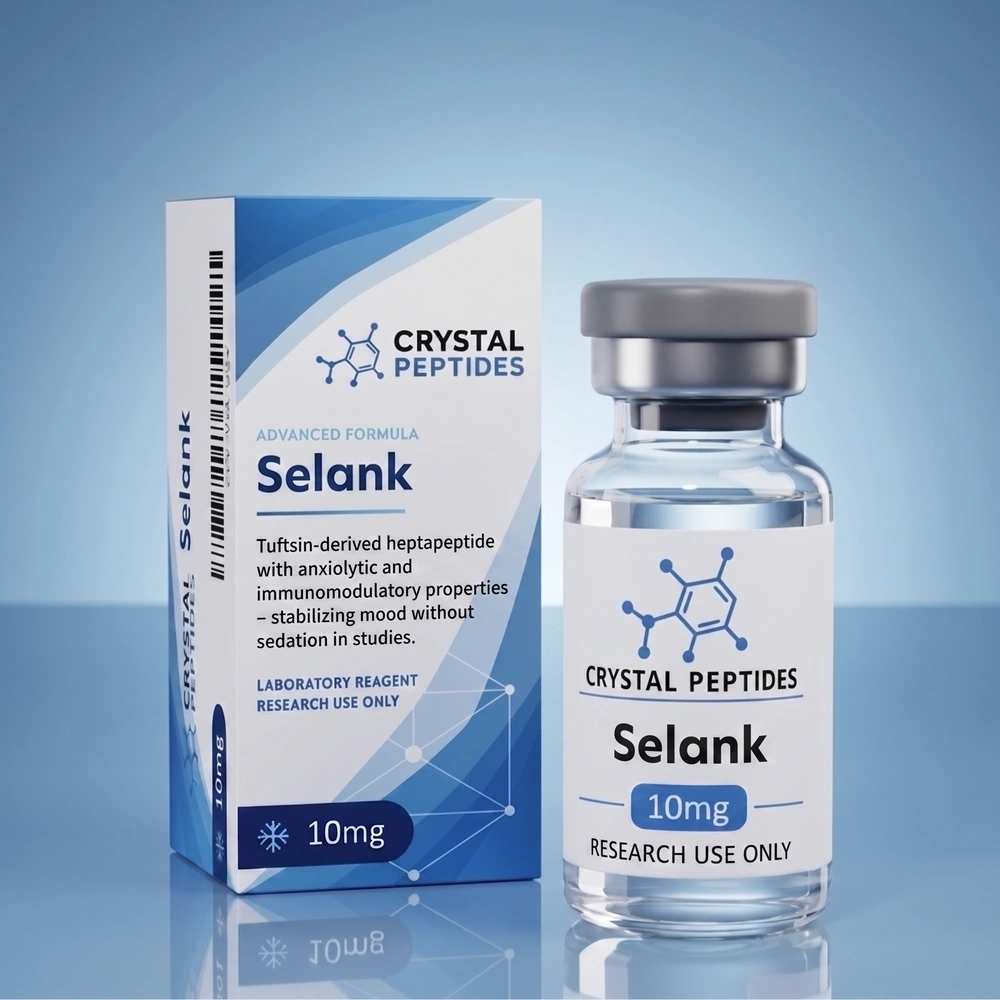
Selank
❄️Lyophilized powder (not reconstituted)
Size:
Total: 42.98 GBP
Discount per Quantity
| Quantity | Discount | Price per Unit |
|---|---|---|
| 5 - 10 | 10% | 38.69 GBP |
| 11 - 20 | 15% | 36.54 GBP |
| 21+ | 20% | 34.39 GBP |
Rigorous third-party testing
Every batch of our research chemicals and peptides undergoes independent third-party laboratory testing for purity and identity.
Total: 42.98 GBP
Selank is supplied as a catalogued research material in 5 mg and 10 mg.
Selank is a defined seven-residue, tuftsin-derived peptide. The free peptide, N-acetyl analogue and acetate or TFA materials are not the same analytical article; sequence, termini and counter-ion must match the batch identity record [1,2].
Chemical properties and registry information
| Property | Value |
|---|---|
| Name and synonyms | TP-7, TKPRPGP |
| Material category | Nootropic & Anxiolytic Peptide |
| Sequence | H-TKPRPGP-OH |
| Molecular formula | C33H57N11O9 |
| Average molecular mass | 751.9 g/mol |
| CAS Registry Number | 129954-30-7 |
| PubChem CID | CID 135505608 |
| Structural features | Heptapeptide, synthetic analogue of the human tuftsin C-terminal fragment. |
| Appearance | White to off-white lyophilised powder |
| Solubility | Readily soluble in bacteriostatic or sterile water. |
| Physical form | Catalogue vial; exact salt/counter-ion and excipients are batch-specific and must be verified in the CoA and SDS. |
Registry values apply only to the specific molecular entity, sequence, termini and material form. Batch records take precedence over family-level literature identifiers.
Selank is a synthetic heptapeptide developed in Russia, known for its anxiolytic, nootropic, and immunomodulatory properties. It is a fragment of the human immunoglobulin G (IgG) heavy chain.
Research background and published evidence
Published research
Published work supports cautious use in peptide-identity, degradation and rodent or cell-model gene-expression research, including exploratory GABA-related pathway analysis. A single validated direct receptor target has not been established [2,3].
Current scientific understanding
The literature is predominantly mechanistic, cellular and animal-model research and does not establish a human-use profile. Results for N-acetyl Selank, other salts or separately manufactured products must not be transferred to this batch.
Technical comparison
| Aspect | This catalogue material | Comparator |
|---|---|---|
| Identity | Selank: TKPRPGP, a tuftsin-derived heptapeptide | Semax: MEHFPGP, an ACTH(4–7)-Pro-Gly-Pro peptide |
| Structural distinction | Thr-Lys-Pro-Arg N-terminal region followed by PGP | Met-Glu-His-Phe N-terminal region followed by PGP |
| Analytical implication | Use Selank-specific retention, mass and impurity references | Shared PGP terminus does not establish interchangeability |
Quality and testing
Quality information is batch- and presentation-specific. Use only the report linked to the exact size and lot. A report listed for another size, lot or similarly named material must not be treated as evidence for this product.
Chromatographic area purity, identity, net peptide or analyte content, water or counter-ion content, sterility, endotoxin and elemental impurities are different measurements. One result does not establish the others. Only tests supported by a visible, matching report should be regarded as available.
Laboratory handling and storage
Store and handle only under the conditions stated on the product label, batch CoA and SDS. Keep the container secured, correctly identified and protected from contamination. Do not infer storage, solvent compatibility or stability from a related compound.
Laboratory preparation, analytical-method selection, risk assessment, personal protective equipment and waste disposal should follow the applicable SDS and the institution's approved procedures.
Regulatory and legal status
| Research-use notice | This material is supplied exclusively for laboratory research by qualified professionals and is not intended for human or veterinary use. Purchasers are responsible for compliance with applicable local requirements. |
Sources and references
- [1] PubChem. Selank compound record.
- [2] FDA GSRS. Selank substance record.
- [3] Volkova et al. Transcriptomic effects of Selank in a rodent model. Frontiers in Pharmacology (2016).
Frequently Asked Questions
Do the CAS number and PubChem CID apply to every batch form?
Only when the exact sequence or structure, termini, conjugation, salt or counter-ion and hydration state match. The batch CoA and SDS govern; a related-compound identifier must not be substituted.
What does an analytical purity result mean?
It is method- and report-specific. For example, an HPLC area percentage is not automatically the same as identity, net content, sterility, endotoxin status or absence of elemental impurities.
How should the material be stored and handled?
Follow the exact label, batch CoA and SDS together with the institution's risk assessment. Use only storage and stability information linked to the exact material form and batch.
Used solely for in vitro experiments and cannot be:
- Used in clinical trials involving humans
- Administered to humans as part of an experiment or investigation
- Supplied to another party for human investigational use.