
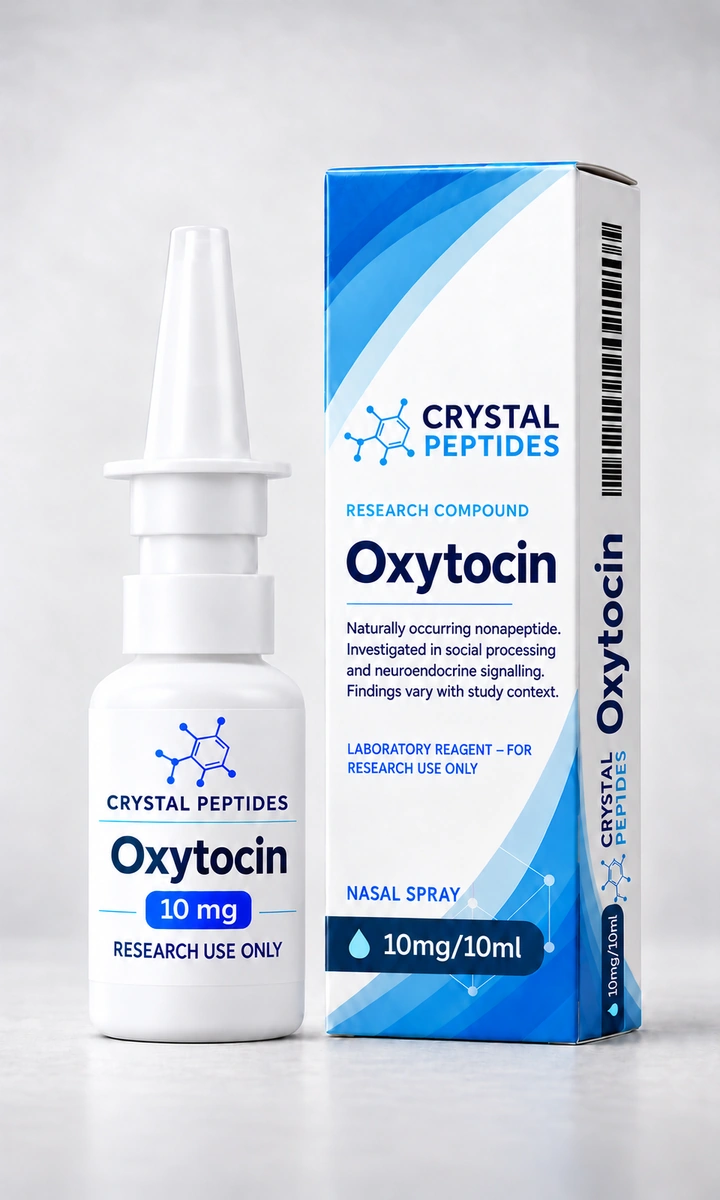
Oxytocin
10mg/10ml
- per spray
- ≈ 166.67 mcg
- ~60 sprays • 10 ml bottle
Total: 58.36 GBP
Discount per Quantity
| Quantity | Discount | Price per Unit |
|---|---|---|
| 5 - 9 | 10% | 52.52 GBP |
| 10 - 19 | 20% | 46.69 GBP |
| 20+ | 30% | 40.85 GBP |
Rigorous third-party testing
Every batch of our research chemicals and peptides undergoes independent third-party laboratory testing for purity and identity.
Total: 58.36 GBP
Ships Monday, Nov 2
Cutoff 3:00 PM EET
Arrives Thu, Nov 5 – Mon, Nov 9
Free shipment protection
Lost or damaged parcels are replaced — refunded in full if a second one fails
Express 1–3 day delivery
Available at checkout
Oxytocin Nasal Spray is supplied by Crystal Peptides as a catalogued research material in the format nasal spray, 10mg/10ml. This catalogue presentation identifies the supplied format and labelled strength; it does not establish equivalence to materials used in published studies or to medicinal formulations.
Oxytocin is a naturally occurring nonapeptide involved in neuroendocrine signalling. Its molecular structure comprises nine amino-acid residues, a disulfide bridge between Cys1 and Cys6, and a C-terminal amide. Research examines oxytocin-receptor recognition, signalling pathways and social processing, with interpretation dependent on the experimental system, material characteristics and study context.
Chemical properties and registry information
| Property | Value |
|---|---|
| Name and abbreviations | Oxytocin; OT; OXT |
| Material category | Neuropeptide hormone |
| Sequence | H-CYIQNCPLG-NH2; disulfide bridge: C1–C6 |
| Molecular formula | C43H66N12O12S2 |
| Average molecular mass | 1007.19 g/mol |
| CAS Registry Number | 50-56-6 |
| PubChem CID | CID 439302 |
| Physical form | Nasal spray, 10mg/10ml; batch-specific excipients and exact material composition must be verified in the matching CoA and SDS. |
These molecular identifiers describe oxytocin, not the complete spray formulation. They do not independently confirm the identity, composition or analytical characteristics of an individual catalogue batch.
Research background and published evidence
Published research
Published work includes peptide synthesis and structural characterisation, oxytocin-receptor recognition, receptor-binding assays and signalling studies. Oxytocin is also investigated in neuroendocrine and social-processing research. These areas use different experimental models, materials and outcome measures; molecular observations and behavioural findings therefore require separate interpretation rather than treatment as interchangeable evidence.
Social-processing research reports context-dependent results. Experimental tasks, participant characteristics and environmental conditions can influence interpretation. The literature should not be reduced to a general claim about bonding, trust or any other uniform behavioural outcome, and it does not establish such an outcome for this catalogue formulation.
Current scientific understanding
Oxytocin provides a defined molecular subject for studying relationships between peptide structure, receptor recognition and neuroendocrine signalling. However, a shared compound name does not demonstrate comparability across studies. Sequence, disulfide connectivity, terminal amidation, material composition and analytical methods remain relevant when evaluating published evidence. Findings involving related peptides or oxytocin analogues are not substitutes for evidence concerning the specified molecular entity.
Formulation note
The published research background largely concerns other research materials, formulations or routes rather than this exact catalogue presentation. Findings from injected or differently formulated material cannot be transferred to this nasal spray formulation. Excipients, formulation characteristics and experimental context may affect comparability; the labelled strength alone does not resolve those differences. No formulation-specific study results are supplied here.
Quality and testing
Quality assessment should rely on a batch-specific Certificate of Analysis (CoA) linked to the exact product and lot, together with the corresponding Safety Data Sheet (SDS). Review the reported methods, identity testing, peptide-content measurements and formulation information rather than inferring batch characteristics from registry entries or literature descriptions.
Chromatographic purity, molecular identity, peptide content and microbiological attributes are distinct measurements. A result for one attribute does not establish the others. Only tests documented for the matching batch should be treated as reported quality information; unspecified attributes remain unverified.
For laboratory research use only by qualified professionals. Not for human or veterinary use. No dosing directions are provided. Purchasers are responsible for compliance with applicable institutional and local requirements.
This site does not provide medical advice. These statements have not been evaluated by the FDA or the European Medicines Agency (EMA). Products are not drugs and are not intended to diagnose, treat, cure, or prevent any disease.
Promo codes & special offers from Crystal Peptides
Enter your email to receive promo codes, special offers and the latest updates.
Occasional emails only. Unsubscribe anytime.