
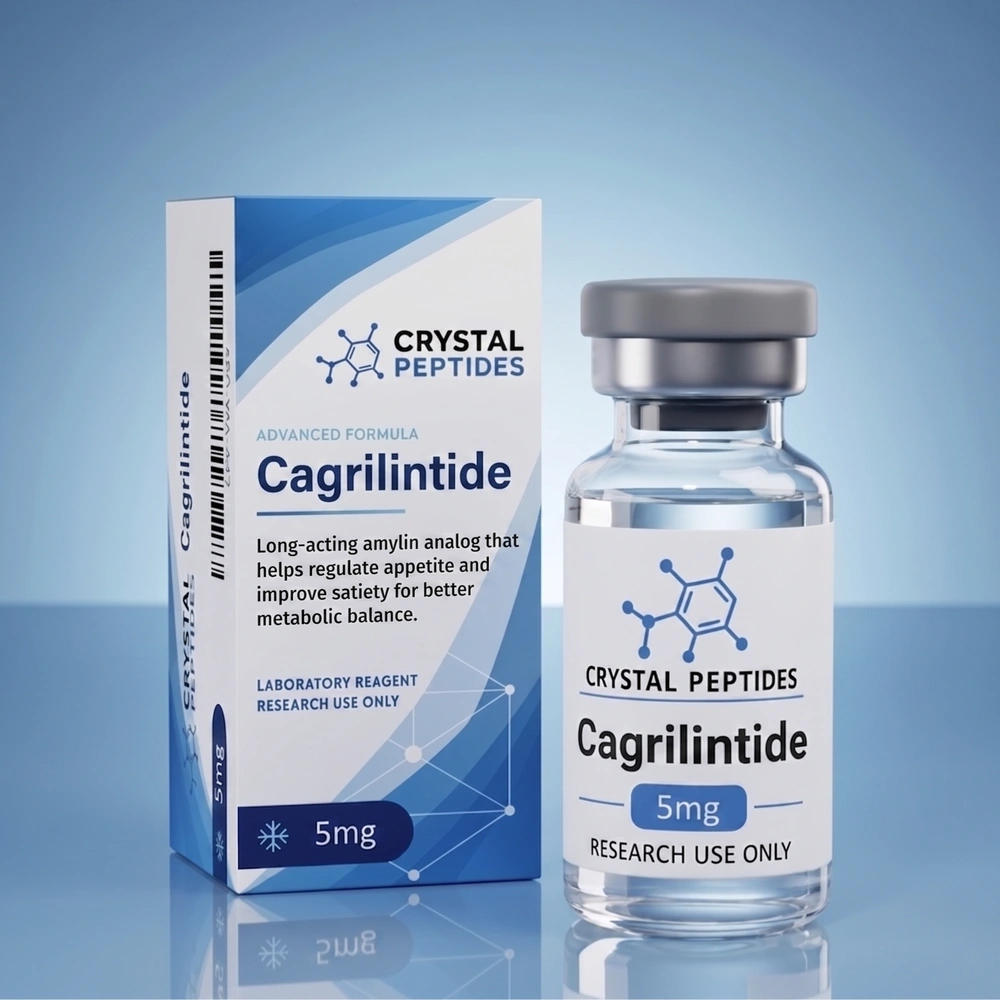
Cagrilintide
5mg
❄️Lyophilized powder (not reconstituted)
Discount per Quantity
| Quantity | Discount | Price per Unit |
|---|---|---|
| 5 - 10 | 10% | €53.99 |
| 11 - 20 | 15% | €50.99 |
| 21+ | 20% | €47.99 |
Rigorous third-party testing
Every batch of our research chemicals and peptides undergoes independent third-party laboratory testing for purity and identity.
Total: €59.99
Cagrilintide is supplied as a catalogued research material in a 5 mg presentation.
Cagrilintide is a structurally complex 37-residue peptide whose identity depends on its sequence, disulfide connectivity, C-terminal amidation and intact Lys-linked lipid conjugate. Registry data apply only when all of these features and the supplied form match [1–3].
Chemical properties and registry information
| Property | Value |
|---|---|
| Name and synonyms | Cagrilintide; long-acting acylated amylin analogue |
| Material category | Synthetic 37-residue lipidated amylin-analogue research peptide |
| Sequence or structural definition | KCNTATCATQRLAEFLRHSSNNFGPILPPTNVGSNTP-NH2 |
| Molecular formula | C194H312N54O59S2 for the defined free acylated peptide; salts and solvates differ. |
| Average molecular mass | 4409.0 g/mol for the defined free acylated peptide. |
| CAS Registry Number | 1415456-99-3 for defined cagrilintide, subject to confirmation of the exact structure and form. |
| PubChem CID | CID 171397054 for defined cagrilintide, subject to confirmation of the exact structure and form. |
| Structural features | Cys2–Cys7 disulfide bond; C-terminal amide; Lys1 lipidated through γ-glutamyl to a C20 fatty diacid. |
| Physical form | Catalogue vial; the exact physical state, salt or counter-ion and excipients are batch-specific and must be verified in the CoA and SDS. |
| Catalogue presentation | 5 mg |
| Batch identity and quality documentation | Batch-specific identity and available analytical reports must be verified against the CoA entry associated with the exact product size and batch. |
Registry values apply only to the corresponding sequence or structure and the exact material form. Confirm terminal modifications, conjugation, salt or counter-ion and hydration in the batch CoA and SDS; batch documents take precedence over literature identifiers.
Research context and published evidence
Published research
Cagrilintide has been characterized as an investigational long-acting amylin analogue in structural, pharmacological and controlled clinical research [2–4].
Current scientific understanding
Published phase 2 observations concern a separately manufactured investigational drug and do not establish authorization, batch equivalence, safety or efficacy for this catalogue material [4].
Technical comparison
| Aspect | This catalogue material | Comparator material |
|---|---|---|
| Identity | Defined lipidated cagrilintide structure, subject to complete batch confirmation | Unmodified human amylin peptide |
| Structural difference | Sequence substitutions, Lys-linked C20 lipid conjugate, disulfide bond and C-terminal amide | Native amylin sequence without the cagrilintide lipid conjugate |
| Analytical implication | Confirm intact conjugate mass, lipid attachment, sequence, termini and disulfide connectivity | Native-peptide methods and identifiers do not establish the identity of the acylated analogue |
Quality and testing
Quality information is batch- and presentation-specific. Use only the report associated with the exact size and batch. A report for another size, another batch or a similarly named material does not constitute evidence for this product.
Chromatographic area purity, identity, net peptide or analyte content, water or counter-ion content, sterility, endotoxin and elemental impurities are different measurements. One result does not establish the others. Only tests supported by a visible, matching report should be regarded as available.
Laboratory handling and storage
Store and handle the material only under the conditions stated on the label, batch CoA and SDS. Keep the container secured, correctly identified and protected from contamination. Do not infer storage conditions, solvent compatibility or stability from data for a related compound.
Laboratory preparation, analytical method selection, risk assessment, personal protective equipment and waste disposal must follow the applicable SDS and the institution's approved procedures.
Regulatory and legal status
| Research-use notice | This material is supplied exclusively for laboratory research by qualified professionals and is not intended for human or veterinary use. Purchasers are responsible for complying with applicable local requirements. |
Sources and references
- [1] PubChem. Cagrilintide, CID 171397054.
- [2] U.S. FDA GSRS. Cagrilintide substance record, UNII AO43BIF1U8.
- [3] Lau et al. Discovery and characterization of the long-acting amylin analogue cagrilintide (2021).
- [4] Lau et al. Randomized phase 2 investigation of cagrilintide (2021).
Frequently Asked Questions
Do the CAS number and PubChem CID apply to every batch form?
Only when the exact sequence or structure, termini, conjugation, salt or counter-ion and hydration state match. The batch CoA and SDS govern; an identifier for a related compound must not be substituted.
What does an analytical purity result mean?
Its meaning depends on the method and report. For example, an HPLC area percentage is not automatically equivalent to identity, net content, sterility, endotoxin status or the absence of elemental impurities.
How should the material be stored and handled?
Follow the exact label, batch CoA and SDS together with the institution's risk assessment. Use only storage and stability information associated with the exact material form and batch.