
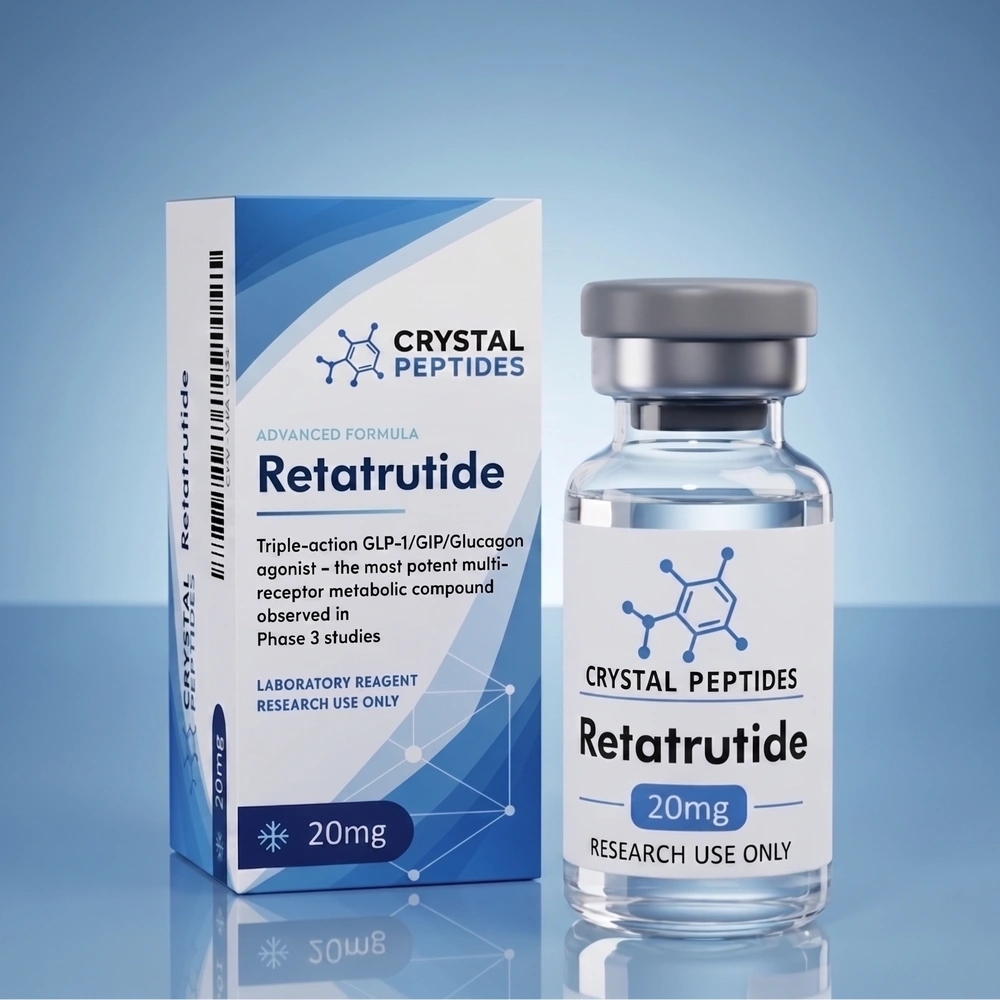
Retatrutide (20mg)
❄️Lyophilized powder (not reconstituted)
Size:
Total: 137.57 GBP
Discount per Quantity
| Quantity | Discount | Price per Unit |
|---|---|---|
| 5 - 10 | 10% | 123.81 GBP |
| 11 - 20 | 15% | 116.93 GBP |
| 21+ | 20% | 110.06 GBP |
Rigorous third-party testing
Every batch of our research chemicals and peptides undergoes independent third-party laboratory testing for purity and identity.
Total: 137.57 GBP
Retatrutide is a synthetic peptide in the class of multi-receptor incretin agonists, engineered to engage three related receptors: GLP-1R, GIPR and GCGR. These are class B G protein-coupled receptors within the incretin signalling system, a hormone network coordinating metabolic communication between the pancreas, gastrointestinal tract, liver and brain.
Researchers within the European Union can buy retatrutide 20 mg from Crystal Peptides. This is a high-purity research peptide independently tested by accredited laboratories for peptide identity, purity, and analytical consistency. Certificates of Analysis are available for every product batch to give researchers full transparency, traceability, and quality documentation as expected for advanced incretin and metabolic research compounds.
Retatrutide Structure and Design
Structurally, retatrutide is built on a GIP peptide backbone with targeted substitutions that introduce cross-reactivity at the GLP-1 and glucagon receptors. Several key modifications contribute to its receptor activity and pharmacokinetic profile:
- Aib² (2-aminoisobutyric acid) at position 2 increases resistance to degradation by dipeptidyl peptidase-4 (DPP-4), contributing to the peptide's prolonged biological activity.
- αMeLeu¹³ (α-methylleucine) at position 13 enhances activity at both the GIP and glucagon receptors while helping maintain balanced multi-receptor agonism.
- Aib²⁰ (2-aminoisobutyric acid) at position 20 contributes to the peptide's pharmacokinetic properties and supports its GIP receptor activity.
- C-terminal amidation reduces susceptibility to degradation by carboxypeptidases, improving overall peptide stability.
The molecule carries a C20 fatty diacid conjugated through a gamma-glutamate and AEEA linker at a lysine side chain. This enables reversible albumin binding, which drives the long circulating half-life of roughly six days and underpins the once-weekly schedule used across its clinical programme.
The third receptor is what separates retatrutide from tirzepatide. Dual agonists engage GIP and GLP-1. Adding glucagon receptor activity brings in a pathway associated with energy expenditure and hepatic fat oxidation, giving researchers a tool for studying multi-pathway metabolic regulation rather than appetite and glycaemic signalling alone.
Chemical properties and registry information
Property | Value |
Name and synonyms | Retatrutide, LY3437943, LY-3437943, GLP-3, Triple-G, GGG triagonist |
PubChem CID | 171390338 |
CAS number | 2381089-83-2 |
FDA UNII | NOP2Y096GV |
Molecular formula | C221H342N46O68 |
Molecular weight | 4731.4 g/mol |
Peptide length | 39 amino acids |
Compound class | Synthetic triple incretin receptor agonist |
Primary targets | GLP-1R, GIPR, GCGR |
Receptor potency (human EC50) | GIPR 0.0643 nM; GLP-1R 0.775 nM; GCGR 5.79 nM |
Half-life | Approximately 6 days |
Physical form | White to off-white lyophilised powder |
Solubility | Bacteriostatic or sterile water; DMSO; PBS pH 7.2 |
Developer | Eli Lilly and Company |
Purity | Please see COA |
Vial sizes |
|
Clinical data and research background
Retatrutide is one of the newest investigational peptides in the incretin field and has attracted considerable scientific interest owing to its unique triple-receptor mechanism of action. Since its development, published preclinical and clinical studies have investigated its pharmacology, receptor biology, pharmacokinetics, and physiological effects, making retatrutide an increasingly important research tool for the study of metabolic and endocrine signalling.
Researchers looking to buy retatrutide should note that the studies summarised below are presented solely to describe the current scientific literature and should not be interpreted as evidence of clinical efficacy or authorised therapeutic use of the research material supplied by Crystal Peptides.
Phase 2 proof-of-concept study (Jastreboff et al., 2023)
One of the landmark publications in retatrutide research was the Phase 2 randomised, double-blind, placebo-controlled study published in the New England Journal of Medicine in 2023. The trial established the first comprehensive clinical characterisation of retatrutide across multiple dose levels over a 48-week treatment period, providing valuable information regarding its pharmacokinetics, safety profile, and biological activity. At the highest dose evaluated, investigators reported a mean body-weight reduction of 24.2%, supporting continued investigation of triple-receptor agonism in larger clinical programmes.
The Phase 3 TRIUMPH programme
Building on these findings, retatrutide progressed into the international TRIUMPH Phase 3 programme. Among the first studies to report results was TRIUMPH-4, a 68-week randomised, double-blind, placebo-controlled trial involving participants with obesity and knee osteoarthritis. Investigators reported mean body-weight reductions approaching 28%, together with improvements in several predefined study outcomes, further expanding the scientific understanding of retatrutide's biological activity. Top-line findings from the pivotal TRIUMPH-1 study, involving 2,339 participants, subsequently demonstrated dose-dependent biological responses through 80 weeks, with longer-term follow-up extending to 104 weeks. These investigations continue to shape the evolving scientific literature surrounding triple-receptor incretin agonists.
Retatrutide vs Tirzepatide and other incretin agonists
As clinical and mechanistic research has expanded, retatrutide has frequently been compared with other incretin-based compounds, particularly Tirzepatide and Semaglutide. Unlike Tirzepatide, which activates the GLP-1 and GIP receptors, retatrutide additionally activates the glucagon receptor, making it the first triple-receptor agonist to progress into advanced Phase 3 clinical research. Researchers also compare retatrutide with Semaglutide, a selective GLP-1 receptor agonist, to better understand how multi-receptor activation differs from selective GLP-1 receptor signalling. These comparisons continue to inform research into incretin biology and the physiological consequences of engaging multiple endocrine pathways simultaneously.
Current scientific understanding
The available evidence has established retatrutide as one of the most comprehensively investigated investigational triple-receptor agonists currently in development. Together, the Phase 2 programme, the ongoing TRIUMPH studies, and an expanding body of mechanistic research have substantially advanced scientific understanding of simultaneous GLP-1, GIP, and glucagon receptor activation.
Retatrutide is investigational and is not approved by the FDA, EMA or any other major regulator as of 2026. |
Research applications
Retatrutide is used as a molecular tool for investigating incretin signalling and the metabolic pathways governed by nutrient-responsive hormones. Because it activates three receptor systems at once, it allows researchers to examine how coordinated signalling across GLP-1, GIP and glucagon pathways influences intracellular networks and cross-tissue metabolic communication.
Energy expenditure and thermogenesis
The glucagon receptor arm is the distinguishing research target. Glucagon receptor activation is associated with increased energy expenditure and substrate mobilisation. Experimental work examines how adding this third pathway to dual incretin agonism alters basal metabolic rate, lipolysis and thermogenic signalling in cellular and preclinical models.
Hepatic fat and liver metabolism
Glucagon receptor engagement drives hepatic fat oxidation. Studies examine gene expression, metabolic enzyme activity and lipid processing pathways within hepatic cell systems and animal models, making retatrutide a frequent tool in research models of metabolic dysfunction-associated steatotic liver disease and steatohepatitis.
Glucose signalling and endocrine pathways
In isolated islets and endocrine cell models, researchers use retatrutide to evaluate second messenger signalling, kinase activation and transcriptional responses in insulin-producing beta cells. Triple receptor engagement provides a model for examining how simultaneous stimulation influences glucose-responsive endocrine signalling.
Lipid metabolism and adipose tissue biology
Adipocyte cultures and animal models are used to analyse how triple receptor activation influences enzyme activity in fatty acid processing and transcriptional regulation of lipid-handling genes.
Comparative receptor pharmacology
Retatrutide's measured potencies differ markedly across its three targets: 0.0643 nM at GIPR, 0.775 nM at GLP-1R and 5.79 nM at GCGR. This roughly twelve-fold GIPR selectivity over GLP-1R, with substantially lower glucagon receptor potency, makes it a useful subject for studying signalling bias and receptor cross-talk. Comparative studies against tirzepatide and semaglutide isolate the contribution of each successive receptor.
How Retatrutide works (mechanism of action)
Retatrutide functions as a triple agonist of the GLP-1, GIP and glucagon receptors, all class B G protein-coupled receptors involved in metabolic signalling and nutrient-responsive hormone regulation.
Target engagement
The peptide backbone is derived from native GIP with substitutions that modify receptor affinity and stability. These modifications allow retatrutide to engage GIPR with high potency while retaining agonist activity at GLP-1R and GCGR. On binding, the peptide induces conformational changes that activate intracellular G protein signalling pathways typical of class B GPCRs. The C20 fatty diacid conjugation enables reversible albumin binding, extending persistence in experimental systems.
Downstream signalling pathways
Receptor activation stimulates the Gs protein signalling pathway, activating adenylate cyclase and raising intracellular cyclic AMP. Elevated cAMP activates protein kinase A and related signalling molecules, driving phosphorylation events and transcriptional responses in responsive cells. Because all three receptors converge on overlapping second messenger systems while sitting on different tissue distributions, retatrutide allows researchers to examine how convergent signalling from distinct receptors integrates within a single cell type.
Cellular effects in experimental models
In cell culture and animal models, retatrutide has been reported to modulate intracellular cyclic AMP levels, alter gene expression associated with metabolic signalling pathways, and change metabolic activity in responsive tissues. The glucagon receptor component contributes effects on hepatic glucose output and lipid oxidation not observed with dual agonists.
Retatrutide compared to related research compounds
Retatrutide sits at the top of a graduated series of incretin compounds distinguished by how many receptors they engage.
Property | |||
Type | Synthetic triple-agonist peptide | Synthetic dual-agonist peptide | Synthetic GLP-1 peptide analogue |
Primary targets | GLP-1R, GIPR, GCGR | GIPR, GLP-1R | GLP-1R |
Class | Triple agonist | Dual agonist | Single agonist |
Distinguishing pathway | Glucagon receptor: energy expenditure, hepatic fat oxidation | GIP receptor added to GLP-1 | Baseline incretin pathway |
Highest reported trial weight loss | Up to 24.2% (Ph2), up to 30.3% (Ph3, severe obesity) | Approximately 21% | Approximately 15% |
Developer | Eli Lilly | Eli Lilly | Novo Nordisk |
Clinical stage | Investigational, Phase 3 | Approved as a medicine | Approved as a medicine |
Supplied here as | Research-use compound | Research-use compound | Research-use compound |
Weight-loss figures are drawn from separate clinical trials, not head-to-head comparisons. Approval status refers to the licensed medicines. All compounds are supplied by Crystal Peptides strictly as research reagents.
Semaglutide provides the single-receptor baseline. Tirzepatide isolates the effect of adding GIP. Retatrutide adds glucagon on top, which is where the reported gains in energy expenditure and hepatic fat clearance originate.
Quality and testing
Every batch is tested by HPLC and independently verified through Janoshik analytical testing, with a batch-specific Certificate of Analysis. Counterfeit and generic collective COAs are widespread in this market. Batch-level third-party verification against a named laboratory is the only reliable check.
Regulatory and legal
All products supplied by Crystal Peptides are intended strictly for research and development use. These materials are provided for laboratory investigation and are not supplied for use in humans or animals.
This product is not a drug, food, dietary supplement, medical device or cosmetic. Retatrutide is not authorised as a medicinal product by the European Medicines Agency, the U.S. Food and Drug Administration, or any other national regulator. Any statements regarding the compound are drawn from published scientific research and have not been evaluated by any regulatory authority. These materials are not intended to diagnose, treat, cure or prevent any disease.
Materials must be handled only by qualified professionals trained in laboratory research procedures. Introduction of this product into humans or animals is prohibited and may breach applicable laws and regulations. Purchasers are responsible for ensuring that all use, storage, handling and disposal complies with applicable national and local regulations. Rules on the purchase and import of research chemicals differ by country.
LABORATORY REAGENT, FOR RESEARCH PURPOSES ONLY. Not a drug or food. Not for human consumption.
Sources and references
- Jastreboff AM, et al. Triple-Hormone-Receptor Agonist Retatrutide for Obesity: A Phase 2 Trial. New England Journal of Medicine. 2023. PMID: 37366315
- Rosenstock J, et al. Retatrutide, a GIP, GLP-1 and glucagon receptor agonist, for people with type 2 diabetes: a randomised, double-blind, placebo-controlled, phase 2 trial. The Lancet. 2023.
- TRIUMPH clinical programme: rationale and design. PMID: 41090431
- Katsi V, Koutsopoulos G, Fragoulis C, Dimitriadis K, Tsioufis K. Retatrutide: A Game Changer in Obesity Pharmacotherapy. Biomolecules. 2025. doi:10.3390/biom15060796
- Marathe SJ, et al. Incretin triple agonist retatrutide (LY3437943) alleviates obesity-associated cancer progression. npj Metabolic Health and Disease. 2025;3(1).
- Ma J, et al. Comparison of the effects of Liraglutide, Tirzepatide, and Retatrutide on diabetic kidney disease in db/db mice. Endocrine. 2024. doi:10.1007/s12020-024-03998-8
- PubChem Compound Summary for CID 171390338, Retatrutide. National Center for Biotechnology Information.
Frequently Asked Questions
What is Retatrutide?
Retatrutide (LY3437943), also known as GLP-3 or Triple-G, is a first-in-class synthetic peptide that simultaneously activates the GLP-1, GIP, and glucagon receptors. This unique triple-receptor mechanism has made retatrutide one of the most extensively investigated investigational incretin peptides in metabolic research. Crystal Peptides supplies retatrutide exclusively for laboratory research and development and not for human or veterinary use.
Why is Retatrutide called GLP-3 or Triple-G?
The names GLP-3 and Triple-G are research-market terms reflecting retatrutide's activity at three hormone receptors rather than the two targeted by tirzepatide. They refer to the same investigational compound, LY3437943, developed by Eli Lilly. PubChem also recognises Triple-G as a synonym for retatrutide.
Where can I buy Retatrutide online?
Researchers within Europe can buy Retatrutide online from Crystal Peptides in 10 mg, 20 mg, and 30 mg lyophilised vials. Every batch undergoes independent third-party analytical testing and is supplied with a batch-specific Certificate of Analysis (COA), providing the transparency, traceability, and quality documentation expected for laboratory research.
What vial sizes does Retatrutide come in?
Crystal Peptides supplies Retatrutide in 10 mg, 20 mg, and 30 mg lyophilised vials to accommodate different research requirements. Across the wider research market, retatrutide is available in a variety of strengths, although concentrations and product quality may differ between suppliers. Researchers should always confirm the supplied quantity against the accompanying batch-specific Certificate of Analysis.
What makes Retatrutide different from Tirzepatide?
Although both peptides belong to the incretin class, they differ in receptor selectivity. Tirzepatide is a dual agonist that activates the GLP-1 and GIP receptors, whereas Retatrutide is a triple agonist that additionally activates the glucagon receptor (GCGR). This additional receptor activity has made retatrutide an important research tool for investigating the biological effects of simultaneous GLP-1, GIP, and glucagon receptor activation and comparing triple agonism with dual incretin signalling.
How does Retatrutide compare with Semaglutide?
Semaglutide is a selective GLP-1 receptor agonist, while retatrutide simultaneously activates the GLP-1, GIP, and glucagon receptors. Researchers frequently compare these peptides to investigate differences between selective GLP-1 receptor activation and multi-receptor incretin signalling. Semaglutide remains an important reference compound for GLP-1 receptor biology, whereas retatrutide has expanded research into triple-receptor agonism and integrated endocrine signalling.
What have published clinical studies reported for Retatrutide?
Published Phase 2 and Phase 3 clinical studies have established retatrutide as one of the most extensively investigated investigational triple-receptor agonists. The Phase 2 trial published in the New England Journal of Medicine reported mean body-weight reductions of up to 24.2% after 48 weeks, while top-line findings from the Phase 3 TRIUMPH-1 programme reported mean reductions of up to 25.0% at 80 weeks, with longer-term extension data reaching 30.3% in participants with severe obesity. These findings are presented solely to summarise the published scientific literature and should not be interpreted as evidence of authorised therapeutic use or as a prediction of individual outcomes.
Is Retatrutide legal, and is a prescription required?
Retatrutide remains an investigational compound and has not been approved as a medicinal product in major jurisdictions. Crystal Peptides supplies retatrutide exclusively as a research reagent for laboratory research and development rather than as a medicine. Because it is not supplied as a medicinal product, prescription requirements do not apply in the same way as they do for licensed pharmaceuticals. Researchers are responsible for ensuring that the purchase, importation, possession, and use of research compounds comply with the laws and regulations applicable in their own country.
Is Retatrutide banned in sport?
Yes. Retatrutide falls within categories of substances prohibited by the World Anti-Doping Agency (WADA). As an investigational metabolic modulator, it should not be used by athletes subject to anti-doping regulations.
How should Retatrutide be reconstituted and stored?
Retatrutide is supplied as a lyophilised peptide and is typically reconstituted using sterile water or bacteriostatic water added slowly down the inside wall of the vial. The solution should be allowed to dissolve naturally without vigorous shaking or vortexing. Lyophilised vials should be stored at -20°C or below, protected from light and moisture. Following reconstitution, solutions should generally be refrigerated at 2–8°C while minimising repeated freeze-thaw cycles to help preserve peptide stability.
Is Crystal Peptides Retatrutide third-party tested?
Yes. Every batch of Retatrutide supplied by Crystal Peptides undergoes independent third-party analytical testing and is accompanied by a batch-specific Certificate of Analysis. Testing includes analytical techniques such as HPLC to verify purity and quality, allowing researchers to independently review the identity, purity, and analytical consistency of the exact batch supplied.
Do you ship Retatrutide across Europe?
Yes. Crystal Peptides ships Retatrutide throughout Europe using discreet packaging and tracked delivery services. Information regarding shipping destinations, estimated delivery times, and available delivery options can be found on the Shipping Information page.
Used solely for in vitro experiments and cannot be:
- Used in clinical trials involving humans
- Administered to humans as part of an experiment or investigation
- Supplied to another party for human investigational use.