
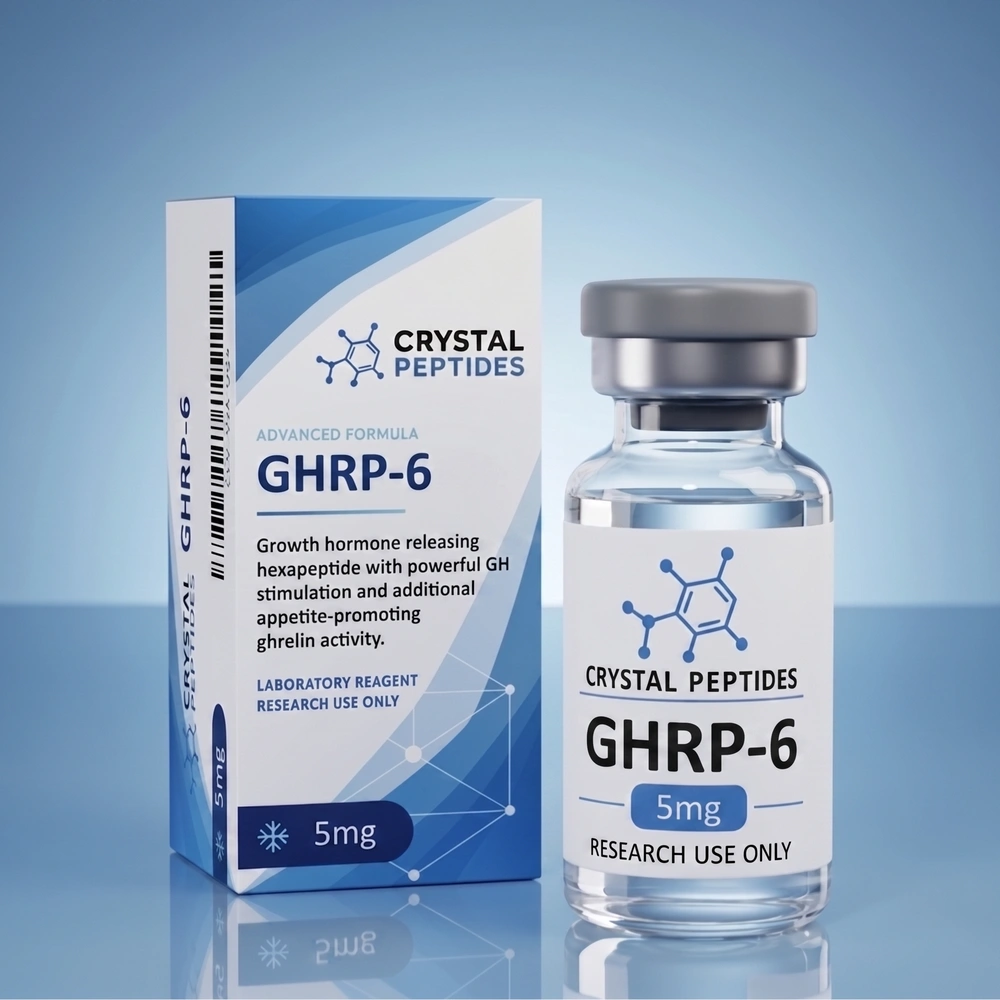
GHRP-6 (5mg)
5mg
❄️Lyophilized powder (not reconstituted)
Total: 25.49 GBP
Discount per Quantity
| Quantity | Discount | Price per Unit |
|---|---|---|
| 5 - 10 | 10% | 22.94 GBP |
| 11 - 20 | 15% | 21.67 GBP |
| 21+ | 20% | 20.39 GBP |
Rigorous third-party testing
Every batch of our research chemicals and peptides undergoes independent third-party laboratory testing for purity and identity.
Total: 25.49 GBP
What Is GHRP-6?
GHRP-6 (growth hormone-releasing peptide-6) is a synthetic hexapeptide belonging to the growth hormone-releasing peptide family. It is primarily studied for its activity at the growth hormone secretagogue receptor 1a (GHS-R1a), the receptor also activated by the endogenous peptide hormone ghrelin. Through this receptor system, GHRP-6 has been investigated in research examining growth hormone secretion, endocrine signalling, receptor pharmacology and related cellular pathways.
GHRP-6 is structurally and pharmacologically distinct from growth hormone-releasing hormone (GHRH), which acts through a different receptor. This makes GHRP-6 a useful research compound for studying the interaction between different regulatory pathways involved in growth hormone signalling and secretagogue activity.
Buy GHRP-6 from Crystal Peptides, a supplier of high-purity research peptides across Europe. Every product lot is third-party tested for quality parameters such as identity, purity and sterility, and Certificates of Analysis are available to verify these results. Secure and reliable shipping is available across Europe, with full shipping information provided below. Sold for research use only and not for human or veterinary use.
What’s Included
GHRP-6 is supplied as a lyophilised powder in a sealed glass vial, typically appearing white to off-white.
Each product lot is accompanied by a Certificate of Analysis following third-party testing. Please refer to the CoA for the analytical results and specifications applicable to your order.
If reconstitution solution is required for your research work, buy BAC Water (10ml) here to add it to your order.
GHRP-6 Technical Specifications
Property | Specification |
Product name | GHRP-6 |
Alternative names | Growth hormone-releasing peptide-6; growth hormone-releasing hexapeptide; Examorelin; SKF-110679 |
Molecule type | Synthetic growth hormone secretagogue |
Peptide sequence | H-His-D-Trp-Ala-Trp-D-Phe-Lys-NH₂ |
Peptide length | 6 amino acids |
Molecular formula | C₄₆H₅₆N₁₂O₆ |
Average molecular mass | 873.01 g/mol |
CAS Registry Number | 87616-84-0 |
PubChem CID | 9919153* |
Primary target | Growth hormone secretagogue receptor 1a (GHS-R1a) |
Receptor class | G protein-coupled receptor (GPCR) |
Structural features | Contains D-Trp and D-Phe residues with a C-terminal amide |
Physical form | White to off-white lyophilised powder |
Available quantity | 5 mg |
Purity & identity | See batch-specific Certificate of Analysis |
Intended use | Laboratory research only; not for human or veterinary use |
*These are registry identifiers; specific molecular properties should be interpreted in the context of the exact sequence, termini, salt/counter-ion and material form; please check the batch-specific CoA provided.
GHRP-6 Overview and Mechanism of Action
GHRP-6 is a synthetic growth hormone secretagogue that has been studied primarily through its interaction with the growth hormone secretagogue receptor 1a (GHS-R1a), a G protein-coupled receptor also known as the ghrelin receptor. [1] GHS-R1a is expressed in the hypothalamic-pituitary system as well as in several peripheral tissues, making it an important subject in endocrine and receptor-signalling research.
GHRP-6 and GHS-R1a Activation
When GHRP-6 interacts with GHS-R1a, the receptor undergoes a conformational change that promotes interaction with intracellular G proteins. The best-characterised signalling route involves Gαq/11, which activates phospholipase C (PLC) and subsequently generates the second messengers inositol trisphosphate (IP₃) and diacylglycerol (DAG). [2]
Intracellular Calcium Signalling
Upon its release, IP₃ promotes the release of calcium from intracellular stores, while DAG contributes to activation of protein kinase C (PKC). The resulting changes in intracellular calcium and downstream kinase activity are central to GHS-R1a signalling and have been studied in relation to growth hormone secretagogue activity. GHRP-6 has also been associated with downstream pathways including ERK signalling, illustrating that GHS-R1a activation can engage multiple intracellular signalling mechanisms depending on the experimental system. [3]
GHS-R1a also exhibits substantial constitutive activity, meaning that the receptor can signal even in the absence of an added ligand. This characteristic is important when interpreting experiments involving GHRP-6 because observed cellular responses can reflect both ligand-dependent signalling and the underlying activity of the receptor itself.
GHRP-6, Ghrelin and GHRH
GHRP-6 and ghrelin both interact with GHS-R1a, but they are chemically distinct ligands. Ghrelin is an endogenous peptide hormone, whereas GHRP-6 is a synthetic hexapeptide developed as a growth hormone secretagogue. Both can activate GHS-R1a and provide useful experimental systems for studying ghrelin-receptor pharmacology.
GHRP-6 also differs from growth hormone-releasing hormone (GHRH), which acts through the separate GHRH receptor. These pathways can interact at the level of growth hormone regulation, but they represent distinct receptor systems. This makes GHRP-6 useful for investigating how GHS-R1a-mediated signalling contributes to growth hormone secretagogue activity independently of direct GHRH-receptor activation.
GHRP-6 Research Applications
GHRP-6 has been used extensively as a research tool for studying growth hormone regulation and the biological pathways activated by growth hormone secretagogues. Because it acts through the growth hormone secretagogue receptor 1a (GHS-R1a), it is also useful for investigating the broader ghrelin receptor system. Its defined structure and established pharmacological activity make it a useful reference compound in laboratory studies.
Growth Hormone Research
One of the primary uses of GHRP-6 in research is to investigate how growth hormone secretion is regulated. Growth hormone is produced by specialised cells in the pituitary gland, and its release is controlled by several signals originating from the hypothalamus and other parts of the endocrine system.
GHRP-6 provides researchers with a way to activate the GHS-R1a pathway and observe how this influences growth hormone-related signalling. Studies have used GHRP-6 in pituitary cells and animal models to investigate the cellular mechanisms involved in growth hormone release and how these mechanisms interact with other regulatory signals, including growth hormone-releasing hormone (GHRH). [3]
Ghrelin Receptor Research
GHRP-6 has an important place in research into ghrelin biology. Ghrelin is a naturally occurring peptide hormone that activates GHS-R1a, and the discovery of this receptor helped explain how both ghrelin and synthetic growth hormone-releasing peptides produce related signalling responses. [4]
Researchers can therefore use GHRP-6 to study how GHS-R1a responds to different ligands, how the receptor changes when activated and how signals are transmitted from the receptor into the cell. This makes GHRP-6 useful in receptor pharmacology and drug-discovery research involving the ghrelin receptor system.
Pituitary Cell and Endocrine Research
GHRP-6 has also been investigated in studies of pituitary cell function and endocrine signalling. Researchers have examined how activating GHS-R1a affects intracellular pathways involved in the activity of pituitary cells and the expression of genes associated with growth hormone production. [2][5]
These studies help researchers understand the connection between receptor activation at the cell surface and changes in cellular activity further downstream. GHRP-6 can therefore serve as an experimental tool for connecting receptor pharmacology with broader endocrine processes.
Intracellular Signalling Research
The effects of GHRP-6 do not stop at the receptor. Once GHS-R1a is activated, it can trigger a series of intracellular signals involving calcium, protein kinases and other signalling molecules. Researchers study these pathways to understand how a signal originating at the cell membrane produces a measurable cellular response.
GHRP-6 has consequently been used in experiments examining calcium mobilisation, phospholipase C signalling, protein kinase C and MAPK-related pathways. These studies can help identify which signalling routes are activated and how responses differ between experimental cell types or conditions. [3][6]
Neuroendocrine Research
GHS-R1a is expressed in parts of the brain involved in endocrine regulation, and GHRP-6 has therefore also been used in neuroendocrine research. Studies have investigated how activation of the receptor interacts with hypothalamic pathways involved in growth hormone regulation and other physiological signalling processes. [5]
This research is particularly useful for understanding how signals from the brain, pituitary gland and peripheral tissues interact within the broader endocrine system.
Feeding and Metabolic Research
GHRP-6 has also been used experimentally to investigate the relationship between GHS-R1a signalling, appetite-related pathways and energy regulation. This research is closely connected to the biology of ghrelin, which is involved in signalling related to energy balance and feeding. [1]
These applications should be distinguished from the peptide’s primary use as a growth hormone secretagogue research tool. Findings from feeding or metabolic models can depend substantially on the species, tissue, receptor expression and experimental conditions used.
Finally, GHRP-6 is particularly valuable because it can be used to investigate several connected levels of biology: receptor activation, intracellular signalling, pituitary function and broader neuroendocrine pathways. However, researchers should interpret GHRP-6 findings according to the specific model, concentration, exposure conditions and biological endpoint being studied.
GHRP-6 vs. GHRP-2 vs. Ipamorelin
GHRP-6, GHRP-2 and Ipamorelin are synthetic growth hormone secretagogues that act through the growth hormone secretagogue receptor 1a (GHS-R1a). They are related pharmacologically but differ in peptide structure and selectivity, making the distinction relevant when choosing a research compound for a particular experimental model.
Property | GHRP-6 | ||
Molecule type | Synthetic hexapeptide | Synthetic hexapeptide | Synthetic pentapeptide |
Sequence | His-D-Trp-Ala-Trp-D-Phe-Lys-NH₂ | His-D-2-(naphthyl)-Ala-D-(p-chlorophenyl)-Ala-Lys-NH₂* | Aib-His-D-2-Nal-D-Phe-Lys-NH₂ |
Peptide length | 6 amino acids | 6 amino acids | 5 amino acids |
Primary target | GHS-R1a | GHS-R1a | GHS-R1a |
Receptor type | GPCR | GPCR | GPCR |
Structural feature | D-Trp, D-Phe and C-terminal amide | Multiple non-proteinogenic/D-configured residues | Aib, D-2-Nal, D-Phe and C-terminal amide |
Research focus | GH secretagogue activity, ghrelin-receptor signalling and endocrine research | GH secretagogue activity and GHS-R pharmacology | GHS-R pharmacology and selective secretagogue research |
Selectivity research | Broader secretagogue profile | Broader secretagogue profile | Developed as a more selective GHS-R agonist |
Key distinction | Classic first-generation GHRP used extensively as a GHS-R research ligand | Closely related hexapeptide with a distinct structure and pharmacological profile | Shorter peptide developed with emphasis on selectivity |
*Sequence nomenclature can vary between databases and material forms; researchers should refer to the applicable product specification and CoA for the exact supplied form.
Storage & Laboratory Handling
GHRP-6 is supplied as a lyophilised research peptide. The unopened vial should be stored according to the conditions specified in the product documentation and protected from factors such as excessive heat, moisture and direct light.
Basic laboratory handling considerations include:
• Keep the vial sealed until the material is required.
• Minimise unnecessary exposure to heat, moisture and light.
• Allow refrigerated or frozen material to reach an appropriate temperature before opening where necessary to reduce condensation.
• Use suitable laboratory-grade containers and materials when handling prepared solutions.
• Minimise unnecessary transfers to reduce potential material loss.
• Avoid repeated freeze-thaw cycles where possible.
• Follow established laboratory procedures for preparation, storage and disposal.
Once prepared, GHRP-6 stability can depend on factors including concentration, solvent, pH, temperature, container and storage duration. There is therefore no single in-use stability period that applies to every research preparation. Researchers should follow the applicable product documentation and establish suitable conditions for their specific experimental system where stability is important.
When you buy GHRP-6 from Crystal Peptides, refer to the product documentation and batch-specific information for the material supplied. These should take precedence over generalised storage recommendations.
Certificate of Analysis & Quality Assurance
A Certificate of Analysis (CoA) provides batch-specific analytical information about the GHRP-6 material supplied. For a defined synthetic peptide, the CoA helps researchers verify that the material corresponds to the intended compound and meets the applicable quality specifications.
When reviewing a CoA, researchers should consider:
• Identity: Confirms that the material corresponds to GHRP-6.
• Purity: Indicates the proportion of the principal peptide relative to detectable impurities.
• Peptide content: Provides information about the amount of peptide present in the tested material.
• Additional quality parameters: Depending on the batch and laboratory, may include endotoxins, sterility, residual solvents, water content or elemental impurities.
Additionally, the CoA should correspond to the specific GHRP-6 product lot you buy. The batch-specific CoA should therefore be treated as the definitive source for the analytical characteristics of the GHRP-6 material supplied.
Frequently Asked Questions
What is GHRP-6?
GHRP-6 (growth hormone-releasing peptide-6) is a synthetic six-amino-acid peptide and growth hormone secretagogue. It is primarily studied for its activity at the growth hormone secretagogue receptor 1a (GHS-R1a), also known as the ghrelin receptor. Research has examined GHRP-6 in growth hormone signalling, receptor pharmacology and related endocrine and neuroendocrine pathways.
What receptor does GHRP-6 activate?
GHRP-6 is studied primarily as an agonist of GHS-R1a, a G protein-coupled receptor also activated by the endogenous peptide hormone ghrelin. Activation of GHS-R1a can engage intracellular signalling pathways involving phospholipase C, calcium and protein kinase activity.
Is GHRP-6 the same as growth hormone?
No. GHRP-6 is a synthetic growth hormone secretagogue, not growth hormone itself. It is studied for its ability to activate GHS-R1a and influence signalling pathways involved in growth hormone regulation. Growth hormone is a separate protein hormone produced by the pituitary gland.
Is GHRP-6 a GHRH analogue?
No. GHRP-6 and growth hormone-releasing hormone (GHRH) belong to different peptide classes and act through different receptors. GHRP-6 activates GHS-R1a, whereas GHRH acts through the GHRH receptor. Research has shown that these pathways can interact in the regulation of growth hormone secretion, but they are not the same signalling system.
What is the relationship between GHRP-6 and ghrelin?
GHRP-6 is a synthetic ligand of GHS-R1a, the receptor commonly known as the ghrelin receptor. Ghrelin is the endogenous ligand of this receptor, while GHRP-6 is a synthetic growth hormone secretagogue that can activate the same receptor. This relationship makes GHRP-6 useful for research into ghrelin-receptor pharmacology and signalling.
What is the difference between GHRP-6, GHRP-2 and Ipamorelin?
All three are synthetic growth hormone secretagogues that act at GHS-R1a, but they have different molecular structures and pharmacological profiles. GHRP-6 and GHRP-2 are hexapeptides, while Ipamorelin is a pentapeptide developed with greater emphasis on selectivity. Researchers may therefore use these compounds as distinct experimental ligands when investigating different aspects of GHS-R1a signalling.
Where can I buy GHRP-6 in Europe?
You can buy GHRP-6 from Crystal Peptides, a European supplier of high-purity research peptides. Crystal Peptides provides GHRP-6 as a lyophilised research compound, with product lots independently tested by third-party laboratories and a batch-specific Certificate of Analysis available. Secure and reliable shipping is available across Europe. GHRP-6 is supplied exclusively for laboratory research and is not intended for human or veterinary use.
Scientific References
Patel, K., Dixit, V. D., Lee, J. H., Kim, J. W., Schaffer, E. M., Nguyen, D., & Taub, D. D. (2012). Identification of ghrelin receptor blocker, D-[Lys3] GHRP-6 as a CXCR4 receptor antagonist. International Journal of Biological Sciences, 8(1), 108–117. doi: 10.7150/ijbs.8.108.
Mear, Y., Enjalbert, A., & Thirion, S. (2013). GHS-R1a constitutive activity and its physiological relevance. Frontiers in Neuroscience, 7, 87. doi: 10.3389/fnins.2013.00087.
Berlanga-Acosta, J., Abreu-Cruz, A., Herrera, D. G. B., Mendoza-Marí, Y., Rodríguez-Ulloa, A., García-Ojalvo, A., Falcón-Cama, V., Hernández-Bernal, F., Beichen, Q., & Guillén-Nieto, G. (2017). Synthetic growth hormone-releasing peptides (GHRPs): A historical appraisal of the evidences supporting their cytoprotective effects. Clinical Medicine Insights: Cardiology, 11, 1179546817694558. doi: 10.1177/1179546817694558.
Smith, R. G., Sun, Y., Bailey, A. R. T., & Paschali, A. (2004). Ghrelin: Central actions and potential implications in neurodegenerative diseases. In E. Ghigo, A. Benso, & F. Broglio (Eds.), Ghrelin (Endocrine Updates, Vol. 23). Springer, Boston, MA. doi: 10.1007/1-4020-7971-0_9.
Airapetov, M. I., Eresko, S. O., Lebedev, A. A., Bychkov, E. R., & Shabanov, P. D. (2021). Expression of the growth hormone secretagogue receptor 1a (GHS-R1a) in the brain. Physiological Reports, 9(21), e15113. doi: 10.14814/phy2.15113.
Tian, C., Ye, F., Xu, T., Wang, S., Wang, X., Wang, H., Wan, F., & Lei, T. (2010). GHRP-6 induces CREB phosphorylation and growth hormone secretion via a protein kinase Cσ-dependent pathway in GH3 cells. Journal of Huazhong University of Science and Technology: Medical Sciences, 30(2), 183–187. doi: 10.1007/s11596-010-0210-5.
Used solely for in vitro experiments and cannot be:
- Used in clinical trials involving humans
- Administered to humans as part of an experiment or investigation
- Supplied to another party for human investigational use.